


Allergens: introducing them during weaning
Egg, peanut, gluten, fish, milk: for a long time, parents were advised to wait before giving these foods to baby. The guidelines have changed: today it is recommended to introduce them early, from the start of weaning, to help baby tolerate them. Here is how to do it in practice, when to ask your doctor's advice and how to recognise a reaction.
The essentials at a glance
- Allergens should be introduced from the start of weaning, without delay, even if there are allergies in the family.
- One new allergen at a time, in a small amount, then regularly in meals.
- Peanuts and tree nuts: only as a powder or as smooth, diluted nut butter, never whole before 5 years.
- Severe eczema, a known allergy or allergies in parents, brothers or sisters: get medical advice first.
- Difficulty breathing or swelling of the throat: this is an emergency, call 150.
Important: these general guidelines follow the official recommendations (WHO, Morocco’s Ministry of Health, Santé publique France). They do not replace the advice of your paediatrician or doctor, who knows your child: ask them for advice, especially if your baby was born prematurely or has an illness or allergy.
What the guidelines say
Santé publique France, based on the opinions of ANSES (2019) and the Haut Conseil de la santé publique (2020), states that all foods can be introduced from the start of weaning, including those that can cause an allergy: “the earlier children taste them, the more they develop their tolerance”. Delaying gluten, egg, peanut or dairy products is no longer recommended, even for children at risk of allergy. The European Society for Paediatric Gastroenterology, Hepatology and Nutrition (ESPGHAN) takes the same view. For the age to start weaning, see our month-by-month guide.
How to offer each allergen
| Allergen | How to offer it to baby |
|---|---|
| Egg | Hard-boiled, well cooked, mashed into the purée; up to ¼ of a hard-boiled egg a day before 1 year, in place of that day's meat or fish |
| Peanut | Smooth peanut butter with no added salt or sugar, diluted in a vegetable or fruit purée, or as a powder; never whole peanuts before 5 years |
| Tree nuts (almond, hazelnut, walnut) | ½ teaspoon of unsalted powder, mixed into a fruit or vegetable purée |
| Cow's milk | In cooking: plain yoghurt, cheese made from pasteurised milk (no homemade jben or lben made from raw milk), purée or milk semolina; not as the main drink before 1 year |
| Wheat (gluten) | Fine semolina, bread, small pasta; in small amounts at first |
| Fish | Well cooked, boneless, mashed into the purée; 2 times a week |
Soya-based products, however, are not recommended before 3 years according to Santé publique France, as they contain a component suspected of being an endocrine disruptor (isoflavones).
In practice: how to do it
- Choose a day when baby is well, and a daytime meal at home, so you can watch baby over the following hours.
- Offer a small amount of just one new allergen, mixed into a food baby already knows.
- Wait before introducing another new allergen, so you know which one is responsible if there is a reaction.
- If there is no reaction, keep this food in the menu regularly: that is what maintains tolerance.
Babies at risk: talk to your doctor first
A child is considered “at risk” of allergy if one of their parents, a brother or a sister has an allergy. In this case, and if baby has severe eczema or a known allergy (to egg, for example), ask your doctor or paediatrician for advice before introducing allergens. For peanut, ESPGHAN considers babies with severe eczema or an egg allergy to be at high risk: for them, it recommends introducing it between 4 and 11 months, after assessment by a specialist.
Recognising an allergic reaction
The reaction usually occurs within minutes of the meal, sometimes up to 2 hours later. Some reactions are delayed: with cow's milk, signs can appear up to 3 days later (worsening eczema, diarrhoea, vomiting). Possible signs:
- redness, patches or itching, especially around the mouth;
- swelling of the lips, face or eyelids; red, stinging eyes;
- vomiting, tummy pain, diarrhoea;
- worsening eczema.
In the event of a mild reaction, do not give the food again and see your doctor promptly.
Life-threatening emergency: difficulty breathing, wheezing, swelling of the tongue or throat, feeling faint, paleness or loss of consciousness. Call the emergency services immediately: in Morocco, dial 150 (ambulance and fire service).
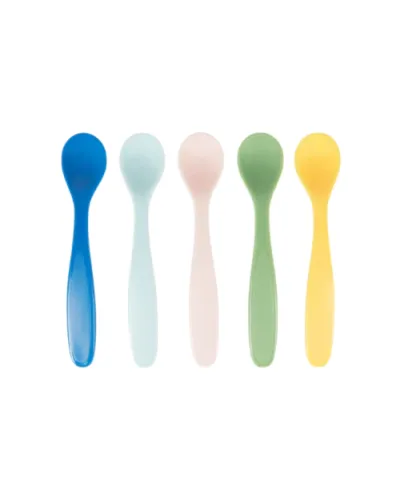
Badabulle
Soft spoons pack of 5 from 4 months Badabulle
Flexible spoons designed for those very first mouthfuls.
Order now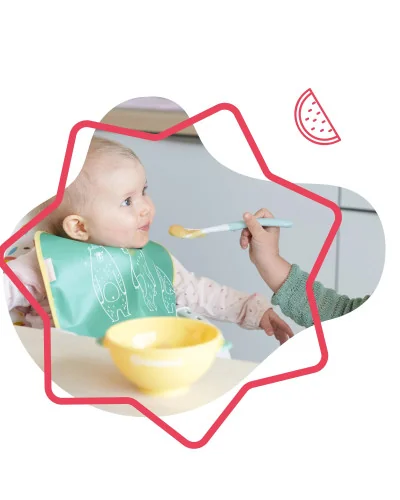
Badabulle
Set of 5 non-slip bowls and 3 soft spoons Badabulle
Five non-slip bowls and three soft spoons.
Order now
Badabulle
Fun Colors baby bowls set of 3 with lids and suction base Badabulle
Suction bowls with lids.
Order nowFrequently asked questions
At what age should allergens be introduced to babies?
From the start of weaning, without delaying them. The WHO and the Ministry of Health recommend starting weaning at 6 months; European guidelines allow a start between 4 and 6 months.
How do you give peanuts to a baby?
As smooth peanut butter with no added salt or sugar, thinned into a purée, or as a powder. Never whole peanuts before 5 years old: risk of choking.
Should you wait until 1 year for eggs?
No. Eggs can be given from the start of weaning, always well cooked (hard-boiled), in small amounts.
My baby has eczema: what should I do?
Ask your doctor for advice before introducing allergens, especially if the eczema is severe or an allergy is already known.
What should you do if there is a reaction after a meal?
If the reaction is mild, stop the food and see your doctor. If your baby has difficulty breathing, swelling of the throat or feels faint, call the emergency services immediately (150 in Morocco).
Advice and demos at our Casablanca showroom
Come and see the baby food makers, tableware and high chairs at our Maârif showroom, 93 rue Brahim Nakhai, Casablanca, Monday to Saturday, 9:30 am to 8 pm, or message us on WhatsApp at 06 61 14 46 02: we’ll advise you and prepare your order. Delivery across Morocco, free from 300 DH.
Ask for advice on WhatsApp See the showroom
Everything in our “Feeding” section
- Weaning: the month-by-month guide
- Homemade baby fruit purée: 10 recipes with no added sugar
- Vegetable purées for babies: first recipes
- Baby recipes from 8 to 12 months: homemade dishes
- Finger foods and BLW: moving on to lumps safely
- Weaning essentials: what you need for first meals
Our feeding departments
Official sources
Pages consulted on 08/10/2026:
- Santé publique France: “Pas à pas, votre enfant mange comme un grand” (in French)
- Santé publique France: new recommendations for children under 3, the essentials (in French)
- Manger Bouger (Santé publique France): between 4 and 6 months, introducing foods gently (in French)
- Manger Bouger: allergies and intolerances, guidance from the start of weaning (in French)
- ESPGHAN: position paper on complementary feeding (2017)
- NHS: food allergies in babies
- NHS: foods to avoid giving babies and young children
- Santé.fr: food allergy (in French)
- WHO: infant and young child feeding (fact sheet)
- Ministry of Health and Social Protection: National Multisectoral Nutrition Strategy 2024-2030




Comments
No comment at this time!
Leave your comment