








Article contents
Key points
- French paediatricians say lumps should not be delayed beyond 10 months.
- A good piece squashes between thumb and forefinger: the “melt” test.
- Before age 1: about 10 g of meat or fish, or a quarter of an egg, at one meal a day.
- Milk still matters: 500 to 750 ml a day, dairy included.
- Always seated, always supervised; grapes and cherry tomatoes cut in four.
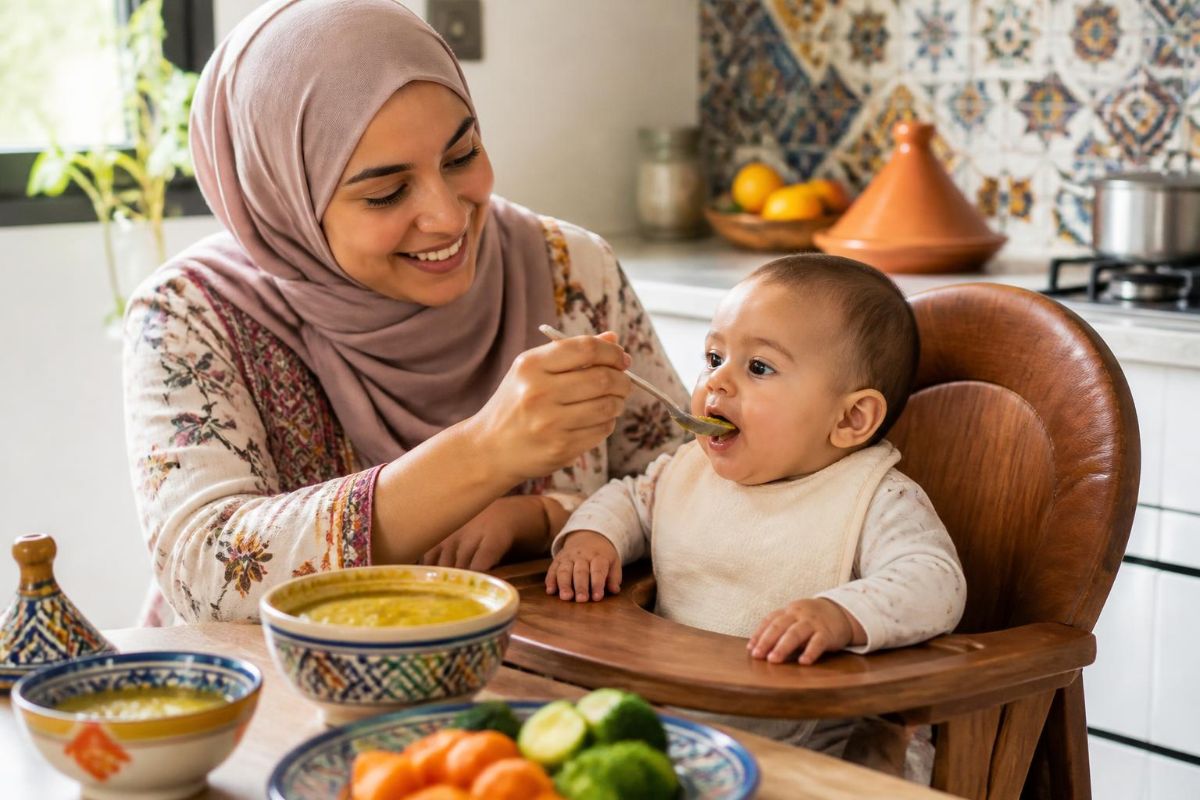
At 9 months, your baby dives a hand into your plate, grabs a piece of bread and chews it with a seriousness that makes you smile. It is the right time to move his meals on. A baby recipe for 9 months no longer has to be smooth: it should be soft, roughly mashed, with small pieces he can pick up himself.
Between 9 and 12 months, the point is less to find complicated dishes than to learn to chew safely. Here is how textures progress, what a day can look like, what amounts to aim for, and 10 simple ideas, several drawn from Moroccan cooking.
Mashed, soft, small pieces: how do textures progress?
Textures advance in stages, at your baby’s pace, but without waiting too long. The Nutrition Committee of the French Society of Paediatrics (SFP) states that lumps should not be delayed beyond 10 months. Health Canada asks that lumpy textures be introduced by 9 months at the latest.
| Around | Texture | Examples |
|---|---|---|
| 9 months | Mashed with a fork, with small lumps | Mashed vegetables, soft lentils, flaked fish |
| 10 months | Very soft pieces to pick up | Well-cooked carrot sticks, pasta, omelette strips |
| 11-12 months | Small tender pieces, minced | Soft meatballs, shredded chicken, ripe fruit in cubes |
The “melt” test is simple: a piece that is ready for your baby squashes effortlessly between your thumb and forefinger. If it resists, cook it longer, grate it or mash it. Teeth are not essential for this: gums do the job very well on tender foods.
The NHS advises offering finger foods at every meal: they train hand-to-mouth coordination and learning to chew. If you chose to let your baby feed himself from the start, our guide to baby-led weaning explains the method.
How many meals, and what amounts around 10 months?
Around 10 months, most babies have 3 meals a day and 1 to 2 snacks depending on appetite, on top of their milk. That is Health Canada’s guide for 9 to 11 months; the WHO speaks of 3 to 4 meals a day from 9 months, with 1 to 2 snacks if needed.
The most useful portion guides come from French paediatricians:
- Meat, fish or egg: about 10 g a day before age 1 (two teaspoons of minced meat, or a quarter of a hard-boiled egg), at just one meal a day. Fish twice a week, one of them oily fish.
- Milk and dairy: 500 to 750 ml a day, counting breast milk or formula, yoghurt and cheese.
- Fats: 1 to 2 teaspoons of raw oil a day added to vegetables (preferably rapeseed or walnut), sometimes a little butter.
- Iron: iron-rich foods at least twice a day, Health Canada reminds us (meat, fish, egg, lentils, chickpeas).
The rest follows his appetite. A baby who turns his head away or closes his mouth has finished: there is no need to empty the bowl.
A typical day around 10 months
| Time | Example |
|---|---|
| Waking | Breastfeed or usual milk |
| Breakfast | Plain bread or baghrir (Moroccan semolina pancake) in pieces, mashed ripe fruit, plain dairy |
| Lunch | Soft vegetables + starch + 10 g of meat, fish or egg + oil |
| Snack | Soft fruit cubes, bread or plain dairy |
| Dinner | Vegetables and starch, no animal protein; dairy |
| Bedtime | Breastfeed or usual milk |
The NHS observes that between 10 and 12 months, many formula-fed babies drink about 400 ml of it a day, on top of dairy. Breastfed babies regulate their own feeds. For what comes next, our guide to meals for 1 to 3-year-olds takes over.
10 easy recipes from 9 months to 1 year
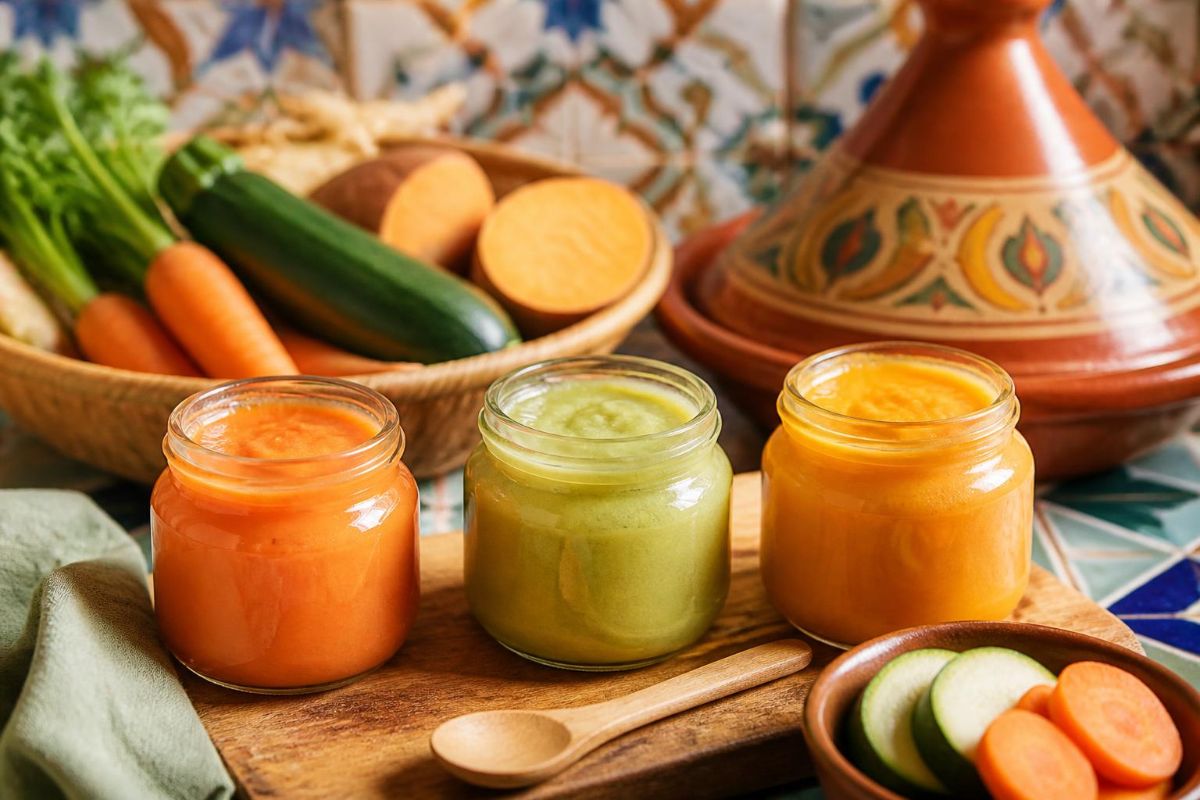
Every recipe is cooked without salt, sugar or stock cubes. Mild spices (cumin, cinnamon, turmeric, ginger) and herbs (parsley, coriander, mint) give flavour. The amounts of meat or fish are worked out to respect the 10 g a day.
1. Courgette omelette strips (from 9 months)
Beat 1 egg with a grated, squeezed courgette. Cook over low heat in an oiled pan, lid on, until the egg is completely set. Cut into finger-sized strips. One egg makes four protein portions for a baby.
2. Sweet potato and carrot sticks with cumin (from 9 months)
Cut sweet potato and carrot into thick chips, coat with a drizzle of oil and a pinch of cumin, and bake until they squash under a finger. The best first food to hold.
3. Soft loubia (white beans) (from 9 months)
Cook white beans soaked the night before, with peeled tomato, garlic, cumin and mild paprika, until they burst. Mash them roughly. A baby version of the family dish, rich in iron.
4. Tiny pasta with pumpkin and soft cheese (from 9 months)
Cook tiny pasta (little lead-shot shapes or tiny pasta tongues) a little beyond the time on the packet. Mix with mashed cooked pumpkin and a spoonful of pasteurised cream cheese.
5. Chickpea and carrot patties (from 10 months)
Mash well-cooked, peeled chickpeas with cooked grated carrot, an egg and a little flour. Shape into small patties and brown them over low heat in very little oil. They hold together well in the hand and freeze well.
6. Flaked fish, rice and little vegetables (from 9 months)
Poach 10 g of fish fillet per portion in water or steam it, flake it, checking with your fingertips that no bone is left. Mix with well-cooked rice and mashed peas. Cooked rice should be cooled quickly and eaten within 24 hours (NHS).
7. Soft kefta meatballs in tomato (from 11 months)
Mix lean minced meat with soaked bread crumb, parsley, coriander and cumin. Shape hazelnut-sized balls and simmer for 20 minutes in a sauce of fresh tomatoes. They must be cooked through and squash with a fork. One 10 g meatball is enough for your baby; freeze the others.
8. Spinach flan (from 10 months)
Blend cooked spinach with 1 egg and a little milk. Pour into ramekins and cook in a bain-marie in the oven until the flan is firm. Cow’s milk is fine in cooking from 6 months (NHS).
9. Shredded chicken, broccoli and potato (from 10 months)
Cook a skinless chicken thigh slowly in water with onion and turmeric until it falls apart. Shred 10 g of meat, and serve with small, very soft broccoli florets and mashed potato with a drizzle of oil.
10. Plain raïb and soft pear (from 9 months)
Serve plain raïb (Moroccan fermented milk) or plain yoghurt made with pasteurised milk, no sugar, with a very ripe pear cut in tiny cubes or grated. The fruit is enough to sweeten the dairy, as the SFP suggests.
For more ideas, including a baby couscous and a milk semolina, see our recipes for 8 to 12 months. And to turn the family dish into a baby meal, our article on Moroccan cooking adapted for little ones covers tagine, couscous and harira.
Feeding himself: the gear that really helps
Your baby will soon want to hold his own spoon: let him try, with a second spoon for you. Soft learning cutlery, a plate that does not slide and a sleeved bib are enough. A suction plate or bowl limits flying purée. For the high chair itself, see our guide to choosing a high chair.
From the shop
So that baby eats (almost) on his own
Easy-grip cutlery, a plate that does not slide and a full-cover bib are plenty. A cooking blender-steamer remains a convenience for families who batch-cook ahead.
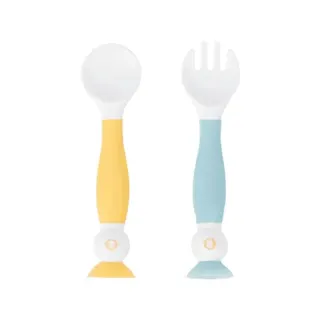 −9 %BadabulleFlexible learning cutlery – Badabulle50 DH
instead of 55 DHView product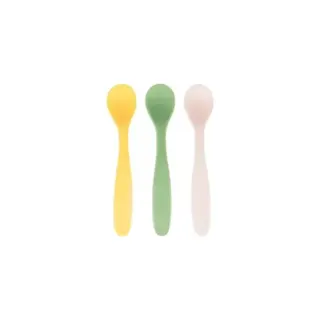 −8 %BadabulleSoft spoons, set of 3, BPA-free – Badabulle46 DH
instead of 50 DHView product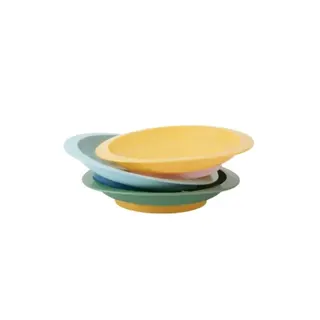 −9 %BadabulleNon-slip plates, set of 3 – Badabulle137 DH
instead of 150 DHView product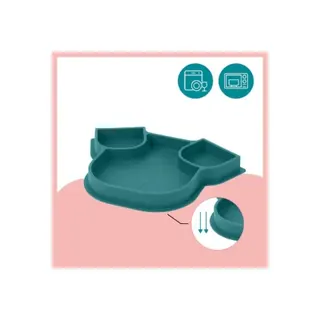 −22 %BabymoovIsy Plate silicone divided baby plate, dog – Babymoov164 DH
instead of 210 DHView product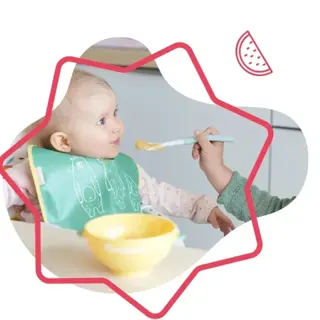 −9 %BadabulleSet of 5 non-slip bowls and 3 soft spoons – Badabulle237 DH
instead of 260 DHView product −9 %BabymoovBib’Isy silicone bibs, x2 – Babymoov200 DH
instead of 220 DHView product −19 %BabymoovNutribaby One 4-in-1 multifunction food processor – Babymoov1 447 DH
instead of 1 790 DHView product- The whole aisle · Baby food steamers and blenders4 products online, delivered anywhere in Morocco.Open the aisle
Products sold by La Maison du Bébé, publisher of this magazine. Prices as of 12 October 2026; please check the product page.
Safety: what not to give before age 1, and how to avoid choking
Choking is the main risk at this age. Gagging, noisy and alarming, is a normal reflex that helps your baby bring food forward in his mouth. Choking, by contrast, is silent: your baby can no longer cough or cry. Learn the rescue moves in our article on baby first aid.
INSPQ rules, valid up to age 4:
- baby eats seated and strapped in his high chair, under an adult’s eye, never while walking or in a car;
- grapes cut in four, raw carrot and apple grated, stones, pips, bones and fish bones removed;
- no whole nuts, peanuts, popcorn or hard sweets; nuts are given as a powder or in a smooth, thinned purée.
Other foods wait until 1 year or later:
- honey, even cooked, because of the risk of infant botulism (NHS, Health Canada);
- added salt and sugar, including in the cooking water (NHS); it is all explained in our article on salt, sugar and honey for babies;
- cow’s milk as a main drink, which waits until 1 year according to the NHS, and at least 9 months according to Health Canada (see our article on cow’s milk for children);
- raw-milk cheeses, and swordfish, whose mercury is not recommended for children (NHS).
Allergens (egg, peanut, fish, sesame…) are offered early and regularly: our guide to food allergies in babies explains how.
Frequently asked questions
My 10-month-old spits out every lump. What can I do?
This is common, and it is not a failure. At every meal, keep offering one very soft food next to his purée, without forcing it. He learns first by touching, mouthing and spitting out. The French Society of Paediatrics reminds us that lumps should not be delayed beyond 10 months. If your baby gags on every texture or refuses all lumps around 12 months, talk to the paediatrician.
At 1 year, can my baby eat what we eat?
Largely yes, provided you set his portion aside before adding salt, stock cubes, smen (Moroccan preserved butter) and chillies, and adjust the size of the pieces. The NHS says a child aged 1 to 3 should have no more than 2 g of salt a day, an amount quickly reached with bread and family dishes. So keep his portion plain and let adults add salt at the table.
How many meals a day for an 11-month-old?
Generally 3 meals (breakfast, lunch, dinner) and 1 to 2 snacks depending on appetite, according to Health Canada and the WHO, on top of his milk. The NHS notes that at this age many babies are down to about 3 breast or bottle feeds a day. These figures are only guides: appetite varies from day to day, and it is the growth chart that tells you whether he eats enough.
Do I still need to blend meat at 9 months?
Not necessarily. Around 9 months, meat can be finely minced or shredded after long cooking that makes it very tender, then mixed into a purée or mashed vegetables. Around 11 to 12 months, soft meatballs or small pieces of well-cooked chicken suit many babies. The amount stays small, though: about 10 g a day before age 1.
Sources
- Your baby's first solid foodsNHS · United Kingdom
- Foods to avoid giving babies and young childrenNHS · United Kingdom
- Les nouvelles recommandations du PNNS sur la diversification alimentaireComité de nutrition de la Société française de pédiatrie, Perfectionnement en Pédiatrie (2022), document diffusé par l'AFPA · France
- Nutrition for healthy term infants: recommendations from six to 24 monthsHealth Canada, Canadian Paediatric Society, Dietitians of Canada and Breastfeeding Committee for Canada · Canada
- Risques d'étouffement : à surveiller jusqu'à 4 ansMieux vivre avec notre enfant, Institut national de santé publique du Québec (INSPQ) · Canada (Québec)
- Infant and young child feedingWorld Health Organization (WHO) · International