









Article contents
Key points
- Delaying egg or peanut does not protect: it could even increase the risk of allergy.
- One new allergen at a time, in a small amount, at a moment when you can watch your baby.
- Once tolerated, the food returns to the menu regularly, several times a week.
- Severe eczema or a known allergy: talk to your doctor before starting.
- Swelling of the lips, tongue or throat, difficulty breathing: call 141 immediately.
The jar of peanut butter is on the table, the hard-boiled egg is cooling, and you hesitate. A cousin had a reaction to peanut, your mother-in-law says to wait until they are 3, and the internet claims the opposite. Good news: on baby food allergies, the guidelines of the last ten years point the same way, and they are fairly simple to follow.
The principle: let your baby taste allergenic foods early, from the start of solids, then keep them on the menu. Here is why, how to go about it in practice, and above all how to recognise a reaction and respond.
Why we no longer wait for allergens
For a long time, the advice was to delay egg, fish or peanut, sometimes until age 3. A review published in 2022 in the journal Nutrients points out that these instructions, abandoned around 2008, may have contributed to the rise in allergies rather than preventing it.
Two large studies changed the picture:
- LEAP, in high-risk babies (severe eczema or egg allergy): giving peanut from 4 to 6 months cut peanut allergy at age 5 by more than 80%, compared with introducing it after 12 months.
- EAT, in 1,303 babies: the overall analysis showed no significant difference, but egg and peanut allergy was clearly less common in babies who actually ate them every week.
Medical societies followed. The UK's NHS believes that delaying peanut and egg beyond 6 to 12 months could increase the risk of allergy to these foods. The Australasian Society of Clinical Immunology and Allergy (ASCIA) asks that all babies, including high-risk ones, receive allergenic foods during their first year. In France, the French Society of Paediatrics (SFP) brings them in from 4 to 6 months, and the Quebec guide Mieux vivre avec notre enfant (INSPQ), at the same time as other foods.

Which foods are allergenic?
The NHS lists about a dozen: eggs, peanut and tree nuts, cow's milk, cereals containing gluten (wheat, barley, rye), pulses, seeds (especially sesame), soya, fish, crustaceans and shellfish, celery, mustard, and the sulphites found in some dried fruit. Here is how to offer the main ones to a baby:
| Food | In what form? |
|---|---|
| Egg | Hard-boiled or in a well-cooked omelette, never raw or runny (SFP, European guidelines EAACI) |
| Peanut | Smooth, plain peanut butter, thinned in a little water or a purée, or as powder in a dairy food; never whole peanuts |
| Almond, walnut, hazelnut | As powder or smooth purée; whole, not before age 3 according to the SFP, age 5 according to the NHS |
| Cow's milk | In plain dairy food or in cooking from 6 months; as the main drink, from age 1 (NHS) |
| Wheat | Fine semolina, bread, pasta, from the start of solids (SFP) |
| Fish | Well cooked, with no bones at all |
| Sesame | Finely ground seeds or sesame paste (NHS) |
Another notable difference: soya, which the NHS puts among the foods to introduce like the others, is not recommended before age 3 by the SFP, because of its phytoestrogens.
How to introduce them, step by step
- Start solids normally, around 6 months, never before 4 months (ASCIA), with the first vegetables and iron-rich foods.
- Only one new allergen at a time, in a small amount, to spot any reaction easily (NHS).
- Choose a moment when you can watch your baby for at least two hours: most reactions begin within minutes, sometimes up to two hours later (NHS).
- If all goes well, increase gradually to a normal portion for their age (INSPQ).
- Then keep it on the menu regularly: twice a week for ASCIA, several times a week for the INSPQ and the Canadian Paediatric Society. The NHS insists: a well-tolerated food should be part of their usual diet to limit the risk of allergy.
- Then move on to another allergen, and so on.
To work it easily into their meals, our recipes for 6 to 8 months include, for example, a mild zaalouk (Moroccan aubergine and tomato dish) with hard-boiled egg. The general framework of first meals is detailed in our guide to starting solids.
A baby at risk: eczema, known allergy or family history
Some babies need medical advice before starting: those with severe eczema or an already known food allergy, according to the SFP and the NHS, and those whose family has food allergies, eczema, asthma or hay fever, the NHS adds.
This is not about delaying, quite the opposite. For these high-risk babies, the American Academy of Pediatrics and the US institute NIAID recommend introducing peanut early, from 4 to 6 months, often after allergy tests. ASCIA points out that in a baby with severe eczema or egg allergy, eating peanut regularly before 12 months can reduce the risk of becoming allergic to it. If your baby's skin is badly affected, our article on infant eczema will also help you care for it.
Recognising an allergic reaction
| Mild to moderate reaction | Severe reaction (anaphylaxis) |
|---|---|
| Itchy red patches, swollen lips or face | Swelling of the tongue or throat |
| Red, itchy, watering eyes | Difficult, fast, wheezy or noisy breathing |
| Sneezing, runny nose, cough | Baby floppy, not responding as usual |
| Vomiting, tummy ache, diarrhoea, worsening eczema | Feeling faint, skin cold to the touch |
These signs are those described by the NHS. They usually appear within minutes of the meal, sometimes up to two hours later. With cow's milk allergy, some symptoms can take up to three days to show.
What to do if there is a reaction
Mild reaction: stop the food, note what they ate and how much, take photos of the patches, and see your paediatrician. Don't give it again without medical advice (ASCIA). And don't remove staple foods from their menu on your own either: the NHS points out the risk of deficiencies.
Severe reaction: this is a life-threatening emergency. Call 141 (SAMU) immediately. If an adrenaline pen has been prescribed for them, use it without waiting. Lay them down, or keep them half-sitting if they are struggling to breathe, and do not stand them up, even if they seem better (NHS). To know where to go and what to say, see our guide on paediatric emergencies.
The special case of cow's milk allergy
Cow's milk is among the NHS allergens. Its symptoms, digestive (vomiting, diarrhoea, constipation) or on the skin (worsening eczema), can take up to three days to appear, which makes the link with the food less obvious. If you suspect it, see a doctor before changing anything. For a baby who is not breastfed, it is the doctor who prescribes a suitable milk; don't change milk on your own initiative.
From the shop
For their first tastes
To let your baby try a new food, a soft spoon and a small bowl are enough. Choose tableware that is easy to wash, so foods are not mixed from one meal to the next.
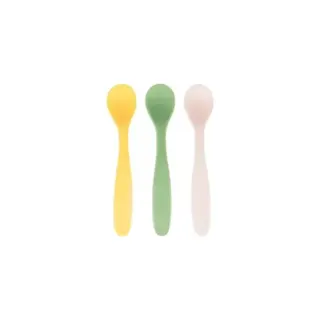 −8 %BadabulleSoft spoons, set of 3, BPA-free – Badabulle46 DH
instead of 50 DHView product −9 %BadabulleSet of 3 Fun Colors baby bowls with lids – Badabulle137 DH
instead of 150 DHView product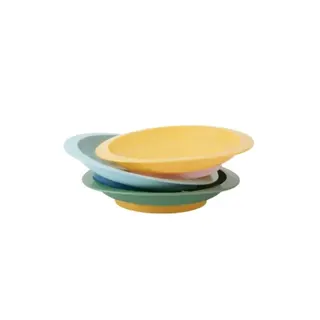 −9 %BadabulleNon-slip plates, set of 3 – Badabulle137 DH
instead of 150 DHView product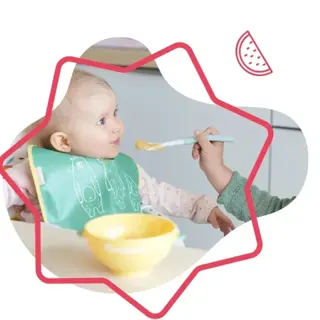 −9 %BadabulleSet of 5 non-slip bowls and 3 soft spoons – Badabulle237 DH
instead of 260 DHView product- The whole aisle · Baby plates and bowls8 products online, delivered anywhere in Morocco.Open the aisle
Products sold by La Maison du Bébé, publisher of this magazine. Prices as of 12 October 2026; please check the product page.
Frequently asked questions
Do I need allergy tests before giving peanut?
Not for most babies. According to the American Academy of Pediatrics, a baby with no eczema or food allergy can have peanut freely, along with their other foods. For a high-risk baby, with severe eczema or an egg allergy, it advises on the contrary early introduction, from 4 to 6 months, but after medical advice and, most often, allergy tests. Talk to your paediatrician.
Can I give amlou or sellou to my baby?
Not before age 1. Amlou (the Moroccan almond, argan oil and honey spread) generally contains honey, which is ruled out before age 1 because of the risk of botulism, and sellou (toasted flour and nut sweet) is sweetened; and no salt or sugar is added to a baby's meals. To let them taste almond, prefer almond powder mixed into a purée or a dairy food, as French paediatricians recommend. Whole almonds, on the other hand, are a choking risk.
One parent is allergic: should I delay allergens?
No, but talk to your doctor first. The UK's NHS recommends asking for advice before starting if the family has food allergies, eczema, asthma or hay fever. The Australian ASCIA guidelines state that all babies, including high-risk ones, should be given allergenic foods during their first year, without delaying them.
How much egg or peanut should I give?
Start with a small amount, then increase to a normal portion for their age if all goes well, advises the Quebec guide Mieux vivre. After that, regularity is what counts: several times a week. In the EAT study, the drop in egg and peanut allergies was seen in babies who ate at least 2 g of protein from them a week, every week.
Sources
- Food allergies in babies and young childrenNHS · United Kingdom
- AnaphylaxisNHS · United Kingdom
- What to feed young childrenNHS · United Kingdom
- Infant Feeding and Allergy Prevention (2020)Australasian Society of Clinical Immunology and Allergy (ASCIA) · Australia
- Early Introduction of Allergenic Foods and the Prevention of Food Allergy (Nutrients, 2022)Trogen B., Jacobs S., Nowak-Wegrzyn A., literature review (NIAID, AAP, EAACI, Canadian Paediatric Society) · United States
- Les nouvelles recommandations du PNNS sur la diversification alimentaireComité de nutrition de la Société française de pédiatrie, Perfectionnement en Pédiatrie (2022), document diffusé par l'AFPA · France
- Comment introduire les aliments ?Mieux vivre avec notre enfant, Institut national de santé publique du Québec (INSPQ) · Canada (Quebec)
- Risques d'étouffement – à surveiller jusqu'à 4 ansMieux vivre avec notre enfant, Institut national de santé publique du Québec (INSPQ) · Canada (Quebec)