








Article contents
Key points
- No salt, no sugar, no stock cube; mild spices and herbs are welcome.
- An iron-rich food at least twice a day: lentils, chickpeas, meat, fish, egg.
- Before age 1, 1 to 2 teaspoons of raw oil a day, added to vegetables.
- Fridge: 1 to 3 days depending on the food. Freezer: 1 to 3 months. Never refrozen.
- Reheat only once, just the amount for the meal, and throw away leftovers.
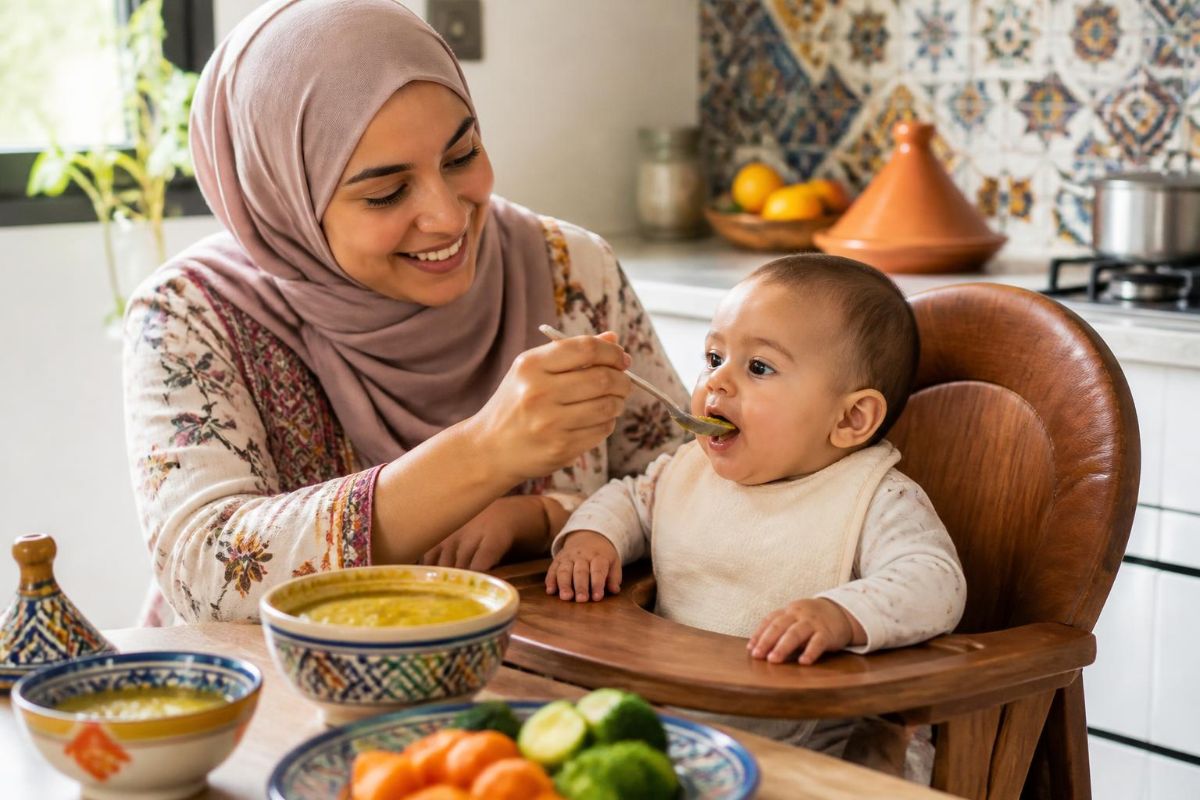
The market is overflowing with squash, turnips and carrots, a pot of harira is simmering, and your baby has just turned 6 months. You don't need jars to feed them well: a few baby recipes for 6 months and up, made at home with seasonal vegetables, are enough to vary their meals without spending your evenings in the kitchen.
Here are 10 simple recipes, designed for 6 to 8 months and inspired by Moroccan cooking, followed by a method for cooking in one go and storing safely. If your baby is on their very first spoonfuls, start with our basic vegetable purées; for fruit, see our compotes with no added sugar.
The golden rules before you cook
- No salt, no sugar, no stock cube, including in the cooking water (NHS). No honey before age 1 (French Society of Paediatrics, SFP).
- Flavour all the same: spices and aromatic herbs bring colour and taste, the SFP reminds us. Cumin, cinnamon, turmeric, parsley, coriander or mint all have their place.
- Iron at least twice a day between 6 and 12 months: meat, poultry, fish, egg, pulses or fortified cereals (Quebec guide Mieux vivre, INSPQ).
- A little fat: the SFP advises adding 1 to 2 teaspoons of raw vegetable oil to vegetables every day before age 1, favouring rapeseed or walnut for their omega-3s, and sometimes alternating with a little butter.
- Meat, fish or egg: about 10 g a day before age 1, at a single meal (SFP). A quarter of a hard-boiled egg equals 10 g of meat.
- Textures that evolve: smooth at first, then mashed and lumpy as soon as your baby copes (NHS).
Cook by steaming or in a little water, until a fork goes in easily; then blend or mash with a little cooking water (INSPQ).
At the market: what's in season?
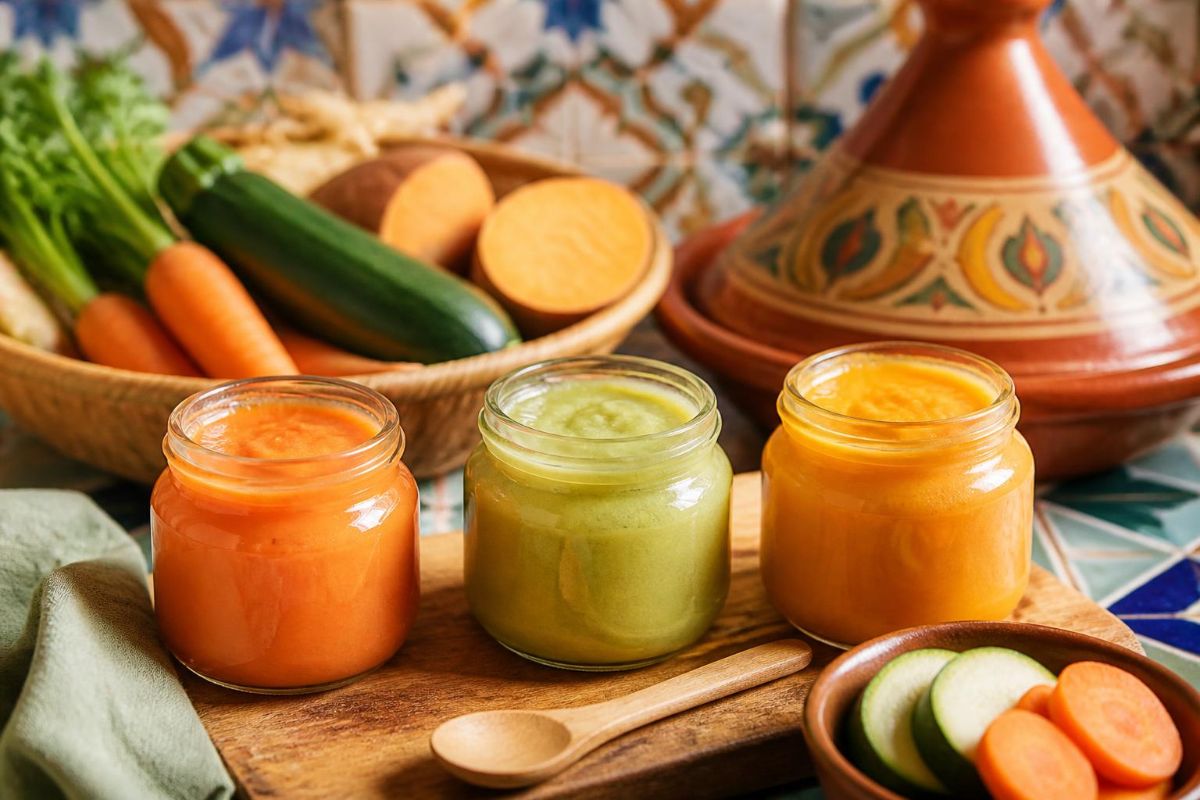
Seasonal, local produce is what the SFP encourages for home cooking. According to the seasonal guide published by Le360:
| Season | Vegetables | Fruit |
|---|---|---|
| Autumn and winter | Squash and pumpkin, carrot, turnip, cauliflower, leek, potato | Apple, pear, quince, orange, mandarin |
| Spring and summer | Courgette, peas, aubergine, tomato, green beans | Apricot, peach, fig, melon, watermelon, plum |
From 6 months: 4 smooth purées
1. Squash and red lentils with cumin
300 g of peeled squash (garaa) and 40 g of rinsed red lentils, cooked together in unsalted water until the lentils fall apart. Blend finely with a pinch of cumin and a little cooking water. Autumn-winter, rich in iron.
2. Cauliflower, potato and parsley
200 g of cauliflower florets and one potato, steamed, blended with a few parsley leaves. A less sweet flavour that is worth offering early (NHS). Autumn-winter.
3. Minted peas
200 g of shelled peas and one small potato, cooked then blended very finely with two mint leaves; pass through a sieve if skins remain. Spring-summer.
4. Courgette and chicken with coriander
30 g of skinless chicken breast, cooked in plenty of water until it falls apart with a fork (INSPQ), and two steamed courgettes. Blend with a little unsalted cooking liquid and a few sprigs of coriander. Makes 3 portions. Spring-summer, rich in iron.
Around 7-8 months: 5 little meals to mash
5. Baby's gentle harira
Take a ladle of the family harira before adding the salt, smen (aged clarified butter) and stock cube: lentils, chickpeas, tomato, coriander and parsley. Blend finely at 7 months, mash with a fork around 8 months. All year, rich in iron.
6. Split-pea bissara
100 g of rinsed split peas, a garlic clove and a pinch of cumin, cooked in plenty of unsalted water until they fall apart. Blend, then add a drizzle of olive oil when serving. Winter, rich in iron.
7. Mild zaalouk with egg
One peeled aubergine and two peeled, deseeded tomatoes, softened under a lid with a splash of water and a pinch of cumin, then mashed. Add a quarter of a well-cooked hard-boiled egg, mashed: a simple way to introduce egg, an allergenic food to offer early (see our article on allergens in babies). Summer-autumn.
8. White fish with mild chermoula
30 g of white fish fillet steamed or poached, with a cooked carrot and potato. Check with your fingertips that no bones remain, then mash everything with parsley, coriander, a pinch of cumin and a drizzle of oil. The SFP advises fish twice a week. All year.
9. Turkey, turnip and carrot, tagine-style
30 g of diced turkey escalope, one turnip and one carrot, cooked under a lid with a splash of water, a pinch of turmeric and ginger, until everything is very tender. Blend roughly or mash. Autumn-winter, rich in iron.
A fruit, no cooking and no sugar
10. Mashed avocado and banana
Half a ripe avocado and half a ripe banana, mashed with a fork at the last moment. Ripe, soft fruit such as banana can be served raw, washed and peeled (INSPQ). Around 8 months, cut them into big sticks to hold if your baby is already eating pieces on their own.
Cooking in bulk and storing
Batch cooking works very well for babies, as long as you respect the cold chain. Cool preparations as fast as possible, ideally within 1 to 2 hours (NHS), then follow the INSPQ cube method:
- Pour the still-warm purée into clean ice-cube trays.
- Cover and leave to cool in the fridge.
- Freeze for 8 to 12 hours.
- Transfer the cubes to a freezer bag, press out the air, and note the name and date.
| Preparation | Fridge | Freezer |
|---|---|---|
| Vegetables, fruit | 2 to 3 days (INSPQ) | 2 to 3 months |
| Meat, poultry, fish, with or without vegetables | 1 to 2 days (INSPQ) | 1 to 2 months |
| Dish containing rice | 24 hours (NHS) | Not specified |
The NHS keeps to 2 days in the fridge for cooked dishes. In summer, and even more when the chergui (the hot dry wind) blows, always keep to the shorter time. A defrosted purée is never refrozen (INSPQ).
From the shop
Cooking, storing and serving their meals
A fork and a saucepan are enough to start. A cooking food processor saves time, and good airtight pots make freezing in portions easier.
 −19 %BabymoovNutribaby One 4-in-1 multifunction food processor – Babymoov1 447 DH
instead of 1 790 DHView product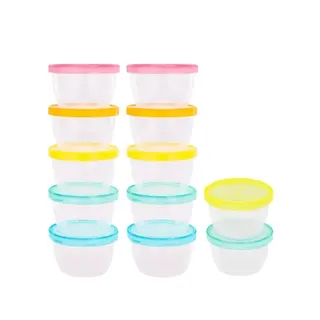 −9 %BadabulleBadabowls Maxi Portions storage pots, 250 ml, set of 12 – Badabulle177 DH
instead of 195 DHView product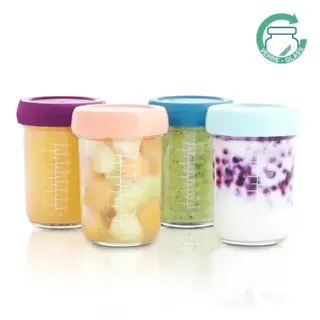 −9 %BabymoovSet of 4 Babybols glass food containers – Babymoov319 DH
instead of 350 DHView product −9 %BabymoovEat’s Isy stainless steel hot and cold food jar, 350 ml – Babymoov255 DH
instead of 280 DHView product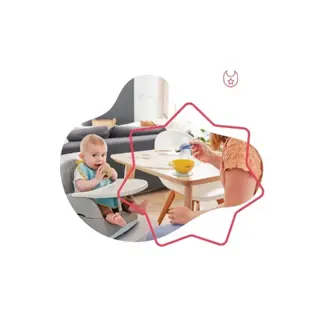 −9 %BadabulleSet of 3 Fun Colors baby bowls with lids – Badabulle137 DH
instead of 150 DHView product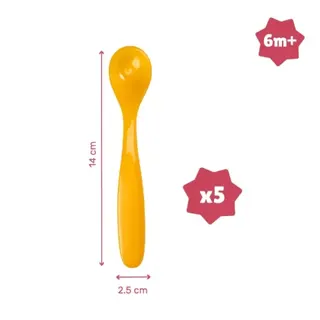 −60 %BadabulleSilicone stage 2 spoons, set of 5 – Badabulle34 DH
instead of 85 DHView product- The whole aisle · Baby food steamers and blenders4 products online, delivered anywhere in Morocco.Open the aisle
Products sold by La Maison du Bébé, publisher of this magazine. Prices as of 12 October 2026; please check the product page.
Defrosting and reheating safely
- Defrost in the fridge overnight, or in the microwave on defrost setting, and use within 24 hours (NHS).
- Reheat only the amount for the meal, in a saucepan, in a bain-marie or in the microwave (INSPQ).
- Heat right through, then let it cool: in the microwave, stir well, wait about thirty seconds and check the temperature on the inside of your wrist (INSPQ, NHS).
- Only once: a dish is not reheated twice (NHS), and leftovers of reheated purée or from the plate are thrown away (INSPQ, NHS).
After 8 months, pieces take up more room: our recipes for 8 to 12 months take over.
Frequently asked questions
Should I add a little salt to the purée so my baby eats it?
No. The UK's NHS and the Quebec guide Mieux vivre advise against any added salt before age 1, including that from stock cubes and cooking water. French paediatricians tolerate very light salting only for a child who refuses vegetables that are too bland. Before getting there, rely on mild spices and herbs such as cumin, cinnamon, parsley or coriander, and offer the vegetable again several times.
How many purée cubes should I give at each meal?
At first, very little: the Quebec guide Mieux vivre advises starting with 3 to 5 ml, half to one teaspoon, then increasing gradually according to appetite. There is no amount to reach. Defrost one or two cubes, offer them, and let your baby show you when they have finished, without insisting. What is left in the bowl is thrown away.
When should I add meat or fish to purées?
From the very start of solids. The Quebec guide Mieux vivre places iron-rich foods, including meat, poultry, fish and egg, among the very first to offer. French paediatricians advise about 10 g of meat, fish or egg a day before age 1, at a single meal, and fish twice a week. Everything is cooked right through, with no bones or fish bones.
Can I prepare the whole week's purées in one go?
Yes, as long as you freeze. In the fridge, a vegetable purée keeps 2 to 3 days and a meat or fish purée 1 to 2 days, according to the INSPQ; the NHS keeps to 2 days for cooked dishes. The rest is frozen in dated cubes: 2 to 3 months for vegetables, 1 to 2 months for meat and fish. A defrosted cube is never refrozen.
Sources
- L'essentiel sur les puréesMieux vivre avec notre enfant, Institut national de santé publique du Québec (INSPQ) · Canada (Quebec)
- Premiers aliments à offrir à votre bébé - de 6 à 12 moisMieux vivre avec notre enfant, Institut national de santé publique du Québec (INSPQ) · Canada (Quebec)
- Your baby's first solid foodsNHS · United Kingdom
- Children's food: safety and hygieneNHS · United Kingdom
- Food allergies in babies and young childrenNHS · United Kingdom
- Les nouvelles recommandations du PNNS sur la diversification alimentaireComité de nutrition de la Société française de pédiatrie, Perfectionnement en Pédiatrie (2022), document diffusé par l'AFPA · France
- Mode d'emploi : quels fruits et légumes manger en fonction des saisons ?Le360 · Morocco