









Article contents
Key points
- Sitting without support is gained between 3.8 and 9.2 months according to the WHO: the gap is normal.
- Passing an object from hand to hand is expected in most babies by about 9 months.
- The WHO advises 2 to 3 meals a day between 6 and 8 months, gradually thickening textures.
- Once he sits, the cot mattress goes down to its lowest level.
- A missing milestone, a lost skill or a doubt: talk to the paediatrician.
He is sitting on the rug, leaning forward, one hand flat on the floor. He lifts it to grab a spoon, wobbles, catches himself. The spoon changes hands and bangs the tiles with gusto. For many 7-month-old babies, that is everything: sitting up, and discovering that two hands are better than one.
The differences between children are still huge, though. Some have sat upright for weeks, others tip over at the slightest movement. After our milestones for baby at 6 months, it is time for hands, syllables and sitting, not forgetting meals, sleep and the house.
Sitting without support: at what age, really?
Sitting develops over several months, and 7 months falls right in the middle. The World Health Organization followed healthy babies in five countries, from Ghana to Norway: they sat without support between 3.8 and 9.2 months.
The US CDC only counts skills achieved by at least three children in four at a given age. At 6 months it describes a baby who sits propping on his hands, and it does not expect sitting without support until 9 months. So your baby who sits "on a tripod" is right on time.
What helps him most: time on the floor every day, with a toy just out of reach, suggests the CDC. That is where he learns to roll, to push up on his arms, then to pull himself upright, following the principle of free movement.

Passing an object from one hand to the other
His hands no longer just grab. He reaches for the toy he wants, brings it to his mouth, turns it over, then slides it into the other hand. The Quebec guide Mieux vivre and the CDC place this transfer around 9 months: at 7 months you often see it starting to appear, and its absence is no cause for worry.
Mouthing is part of the programme, the CDC reminds us from 6 months. And when he drops his spoon for the tenth time while looking at you, pick it up: that is how he understands the link between his actions and their effects.
"Ba-ba", "da-da": the month of syllables
Around 6 months, according to the CDC, a baby makes mouth noises, lets out little squeals and "answers" in turn when you talk to him. Long strings such as "mamamama" come next, up to about 9 months. Between 6 and 9 months, adds Mieux vivre, he turns when his name is called and looks for where voices come from.
These "baba"s are not words yet, even if the whole family wants to hear "papa". Imitate his sounds and add a simple word, as the CDC advises.
Playing with him this month
Simple games, inspired by the CDC and Mieux vivre:
- "Your turn, my turn": hand him a rattle, then ask for it back. He practises exchanging, and often passing from one hand to the other.
- Two blocks at once, which he will bang together: the noise is part of the fun.
- The unbreakable mirror: he often tries to grab his reflection.
- One picture book a day, naming what you show.
Our guide to educational play and Montessori toys by age reviews the options. In the activity toys aisle, choose light, washable and with no small parts.
From the shop
Toys to grab, shake and pass from hand to hand
Light objects, easy to catch and bring to the mouth, plus a little help at mealtimes: a teething spoon and soft spoons. Always check the age recommended by the manufacturer on the packaging.
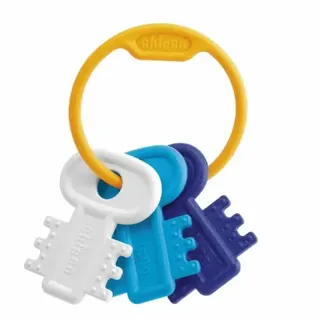 −41 %ChiccoKeys rattle, blue – Chicco82 DH
instead of 140 DHView product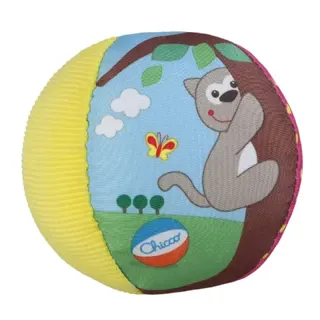 −48 %ChiccoSoft Ball musical toy, 3 months-3 years – Chicco104 DH
instead of 200 DHView product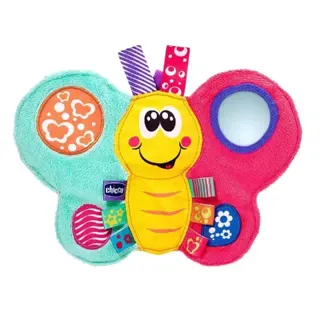 −48 %ChiccoDaisy Ninon the Butterfly activity toy, 3-24 months – Chicco94 DH
instead of 180 DHView product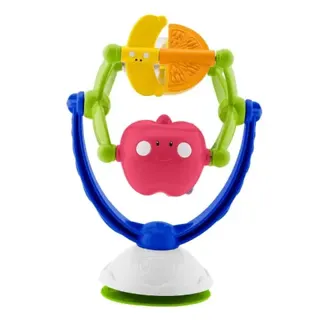 −48 %ChiccoFruits musical suction-cup rattle, from 6 months – Chicco156 DH
instead of 300 DHView product −48 %LudiMagic bath book, from 6 months – Ludi52 DH
instead of 100 DHView product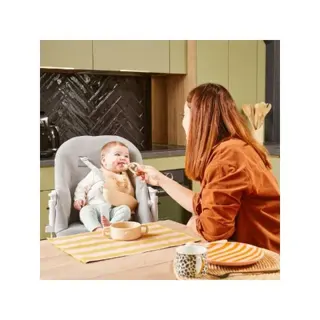 −34 %Babymoov2-in-1 silicone teething spoon, beige – Babymoov59 DH
instead of 90 DHView product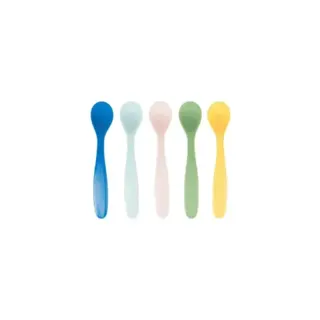 −9 %BadabulleSoft spoons, set of 5, from 4 months – Badabulle77 DH
instead of 85 DHView product- The whole aisle · Baby activity toys21 products online, delivered anywhere in Morocco.Open the aisle
Products sold by La Maison du Bébé, publisher of this magazine. Prices as of 12 October 2026; please check the product page.
His meals, a month into solids
The WHO advises 2 to 3 meals a day between 6 and 8 months, on top of milk, gradually thickening textures. The UK's NHS describes a gradual move to three meals between 7 and 9 months, with more mashed food, small lumps and finger foods: well-cooked vegetables, avocado, hard-boiled egg, boneless fish.
In a family that shares its dishes, take his portion of vegetables from the couscous or tagine before salting: the NHS advises against salt, sugar and stock cubes for babies. Seat him upright and strapped in, stay close, and offer a few sips of water in a cup. When he closes his mouth or turns his head away, he has finished, notes the CDC. The stages are detailed in our guide to starting solids.
Sleep: what changes once he sits
Between 4 and 12 months, a baby needs about 12 to 16 hours of sleep per 24 hours, naps included, according to the CDC. What is new concerns the cot: once he sits up or gets on all fours, Quebec public health advises lowering the mattress to its lowest level and removing mobiles. No pillow, no bumper, no soft toy: the rules are gathered in our guide to safe sleep.
Falls from the sofa, objects in the mouth: the risks of the moment
Never leave him alone on the changing table, the parents' bed or the high seating in the living room (sedari), even for a few seconds. CHU Sainte-Justine in Montreal reminds us that falls from the changing table are the most common accident before age 1.
Everything lying around will be tasted. Quebec public health asks you to keep small objects he could swallow, medicines and cleaning products out of reach. The full list is in our checklist for making the house safe.
Check-ups and vaccines
Bring the health record to every appointment: his growth and vaccines are noted there. The age for each injection is in our vaccination schedule in Morocco. For a baby born prematurely, Mieux vivre reminds us that we go by corrected age: born two months before term, he now has the milestones of a baby of about 5 months.
Next month, many babies start to crawl: read on in our article on baby at 8 months.
Frequently asked questions
My 7-month-old cannot sit alone yet. Is that normal?
Yes, it is common. In the WHO study carried out in five countries, healthy babies sat without support between 3.8 and 9.2 months. The US CDC only expects most children to have this skill at 9 months. Let him play on the floor every day, on his tummy and on his back. If he still does not sit by about 9 months, or if other milestones are missing, talk to the paediatrician.
How many meals should a 7-month-old have?
The WHO recommends 2 to 3 meals a day between 6 and 8 months, on top of milk, then 3 to 4 from 9 months, with one or two snacks if needed. The UK's NHS describes a gradual move to three meals between 7 and 9 months. Amounts follow his appetite: when he closes his mouth or turns his head away, he is done.
Which toys should I choose for a 7-month-old?
Objects he can grab with one hand, pass to the other, shake and chew: a rattle, soft ball, teething ring, wooden spoon, plastic bowl, cloth or board book. An unbreakable mirror is a big hit. Keep away toys with small detachable parts and check the age on the packaging: at this age, everything ends up in the mouth.
Should my 7-month-old drink water?
Yes, in small amounts, at mealtimes. The NHS advises offering a few sips of water from 6 months, in an open cup or one without a valve, which helps him learn to drink and protects his teeth. Milk, breast milk or infant formula, stays his main drink.
My 7-month-old puts everything in his mouth. Should I stop him?
No, it is his way of discovering shapes and textures: the CDC counts this among the skills expected around 6 months. You do need to watch what is within reach. Keep small objects he could swallow, medicines and cleaning products out of reach, and give him age-appropriate toys that are easy to wash.
Sources
- Motor development milestonesWorld Health Organization (WHO), child growth standards · International
- Milestones by 6 MonthsCenters for Disease Control and Prevention (CDC), Learn the Signs. Act Early. · United States
- Milestones by 9 MonthsCenters for Disease Control and Prevention (CDC), Learn the Signs. Act Early. · United States
- Étapes du développement de l'enfantMieux vivre avec notre enfant de la grossesse à deux ans, INSPQ · Canada (Quebec)
- Aménager un environnement sécuritaire pour votre enfantMieux vivre avec notre enfant de la grossesse à deux ans, INSPQ · Canada (Quebec)
- Attention aux chutes !Health promotion, CHU Sainte-Justine · Canada (Quebec)
- Infant and young child feedingWorld Health Organization (WHO) · International
- Your baby's first solid foodsNHS · United Kingdom