









Article contents
Key points
- The social smile, aimed at you, most often appears during the second month.
- Answering baby's cooing teaches the turn-taking of a real conversation.
- On the tummy, awake and watched: at least 30 minutes a day, in several sessions.
- At the end of your rope? Put baby down safely in the cot and step out. Never shake a baby.
- No water, no herbal tea, no other food: milk covers every need.
You are talking softly, leaning over the changing mat. Baby stares at you, serious, then their whole face opens up. That smile is for you. It is the social smile, one of the big milestones of the 2-month-old baby, along with the first cooing and a head that lifts when they are on their tummy.
These milestones do not arrive on the same day for everyone: the US CDC lists describe what at least 75% of babies do at a given age. A perfectly healthy child can therefore be a little ahead or behind. Just past the first-month milestone? Here is what comes next.
The social smile: baby answers you
During the second month, baby starts to smile on purpose and to copy your expressions, describes the Quebec public health institute (INSPQ). At 2 months, according to the CDC, most babies smile when you talk or smile at them, look at your face, seem happy to see you coming and calm down when picked up.
Answer that smile: smile back, exaggerate your expressions a little, then wait for baby's reply. UNICEF advises bringing your face close to theirs so they learn to recognise your features, and keeping baby skin to skin to soothe them.
After the nfissa (the traditional forty days of postpartum rest), visits often multiply. Watch baby's signals: if they turn their head away, yawn or fuss, they are asking for a break, explains the CDC.

Cooing: baby's first conversations
Among the 2-month milestones, the CDC counts making sounds other than crying and reacting to loud noises. UNICEF describes a baby drawn to sounds, who turns towards them and coos.
The principle fits in one word: respond. When baby makes sounds, copy them, then leave a silence so they can “take their turn”: that is how they learn the back-and-forth of a conversation, according to the CDC. Talk to them, sing, in darija, French, Tamazight or English. No screens, though: the CDC recommends none before age 2, except video calls with relatives. So the grandfather calling from Tangier or Brussels keeps his place.
On the tummy, the head lifts
At 2 months, most babies hold their head up when on their tummy (CDC). UNICEF adds that baby pushes on their arms to lift it, and that arm and leg movements become smoother. Their hands open at times.
Tummy time remains the best training: at least 30 minutes a day, in several sessions and while awake, recommends the World Health Organization (WHO). The CDC advises placing toys at eye level and never leaving baby alone in this position. If baby protests, lie down facing them and talk (UNICEF).
As for toys, the American Academy of Pediatrics (AAP) lists for this age high-contrast pictures and books, a colourful mobile, sturdy rattles and soft music at low volume. A light rattle, shaken gently to one side, invites baby to turn towards the sound.
From the shop
For playing together, on the floor or in your arms
A play gym for time on the back and on the tummy, a colourful mobile to hang away from the cot and two light rattles to shake for baby: a few things to support those first exchanges.
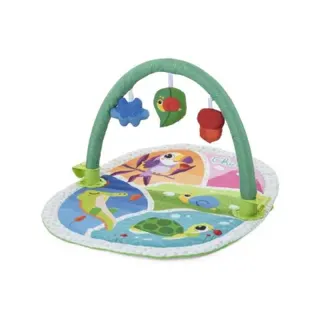 −48 %ChiccoForest Arch 3-in-1 activity gym – Chicco234 DH
instead of 450 DHView product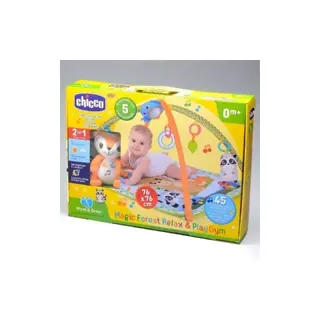 −48 %ChiccoForest Gym activity mat – Chicco515 DH
instead of 990 DHView product −48 %Doudou et CompagnieTropical musical mobile – Doudou et Compagnie494 DH
instead of 950 DHView product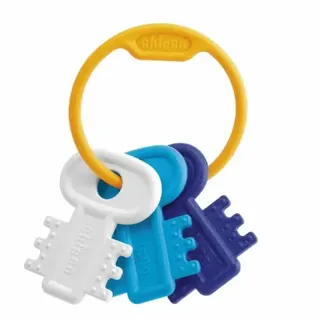 −41 %ChiccoKeys rattle, blue – Chicco82 DH
instead of 140 DHView product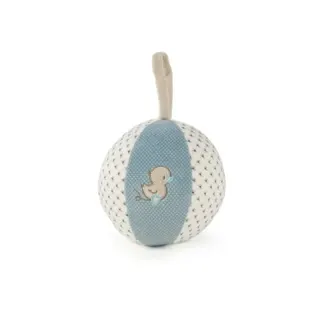 −48 %Pasito a PasitoMousy balloon rattle, blue – Pasito a Pasito99 DH
instead of 190 DHView product- The whole aisle · Baby activity toys21 products online, delivered anywhere in Morocco.Open the aisle
Products sold by La Maison du Bébé, publisher of this magazine. Prices as of 12 October 2026; please check the product page.
Evening crying: what helps, and what you never do
This is also the age of crying. According to the INSPQ, it increases from the second week, peaks around the sixth and usually decreases around the third or fourth month. Some babies cry much more than others, depending on temperament.
What soothes changes from one evening to the next: rocking, carrying, lowering the lights, skin to skin, a feed, or the “tiger in the tree” hold, face down along your forearm (INSPQ). Our article on newborn crying helps decode the causes.
When nothing works and tension rises, lay baby on their back in the cot, close the door and step away for a moment, checking on them every 5 to 10 minutes (CDC). Never shake a baby, and do not let anyone else do it: shaking a baby can damage their brain, even kill them. Better still, hand over to dad, a grandmother or an aunt: that is the first solution the INSPQ suggests.
Sleep: still waking, and that is expected
Nights are still broken, and that is normal: the AFPA paediatricians (mpedia) place the first real nights of sleep between 4 and 6 months on average. Set some markers now: at night, very dim light, a low voice and a quick return to bed. The CDC also advises regular sleep and feeding routines. If the night wakings are wearing you out, read why baby does not sleep through yet.
In summer, in Marrakech as in Fes, the question becomes how to dress baby. The AAP points out that overheating raises the risk of sudden infant death. Dress baby in just one extra layer compared with you, with no hat indoors: a hot chest, sweat or red skin tell you they are too warm.
Breast or bottle: reading the signals
Milk covers all baby's needs (UNICEF): no food, water or other drink before about 6 months, reminds the CDC. Hunger signs come back about 8 to 12 times in 24 hours at this age, according to UNICEF. The other half of the job, insists the CDC, is spotting the signs of fullness and stopping when baby is done, even if the bottle is not empty.
For many working mothers, this month is also when work resumes. In the private sector, maternity leave lasts 14 weeks. The Labour Code then grants one paid nursing hour a day for 12 months from the return to work. Our article on breastfeeding after going back to work explains how to organise.
Vaccines and the 2-month check-up
The national immunisation programme (PNI) is free in public health centres, and its dates are gathered in our Moroccan schedule, vaccine by vaccine. To soothe baby after the injection, read our article on what to expect after a vaccine.
Come with your observations: the CDC encourages parents to raise any worry without waiting and, if in doubt, to ask for a developmental screening. Next month, baby's hands become their favourite toy: see you at 3 months, the age of hands and first laughs.
Frequently asked questions
At what age does a baby give their first real smile?
Usually during the second month: that is when, according to the Quebec public health institute (INSPQ), baby starts to smile on purpose. The US CDC lists smiling in response to your voice or smile among the 2-month milestones, reached by at least 75% of babies. If baby does not smile at people by 2 months, UNICEF advises talking to the doctor, who will take a look.
How long should a 2-month-old spend on their tummy?
Aim, like the WHO, for at least half an hour a day in total, split into several moments when baby is wide awake. At 2 months, several short sessions beat one long one. Stay beside baby and place a toy at eye level, as the CDC advises, or lie down facing them. If they protest, pick them up and try again later.
How many feeds a day for a 2-month-old?
There is no number to reach. UNICEF says hunger cues come back about 8 to 12 times in 24 hours at this age, and the WHO advises breastfeeding on demand, night and day. Whether at the breast or the bottle, watch for signs of fullness too: the CDC reminds us that you can stop when baby is done.
My 2-month-old sucks their hand: should I give a dummy?
It is not compulsory. Sucking their hand is one of the ways a 2-month-old calms down, notes UNICEF. If you offer a dummy (pacifier), the American Academy of Pediatrics advises waiting until breastfeeding is well established; it also reminds us that a dummy at sleep time lowers the risk of sudden infant death, even if it falls out later. Never a cord around the neck or clipped to clothing during sleep.
Sources
- Milestones by 2 MonthsCDC, Learn the Signs. Act Early. · United States
- Developmental Milestones: 1-4 Months OldHealthyChildren.org, American Academy of Pediatrics (AAP) · United States
- How to Keep Your Sleeping Baby Safe: AAP Policy ExplainedHealthyChildren.org, American Academy of Pediatrics (AAP) · United States
- Les grandes étapes du développement de votre bébé à 2 moisUNICEF, Parenting portal · International
- To grow up healthy, children need to sit less and play moreWorld Health Organization (WHO) · International
- Étapes du développement de l'enfantMieux vivre avec notre enfant, INSPQ (Quebec public health institute) · Canada (Quebec)
- Pleurs du nouveau-néMieux vivre avec notre enfant, INSPQ (Quebec public health institute) · Canada (Quebec)
- Rythme veille-sommeil, quand va-t-il « faire ses nuits » ?Santé.fr, based on mpedia (French Association of Ambulatory Paediatrics) · France