









Article contents
Key points
- Startling, gripping, rooting: these reflexes are normal and fade one by one over the coming months.
- Baby focuses at 20-30 cm: your face, at feeding distance, is their best toy.
- 14 to 17 hours of sleep a day, in short chunks: there is no need to impose a schedule.
- Milk on demand, day and night, and no other drink, water included.
- Before 3 months, a temperature of 38 °C or above calls for urgent medical advice.
A door slams in the hallway. Your 1-month-old baby startles, throws their arms wide, opens their hands, then pulls them back in and cries. This movement has a name, the Moro reflex, and it is perfectly normal: according to the American Academy of Pediatrics (AAP), it is actually at its strongest during the first month.
This first month is the month of reflexes, of eyes that lock onto faces, and of days cut up into sleeping and feeding. For a premature baby, we count in corrected age, starting from the due date, reminds the Quebec public health institute (INSPQ). And if you have only just come home from the clinic, take a look at what happens in the first days at the maternity ward.
Primitive reflexes: movements baby does not control
At 1 month, many of baby's movements are reflexes, automatic responses present from birth. They fade one by one over the months; for the main ones, the INSPQ places their disappearance between 3 and 12 months. Here are the ones the AAP describes.
| Reflex | What you see | Fades around… |
|---|---|---|
| Rooting | When a cheek is stroked, baby turns that way with an open mouth, as if looking for the breast. | 4 months |
| Moro (startle) | At a noise, or if the head tips back, baby flings the arms out then pulls them in, often crying. | After 2 months |
| Grasping | Baby grips the finger placed in their palm; the toes curl if you stroke the foot. | 5-6 months (hand), 9-12 months (foot) |
| “Fencer” | With the head turned to one side, baby stretches that arm and bends the other. | 5-7 months |
| Automatic walking | Held under the arms with feet flat, baby makes a few “steps”. | Around 2 months |
Two precautions from the AAP. Do not test baby's grip by lifting them: they cannot control it and may let go suddenly. And tell the paediatrician about a reflex that differs from one side to the other, or one side of the body that moves less well. Otherwise, movement is still jerky: arms waving in fits and starts, fists often clenched, and a head that falls back if it is not supported.

What does a one-month-old see and hear?
Baby focuses at 20-30 cm, the distance between their face and yours during a feed. They prefer faces to any other pattern and are drawn to very contrasting drawings, black and white for example. Their eyes sometimes wander or cross: this can happen at this age, says the AAP. Around 2 months, baby will begin to tell colours apart and follow a slowly moving object with their eyes (INSPQ).
Hearing, on the other hand, is already complete: baby startles at loud noises and calms to familiar voices. They recognise the smell of their mother's milk and dislike being handled roughly (AAP). They also recognise the sounds of their mother tongue, notes the INSPQ: whether it is darija, Tamazight, Arabic or French, that is the music that reassures them.
Stimulating a 1-month-old: your face first
At this age, stimulation comes from you far more than from toys. Hold baby facing you, about thirty centimetres away, talk to them, sing, and give them time to “answer” with a facial expression when they are calm and fully awake.
Tummy time also begins. For babies who are not yet moving around, the World Health Organization (WHO) recommends at least 30 minutes a day on the tummy, spread over several sessions, always while awake. At 1 month you build up in small touches: lying on your chest, or a few moments on a firm mat, under your eyes. A contrasting play mat can serve as a playground, though it is not essential.
From the shop
Stimulating a one-month-old without overdoing it
At this age your face is still the best toy. A high-contrast play mat, a mobile hung well away from the cot, a soft rattle and a baby carrier are more than enough.
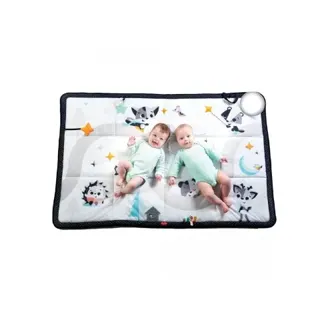 −54 %Tiny LoveBlack & White giant activity mat – Tiny Love365 DH
instead of 790 DHView product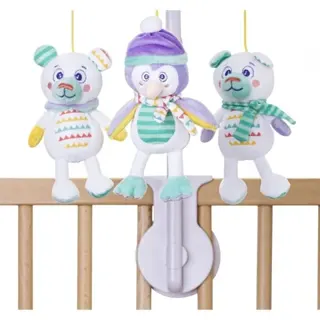 −48 %SaroWinter Friends musical mobile, yellow – Saro312 DH
instead of 600 DHView product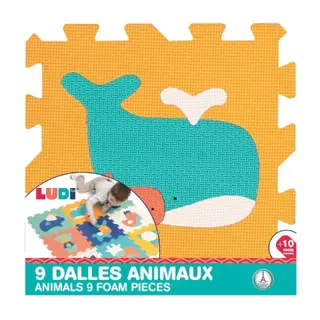 −42 %LudiAnimal tiles play mat, from birth – Ludi143 DH
instead of 245 DHView product −48 %ChiccoTulip bell rattle, blue – Chicco78 DH
instead of 150 DHView product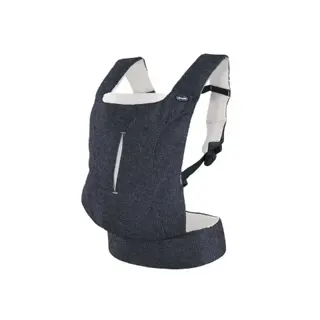 −42 %ChiccoMyamaki ergonomic baby carrier, Denim Beige, birth-15 kg – Chicco813 DH
instead of 1 390 DHView product- The whole aisle · Baby activity toys21 products online, delivered anywhere in Morocco.Open the aisle
Products sold by La Maison du Bébé, publisher of this magazine. Prices as of 12 October 2026; please check the product page.
How much does a one-month-old sleep?
Between 14 and 17 hours out of 24, naps included, according to the WHO. But these hours come in pieces: before “sleeping through”, a newborn normally wakes after 2 to 4 hours of sleep. This rhythm is set by the brain rather than by hunger, explain the AFPA paediatricians on mpedia. Before 3 or 4 months, you therefore follow baby's rhythm without looking for a schedule.
What matters is elsewhere: how baby sleeps. The AAP recommends putting baby on their back for every sleep, on a firm mattress with just a fitted sheet, with no pillow, blanket, cot bumper or soft toy, in your room but not in your bed, for at least the first 6 months. The traps specific to our living rooms, sofa benches included, are covered in our article on safe sleep and sudden infant death.
Milk on demand, and nothing else
For the WHO, a baby feeds only on breast milk for the first 6 months, as often as they ask, day and night. It advises against any other food or drink, water included, unless there is a medical reason. No herbal tea either, even when a well-meaning grandmother offers one “for the tummy”: milk is enough. Our guide to getting breastfeeding off to a calm start answers the questions of the first weeks. If you bottle-feed, ask the paediatrician for the amounts that suit your baby's weight.
A month of paperwork and appointments
In Morocco, a birth must be declared within 30 days at the civil registry office of the place of birth, with the birth notice given by the maternity unit and the declarant's ID. After that, the record can only be drawn up with authorisation from the civil registry administration, and the court steps in only if it is refused: see our article on declaring a birth in Morocco.
On the health side, vaccinations follow the National Immunisation Programme, free in public health centres: exact ages are in our Moroccan vaccination schedule. The health record goes with you to every appointment, along with the questions you have noted down in advance. And what comes next? The first real smiles, to discover in the article on your 2-month-old.
Frequently asked questions
My one-month-old squints at times: is that normal?
Most of the time, yes. According to the American Academy of Pediatrics, a one-month-old's eyes can still wander, cross or drift outwards. The eyes then coordinate little by little: around 2 months, baby starts to follow a slowly moving object. Talk to the doctor if one eye seems not to move like the other, or simply if it worries you.
Can a one-month-old smile yet?
The “social” smile, the one aimed at you in answer to your face or voice, usually appears during the second month, according to the Quebec public health institute (INSPQ). Until then, baby answers in other ways: gazing at you, calming at the sound of your voice, sometimes turning towards you. That first real smile will be one of next month's big milestones.
Should I give a one-month-old water when it is very hot?
Not if baby is breastfed: the WHO recommends no other drink, water included, for the first 6 months, unless there is a medical reason. In hot weather, simply offer the breast whenever baby asks, as often as they like. If baby takes formula, ask your paediatrician what they advise during heatwaves or chergui (hot desert wind) days.
What toy suits a one-month-old?
Almost nothing is essential. The American Academy of Pediatrics suggests, at this age, mobiles with very contrasting patterns hung away from where baby sleeps, soft music and soft brightly coloured toys that make a gentle sound. None of these toys stays in the cot during sleep. The rest is you: your voice, your face thirty centimetres away, your arms.
Sources
- Developmental Milestones At 1 Month OldHealthyChildren.org, American Academy of Pediatrics (AAP) · United States
- Newborn ReflexesHealthyChildren.org, American Academy of Pediatrics (AAP) · United States
- How to Keep Your Sleeping Baby Safe: AAP Policy ExplainedHealthyChildren.org, American Academy of Pediatrics (AAP) · United States
- Étapes du développement de l'enfantMieux vivre avec notre enfant, INSPQ (Quebec public health institute) · Canada (Quebec)
- Rythme veille-sommeil, quand va-t-il « faire ses nuits » ?Santé.fr, based on mpedia (French Association of Ambulatory Paediatrics) · France
- To grow up healthy, children need to sit less and play moreWorld Health Organization (WHO) · International
- Infant and young child feedingWorld Health Organization (WHO) · International
- High temperature (fever) in childrenNHS · United Kingdom