






Article contents
Key points
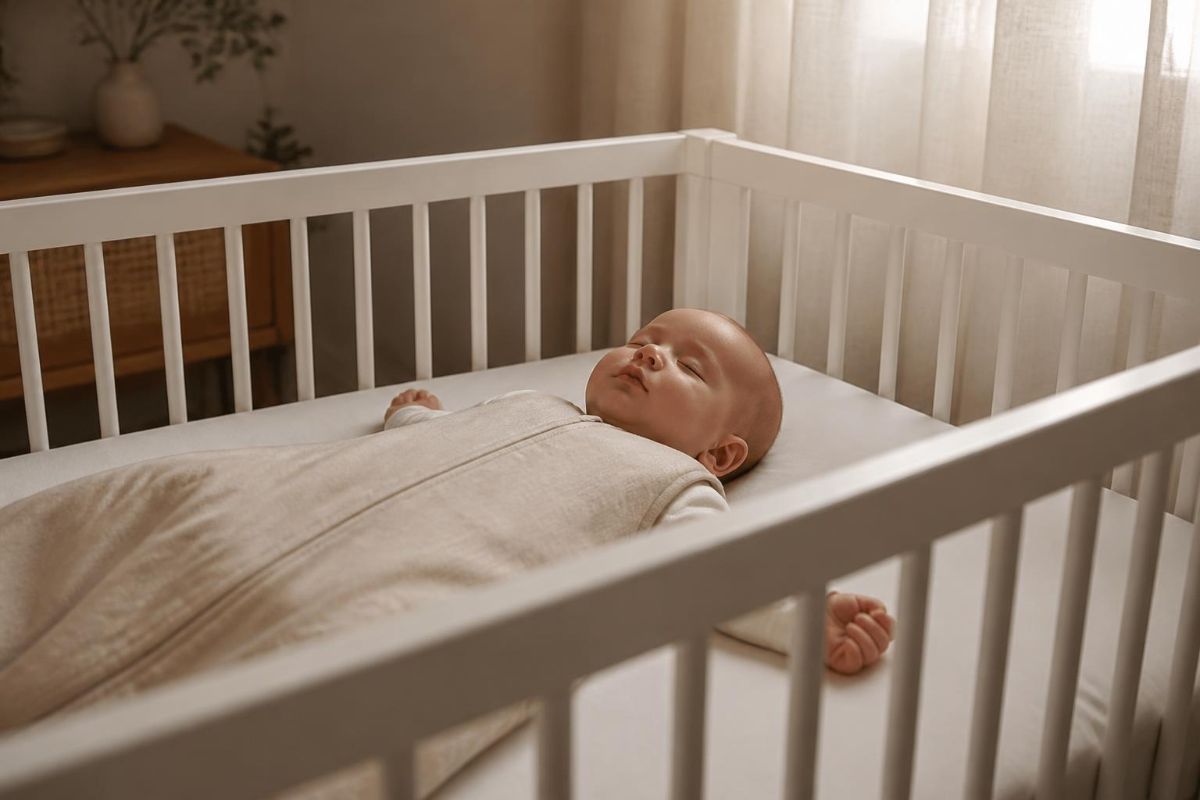
- On the back for every sleep, naps included, until age 1.
- A firm, flat mattress and a fitted sheet: nothing else in the cot.
- In your room, in their own cot, for at least the first 6 months.
- Never share sleep on a sofa, an armchair or a living-room banquette.
- No smoking around your baby, no hat at night, no overheating.
The cot bumper that matches the curtains, the little embroidered pillow given at the sbou3 (the naming ceremony a week after birth), grandmother's thick blanket for winter nights: all of it is pretty, and all of it should come out of your baby's cot. Sudden infant death syndrome remains rare, but a large part of the risk comes down to how a small baby is put to sleep.
The rules below are shared by American, Canadian and British health authorities and paediatricians. They are simple, free, and apply to every sleep, at night and during naps.
What is sudden infant death syndrome?
It is the unexplained death, during sleep, of a baby under one year old who seemed healthy. It used to be called "cot death", and it is also known as sudden unexpected infant death. Its exact cause remains unknown. In the United States, the American Academy of Pediatrics (AAP) counts about 3,500 babies dying suddenly and unexpectedly in their sleep each year.
The risk is highest during the first 6 months, but it lasts until 12 months, by day and by night. According to the British NHS, some babies are more vulnerable:
- premature babies, born before 37 weeks;
- babies weighing under 2.5 kg at birth;
- twins and other multiple births;
- babies exposed to tobacco, during pregnancy or afterwards.

Alone, on the back, in a suitable cot: the three basic rules
On the back, for every sleep. This is the single most protective step. Even a baby who often spits up is safer on their back, notes the Canadian Paediatric Society (CPS). When your baby starts to roll over, keep laying them on their back; once they roll on their own in both directions, there is no need to turn them back all night.
In their own cot, in your room. The AAP, the CPS and the NHS recommend that your baby sleeps near you, in their own bed, for at least the first 6 months, naps included. According to the AAP, sharing a room this way can reduce the risk by up to 50%.
On a firm, flat mattress. A cot, crib or co-sleeping crib that meets standards, a firm mattress of the exact size of the cot, with no gap at the sides, and a simple fitted sheet. To compare models, standards and mattresses, follow our guide to choosing a baby bed and mattress.
What should you take out of your baby's cot?
Anything that could cover their face or interfere with their breathing. Health bodies agree on this list:
| Remove from the cot | Why |
|---|---|
| Pillow, cushion, head support | Baby can bury their face in it |
| Duvet, quilt, thick blanket | They ride up over the head and make it too hot |
| Cot bumper | It can cover the face and block breathing |
| Soft toys, comfort toys, toys | Suffocation risk before age 1 |
| Baby wedge, positioner, nest, cocoon | Not recommended by the CPS and the NHS |
| Tilted mattress, inclined plane | Dangerous surface beyond 10 degrees according to the AAP |
To keep warm without a blanket, a baby sleeping bag is the simplest solution. The Réseau Morphée prefers it to a blanket, and the CPS insists on the size: too big, and your baby's head can slide inside; too small, and it restricts the hips. Choose it according to your baby's weight and length, not only their age: our baby sleeping bag guide details sizes and TOG ratings.
Finally, be wary of any product that promises to "prevent SIDS": the AAP calls for the greatest caution with these claims. As for a flat head, it is prevented by putting your baby on their tummy when they are awake and supervised, not with a head support: see our article on flat head syndrome.
From the shop
Simple, safe sleeping
A cot that meets standards, a firm mattress that fits it, tight fitted sheets and light clothing: that is all your baby needs to sleep. No bumper, no baby wedge, no pillow.
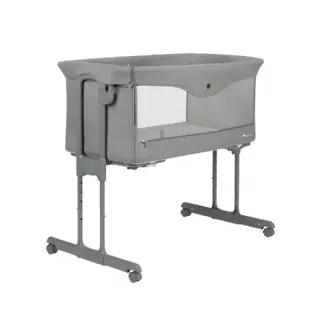 −9 %Bebe ConfortAmara 2-in-1 bedside crib, Tinted Gray – Bébé Confort1 811 DH
instead of 1 990 DHView product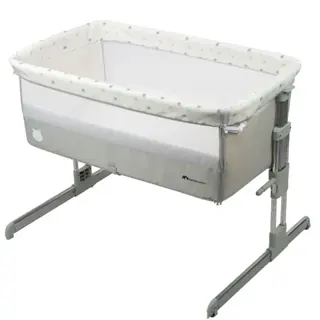 −53 %Bebe ConfortCalidoo bedside crib, Sleepy Bear – Bébé Confort1 347 DH
instead of 2 890 DHView product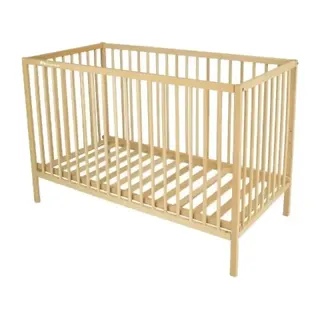 −9 %Bebe ConfortPoppy cot, natural wood, 60 x 120 cm – Bébé Confort1 993 DH
instead of 2 190 DHView product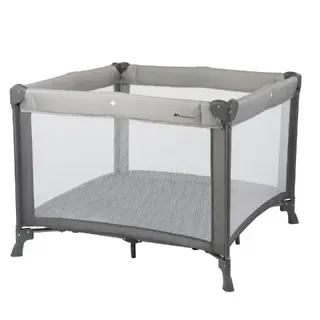 −46 %Bebe ConfortTravel playpen cot, Gray Mist – Bébé Confort857 DH
instead of 1 590 DHView product −74 %BabiduFitted sheet, 60 x 120 cm, white – Babidu65 DH
instead of 250 DHView product −74 %BonjourBébé PremiumFitted sheets, 60x120 cm, grey – BonjourBébé Premium65 DH
instead of 250 DHView product −74 %BabiduShort-sleeved bodysuit, beige, 6 months – Babidu34 DH
instead of 130 DHView product- The whole aisle · Baby bedding55 products online, delivered anywhere in Morocco.Open the aisle
Products sold by La Maison du Bébé, publisher of this magazine. Prices as of 12 October 2026; please check the product page.
Heat or cold: how to avoid overheating?
Overheating increases the risk of SIDS, notes the CPS. Bedroom temperature guidelines vary from country to country:
- 16 to 20 °C for the British NHS and Lullaby Trust;
- 20 to 21 °C for Naître et grandir, in Québec;
- about 20 to 22 °C for the AAP.
Moroccan summers often exceed these figures. In that case, lighten what your baby wears rather than covering them: a light bodysuit may be enough. The AAP advises dressing them in no more than one extra layer compared with you, and the NHS advises checking their temperature by touching the back of the neck or the chest, not the hands or feet, which are normally cooler. If they are sweating or have hot, red skin, remove a layer.
In winter, in homes without heating, the temptation is to pile everything on. A warmer sleeping bag is better than a duvet. No hot-water bottle or electric blanket, and never put the cot near a space heater, a fire or in direct sun (NHS). And no hat for sleeping indoors once you are home from the maternity unit (AAP). All the guidelines by season are in our guide to dressing your baby at night.
Bed sharing, sofa, banquette: where are the real dangers?
The greatest danger is falling asleep with your baby on a sofa or armchair: according to the AAP, the risk there is up to 67 times higher. In Morocco, the living-room banquette and its big cushions fall in the same category.
On the parents' bed, recommendations differ. The AAP advises against it in all cases, and the CPS points out that it increases the risk, even when it was not planned. The NHS and the Lullaby Trust give rules to make it safer, and Naître et grandir notes that some specialists consider it acceptable when there are no risk factors. All agree on the situations where it becomes very dangerous:
- an adult who smokes, or a mother who smoked during pregnancy;
- an adult who has drunk alcohol, taken drugs or a medicine that causes drowsiness;
- a premature baby or one weighing under 2.5 kg at birth.
The AAP adds that before 4 months, the risk of bed sharing is 5 to 10 times higher.
According to the Lullaby Trust, around half of sudden infant deaths happen during shared sleep, most often in these risk situations. The alternative of a crib attached to the parents' bed is presented in our co-sleeping crib guide.
Dummy, breastfeeding, vaccines: what else protects
- Breastfeeding: according to the CPS, breastfeeding for at least 2 months reduces the risk by about half, and the protection grows with duration.
- A dummy at bedtime: the AAP states it reduces the risk, even if it falls out during sleep. For a breastfed baby, wait until breastfeeding is well established. Never a dummy clip or cord during sleep (see our dummy guide).
- Zero tobacco: the CPS estimates that about one sudden infant death in three could be avoided if mothers did not smoke. Nobody smokes near your baby, in the house or in the car.
- Vaccines: the AAP and the NHS list them among protective steps. Follow the vaccination schedule.
Naps in the pushchair, car seat, travel
Car seats, bouncers, swings and pushchairs are not places to sleep: sitting up, a baby's head can fall forward and interfere with breathing (CPS). If your baby falls asleep during the journey, take them out as soon as you arrive and lay them on their back in a bed. When travelling or at family homes, a travel cot will do, provided you never add a second mattress or padding, and keep it away from curtain cords.
Frequently asked questions
My baby spits up a lot: can I lay them on their tummy or tilt the mattress?
No. The Canadian Paediatric Society points out that a baby who often spits up is still safer on their back. The American Academy of Pediatrics considers any surface inclined beyond 10 degrees dangerous, and wedges or inclined planes are not recommended. If the spit-up worries you, talk to your paediatrician rather than changing how your baby sleeps.
My baby rolls onto their tummy in their sleep: should I put them back on their back?
Always lay them on their back. As long as they cannot roll over on their own in both directions, the NHS advises turning them back if they roll. Once they roll easily both ways, the American Academy of Pediatrics sees no need to keep turning them, as long as the cot stays free of any soft objects.
Can I put a blanket in my baby's cot?
Opinions differ. The Canadian Paediatric Society says a baby does not need a blanket, and the American Academy of Pediatrics prefers a wearable blanket, such as a baby sleeping bag. In the UK, the NHS accepts a light blanket, with the baby lying with their feet touching the foot of the cot so they cannot slip under it. A well-sized sleeping bag remains the simplest solution.
Does a baby monitor or breathing sensor protect against SIDS?
No. The American Academy of Pediatrics advises against using home cardiorespiratory monitors to reduce the risk of SIDS, and points out that no connected device (pulse sensor, sock, oximeter) has been shown to work. A baby monitor can reassure you when your baby sleeps in another room, but it never replaces the safe sleep rules.
Until what age should I follow these rules?
Until age 1. The risk is highest during the first 6 months, but SIDS can occur up to 12 months, the NHS notes. For a baby born premature or small, British guidance asks you to follow these rules until 1 year after the due date, not after the date of birth.
Sources
- How to Keep Your Sleeping Baby Safe: AAP Policy ExplainedHealthyChildren.org, American Academy of Pediatrics (AAP) · United States
- Healthy Sleep Habits: How Many Hours Does Your Child Need?HealthyChildren.org, American Academy of Pediatrics (AAP) · United States
- Sudden infant death syndrome (SIDS)NHS · United Kingdom
- Safer sleep overviewThe Lullaby Trust · United Kingdom
- Co-sleeping with your babyThe Lullaby Trust · United Kingdom
- Dormir en toute sécuritéCaring for Kids, Canadian Paediatric Society · Canada
- Le sommeil de bébéNaître et grandir · Canada (Québec)
- Les bonnes pratiques pour préserver le sommeil du bébéSanté.fr (Réseau Morphée content) · France