









Article contents
Key points
- Holding a toy, shaking it, bringing it to the mouth: baby's hand is becoming a tool.
- Rolling from tummy to back: often around 3-4 months, and by 6 months in most babies.
- Changing table, bed, sofa bench: constant supervision from the first rolls.
- Nights unravelling? A baby's sleep can regress and change from one night to the next.
- Starting solids: never before 4 months, and the right time is chosen with the paediatrician.
You hold out a rattle. Baby's hand sets off, misses, bangs the toy, tries again, then closes around it, and the rattle heads straight for the mouth. This little feat sums up the 4-month-old baby: they are starting to act on the world. One morning they may roll from tummy to back, to everyone's surprise.
Two new things need your attention this month: rolling, which changes the safety rules, and nights that, for some babies, get complicated. At 3 months, baby discovered their hands; at 4 months, they use them.
Grabbing: from the swatting hand to the gripping hand
According to CDC milestones, a 4-month-old generally holds the toy you slip into their hand, swings an arm towards what attracts them, brings their hands to the mouth and keeps the head steady when carried. UNICEF adds that many reach a hand towards a toy, shake the one they hold and coordinate hands and eyes better. The movement is still imprecise: often baby swats the object before managing to grasp it.
To train, the CDC advises placing baby on the floor, on a blanket, with a few safe toys around them, so they reach, kick and explore. Let them chew too: the mouth is part of learning, as long as the object is not sharp, hot or small enough to choke on. During a nappy change or bath, tell baby what you are doing, and look together at what interests them, advises UNICEF.

Rolling over: everyone has their own timetable
Rolling often comes around 3 or 4 months, sometimes earlier, notes the American Academy of Pediatrics (AAP). Yet the CDC lists rolling from tummy to back among the 6-month milestones, the age at which at least 75% of babies manage it. Both are true: some roll early, others take their time, and a 4-month-old who is not rolling yet is still within the norm.
UNICEF advises encouraging it on a firm surface, because rolling is harder on a soft one. A play mat big enough to roll on, laid on the floor, does the job nicely.
From the shop
Things to grab, shake and roll towards
A large mat for rolling on the floor, a soft ball that is easy to grasp, light rattles and an activity spiral for the pushchair: simple toys to exercise baby's hands and first rolls.
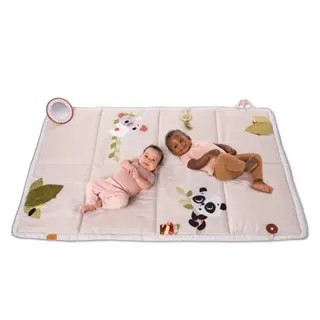 −26 %Tiny LoveBoho Chic giant activity mat – Tiny Love585 DH
instead of 790 DHView product −9 %Tiny LoveSuper Mat activity mat, Garden of Adventures – Tiny Love683 DH
instead of 750 DHView product −48 %ChiccoSoft Ball musical toy, 3 months-3 years – Chicco104 DH
instead of 200 DHView product −46 %Tiny LoveBoho Chic sloth rattle – Tiny Love107 DH
instead of 200 DHView product −48 %Saro ClassicSweet Woolly hot-air balloon rattle, blue, dog – Saro Classic156 DH
instead of 300 DHView product −48 %ChiccoMy Sweet Doudou stroller activity spiral – Chicco148 DH
instead of 285 DHView product- The whole aisle · Baby activity toys21 products online, delivered anywhere in Morocco.Open the aisle
Products sold by La Maison du Bébé, publisher of this magazine. Prices as of 12 October 2026; please check the product page.
Once baby rolls, never alone on a raised surface
A baby who rolls can fall from anything raised, and nobody knows in advance which day they will do their first roll. The CISSS de l'Outaouais, a Quebec health body, says it plainly in its fall-prevention guidelines: on the changing table, baby stays under constant supervision. Prepare nappy, wipes and clothes before putting baby down, and always keep a hand close.
In a Moroccan salon, think of the banquettes: baby is often set down between two cushions while the tea is served, and can end up on the floor. When in doubt, put baby straight on the floor, on a mat: they cannot fall any lower. Same logic for the parents' bed or the sofa. Burns, poisoning, small objects: the other hazards in the home are covered in our article on accidents at home.
Nights get complicated: what happens around 4 months?
Naître et grandir points out that there is no scientific consensus on what “sleeping through the night” means, and that a baby's sleep can regress and change from one night to the next. Between 3 and 6 months, waking 3 or 4 times a night is still normal. The expression “4-month regression” describes these periods when wakings return: what research says about it, and how to get through these phases, is explained in our article on sleep regression.
As for needs, the World Health Organization (WHO) counts 12 to 16 hours of sleep per 24 hours between 4 and 11 months, naps included. The things that help do not change: daylight walks, dark and calm nights, and a bedtime ritual repeated every evening (Naître et grandir).
Some good news along the way: according to Naître et grandir, the risk of sudden infant death falls from about 4 months, partly because baby is better at waking and crying when breathing is difficult. Sleeping on the back is still the rule until 1 year.
Baby watches your plate: time to start solids already?
On this point, recommendations differ. The WHO recommends exclusive breastfeeding until 6 months, then introducing foods from that age while continuing to breastfeed. In France, the 2021 recommendations, taken up by the Nutrition Committee of the French Society of Paediatrics, place the start of complementary feeding between 4 and 6 months, for a healthy full-term baby, breastfed or not. Neither advises starting before 4 months.
Why the gap? The French text relies notably on the risk of insufficient iron intake when exclusive breastfeeding goes on beyond 6 months. In practice, the right time is decided with your paediatrician, by looking at your baby rather than the calendar. Our guide to starting solid foods covers what follows.
The 4-month appointment
This is the time to raise the question of starting solids, have the growth curve checked and review the vaccines planned in Morocco's vaccination schedule. Tell the doctor about any milestone that seems to be missing: the CDC advises not waiting and, if doubt remains, asking for a developmental assessment. Next month, everything will end up in baby's mouth: we talk about it in the article on 5 months.
Frequently asked questions
My 4-month-old is not rolling over yet: should I worry?
No. The American Academy of Pediatrics observes that first rolls often come around 3 or 4 months, but the CDC only expects this move from tummy to back by 6 months. Give baby floor time on a firm surface, where rolling is easier. If baby still does not roll by 6 months, mention it to the doctor.
My 4-month-old cries when we stop playing: is that normal?
Yes. UNICEF describes a 4-month-old who likes playing with others and sometimes cries when the game stops. At this age baby also cries differently depending on whether they are hungry, hurting or sleepy. Respond quickly to their cries and look for what they mean, advises UNICEF. And when baby coos, repeat their sounds: UNICEF sees this as a simple way to extend the exchange.
Should I stop swaddling baby at 4 months?
Yes, as soon as baby seems to be trying to roll over, recommends the American Academy of Pediatrics, and those attempts often start around 3 or 4 months, sometimes earlier. A swaddled baby who rolls onto the tummy has a higher risk of suffocation. Leave the arms free and keep putting baby to sleep on the back, on a firm mattress, with nothing around them.
What toys keep a 4-month-old busy?
Light toys that are easy to hold, which baby can shake and chew safely: the CDC mentions rattles and colourful cloth books. A large mat for floor play and a soft ball complete the kit nicely. Keep away anything sharp, hot or small enough to choke on, and always read the minimum age printed on the box.
Sources
- Milestones by 4 MonthsCDC, Learn the Signs. Act Early. · United States
- How to Keep Your Sleeping Baby Safe: AAP Policy ExplainedHealthyChildren.org, American Academy of Pediatrics (AAP) · United States
- Les grandes étapes du développement de votre bébé à 4 moisUNICEF, Parenting portal · International
- To grow up healthy, children need to sit less and play moreWorld Health Organization (WHO) · International
- Infant and young child feedingWorld Health Organization (WHO) · International
- Le sommeil de bébéNaître et grandir · Canada (Quebec)
- Prévention des chutesCISSS de l'Outaouais (Quebec health network) · Canada (Quebec)
- Les nouvelles recommandations du PNNS sur la diversification alimentaireNutrition Committee of the French Society of Paediatrics, Perfectionnement en Pédiatrie (2022), distributed by AFPA · France