





Article contents
Key points
- A fever starts at 38 °C, and only an electronic thermometer can confirm it.
- Under 3 months, a temperature of 38 °C or more needs medical advice immediately.
- The aim of medicine is baby’s comfort, not a normal number.
- No cold bath or wet towels: offer fluids and dress baby lightly.
- A first seizure, or one lasting over 5 minutes: call 141.
It is 10 p.m., baby is fretful, their cheeks are red and their forehead feels burning. In many families, the first reflex is to put a hand on the forehead. Yet a baby’s fever cannot be guessed: it is measured. And what should guide your decisions is above all their age and general condition, far more than the number on the display.
Fever, skhana in darija, is most often the normal reaction of a body defending itself against a virus. Yet it is very frightening: in the paediatric emergency department in Rabat, 96.8% of the 264 parents questioned in a study judged it very serious, and only 3.5% knew its exact definition.
At what temperature does a baby have a fever?
A fever is defined as 38 °C or above. France’s Haute Autorité de santé (HAS), the UK’s NHS and the Canadian Paediatric Society use the same threshold, for a child normally dressed, at rest, in a room that is not overheated.
Normal temperature is around 37 °C: the French health insurance service puts it below 37.5 °C in the morning and below 37.8 °C in the evening. A baby bundled up on a chergui day, or who has just cried for a long time, can read a few tenths too high without being ill. Remove any extra clothing, leave them quietly for about twenty minutes, then measure again.

Which thermometer should you choose and how do you take the temperature?
The right tool is the electronic thermometer; mercury ones are to be avoided. As for touch, it is not reliable: in Rabat, 44.4% of the parents questioned nevertheless judged fever that way.
The Canadian Paediatric Society’s guide, method by method:
| Method | From what age | Fever above | Good to know |
|---|---|---|---|
| Rectal (in the bottom) | From birth | 37.9 °C | The most accurate before age 2 |
| Under the arm | From birth | 37.5 °C | Simple, but tends to underestimate |
| In the ear | After age 2 | 37.9 °C | Quick, not recommended before age 2 |
| In the mouth | After age 5 | 37.5 °C | For a child who keeps the thermometer under the tongue |
| Forehead strip | Not recommended | - | Not accurate enough |
Contactless forehead thermometers are quick, but sweat or a hat throws the reading off.
Countries do not say quite the same thing: the HAS makes the rectal thermometer the reference, while the NHS rather advises underarm measurement in babies. In practice, the underarm reading is enough for monitoring; if the result is borderline or baby seems unwell, the rectal route gives the most reliable figure.
From the shop
To take a temperature without hesitating
No need to invest in a sophisticated device: a reliable electronic thermometer is enough. These care kits contain one, with a few everyday accessories, and a health-record cover keeps the health book ready for the appointment.
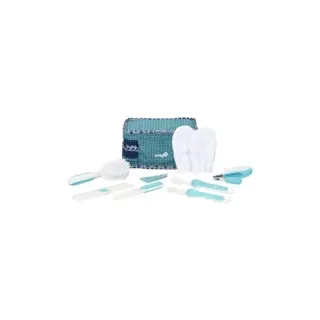 −48 %Safety 1stArctic newborn baby care kit, 8 pieces – Safety 1st156 DH
instead of 300 DHView product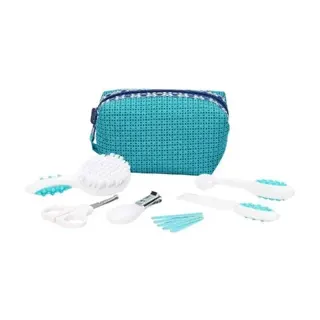 −37 %Safety 1stArctic newborn baby care kit, 6 pieces – Safety 1st177 DH
instead of 280 DHView product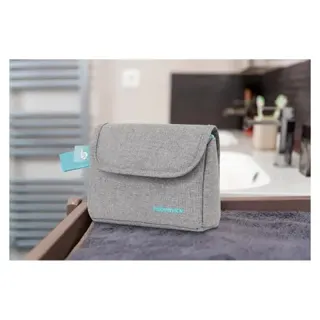 −9 %BabymoovTravel baby care kit – Babymoov346 DH
instead of 380 DHView product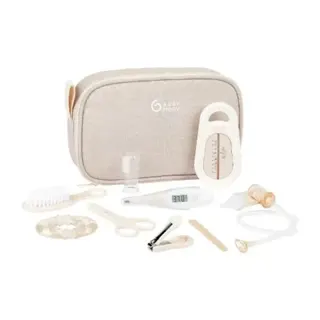 −9 %BabymoovBaby toiletry kit, sand, 9 accessories – Babymoov410 DH
instead of 450 DHView product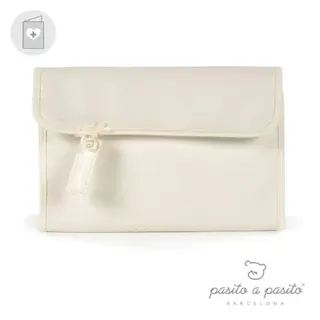 −48 %Pasito a PasitoCotton health record cover, white – Pasito a Pasito234 DH
instead of 450 DHView product- The whole aisle · Bath thermometers3 products online, delivered anywhere in Morocco.Open the aisle
Products sold by La Maison du Bébé, publisher of this magazine. Prices as of 12 October 2026; please check the product page.
Under 3 months: why see a doctor without delay?
In an infant under 3 months, a temperature of 38 °C or more calls for medical advice without delay, even if they look well. The HAS lists this young age among the warning signs, and the Canadian Paediatric Society speaks of an emergency. At this age, baby expresses poorly what they feel, and a serious infection can hide behind an isolated fever.
Call your paediatrician or go to the paediatric emergency department. Give no medicine without medical advice: the NHS reminds us that paracetamol is not given before 2 months without a professional’s approval.
Between 3 and 6 months, thresholds vary: the NHS asks for urgent advice from 39 °C, the Canadian Paediatric Society as soon as there is a fever before 6 months. If in doubt, call.
The right steps at home
After 3 months, if baby drinks, responds and smiles between fever peaks, most of the care happens at home. Guidance from different countries agrees:
- Offer fluids often: breastfeed on demand, more frequent bottles, water for an older child. Watch for fewer wet nappies, sunken eyes, crying without tears: these are signs of dehydration.
- Dress them lightly, with no thick blanket. Do not undress them completely: if they shiver, their temperature rises.
- Keep the room temperate, ideally between 18 and 20 °C according to the French health insurance service. Air the room, avoid space heaters in winter and an overheated bedroom in summer.
- Forget the cold bath and wet cloths: the HAS advises against them, because their effect is weak and brief, and they add to discomfort.
- Keep watching, including at night, their colour, breathing and the way they respond, and keep them quietly at home rather than at nursery.
In the Rabat study, 45.1% of parents used traditional remedies, and cloths soaked in cold water were still common. These simple steps are nevertheless enough.
Should you give medicine for fever?
Not necessarily. Treatment aims at the child’s comfort, not a number on the thermometer: that is the HAS position. A feverish baby who plays, feeds and smiles does not always need medicine; a listless, grumpy baby may be relieved by it.
If medicine is useful:
- Paracetamol is the first-choice treatment.
- One medicine at a time: do not alternate paracetamol and ibuprofen without medical advice.
- Never aspirin in children, because of the rare but serious risk of Reye’s syndrome.
- Ibuprofen is not suitable for everyone: not before 3 months, not with chickenpox, nor if the child is dehydrated.
- The dose depends on weight, not age. Ask your doctor or pharmacist for the dose suited to your child’s weight, and use the measuring device supplied with the bottle, never one from another medicine.
Antibiotics are given only on prescription, after an examination: they have no effect on viral infections, the most common in little ones. To know what to keep on hand, see our list for baby’s medicine cabinet.
Febrile seizures: what to do if baby has a convulsion
The scene is frightening, but uncommon and almost always harmless: according to the French health insurance service, 2 to 5% of children under 5 have one during a high fever, most often between 6 months and 5 years. The body is shaken by jerky movements, the eyes may roll back, the child does not respond. The seizure generally lasts 1 to 5 minutes, then gives way to drowsiness.
During the seizure:
- Note the time.
- Lay the child on their side, on a safe surface, without restraining their movements.
- Put nothing in their mouth: no finger, no object, no medicine.
- Call 141 if the seizure lasts more than 5 minutes, if it is the first, if baby is under one year old, if it affects only one side of the body or if it repeats.
Also call 141 if, after the seizure, they breathe poorly, have blue lips or do not wake up normally. In other cases, they should be seen by a doctor the same day. A febrile seizure leaves no after-effects, but recurs in about one child in three during a later fever. And contrary to a stubborn belief, bringing the fever down does not prevent it.
How long does a fever last, and when should you go back?
Most viral fevers pass in a few days. On when to go back, the guidance varies: the Canadian Paediatric Society advises seeing a doctor after 48 to 72 hours, the NHS from 5 days in a child who is otherwise well. The 48-hour rule is the most cautious.
See a doctor sooner if the fever comes with spots or rashes (see our guide to childhood rashes), if baby seems to have ear pain, if they are vomiting, or if the fever comes back after a few days of improvement. After a vaccine, a moderate fever is common: our article on reactions after vaccination explains how to monitor it.
Frequently asked questions
My baby’s forehead feels hot: does that mean a fever?
No. Touch is not a reliable method, the Canadian Paediatric Society reminds us: a forehead can feel warm after crying, a nap under a blanket or a day of chergui (the hot, dry wind). Only an electronic thermometer settles it. Measure after removing extra clothes and leaving baby quietly for about twenty minutes.
Should I wake my baby at night to give medicine?
Generally not. Treating a fever is about the child’s comfort, not a number: a baby sleeping peacefully does not need to be woken to bring the temperature down. Do check on them regularly through the night, as the UK’s NHS recommends, to check their breathing, colour and responsiveness.
Which thermometer should I buy for a newborn?
An electronic thermometer, ideally with a flexible tip. It allows rectal measurement, the most accurate before age 2, and underarm measurement for monitoring. Avoid ear thermometers before age 2, forehead strips, which are not very accurate, and old mercury thermometers. And a bath thermometer does not measure body temperature.
Can a high fever damage my baby’s brain?
This is a very common fear: in the study carried out in the paediatric emergency department in Rabat, nearly 29% of parents dreaded it. Fever is first of all a defence reaction against infection, and febrile seizures, however frightening, have no effect on the brain according to the French health insurance service. What matters is the cause of the fever and the child’s general condition.
My child has a fever but is playing and drinking well: should I see a doctor?
If they are over 3 months old and drinking, smiling and staying active, a moderate fever can be watched at home, the French health insurance service stresses, not necessarily with medicine. See a doctor if it lasts more than 48 hours, if other symptoms appear or if their behaviour changes. Under 3 months, however, medical advice is needed without delay.
Sources
- Prise en charge de la fièvre chez l'enfant (fiche mémo, octobre 2016)Haute Autorité de santé (HAS) · France
- Comprendre et gérer la fièvre chez l'enfantameli.fr, French national health insurance · France
- Fièvre de l'enfant : les bons réflexes et les cas où il faut consulterameli.fr, French national health insurance · France
- When to get urgent medical help for babies and children under 5NHS · United Kingdom
- Convulsions fébriles de l'enfantameli.fr, French national health insurance · France
- La fièvre et la prise de la températureCaring for Kids, Canadian Paediatric Society · Canada
- High temperature (fever) in childrenNHS · United Kingdom
- Febrile Convulsions - Information for parents/carersCambridge University Hospitals, NHS · United Kingdom
- Épisode fébrile chez l'enfant : connaissances des parents marocains et prise en charge par ces derniers (EMHJ, 2014)Eastern Mediterranean Health Journal, WHO Eastern Mediterranean · Morocco