





Article contents
Key points
- The essentials: digital thermometer, saline, ORS, nappy cream, plasters.
- No medicine without your doctor’s or pharmacist’s advice, and never another child’s.
- Always use the measuring device supplied with the medicine, never one from another bottle.
- Store up high, closed, somewhere cool, away from the bathroom.
- Medicine swallowed by mistake: Poison Control Centre on 0801 000 180, or 141.
A fever at 2 a.m., a blocked nose on a Friday evening, a small cut on a holiday: something is always missing at the worst possible moment. A well-stocked baby medicine cabinet saves you a dash to the on-duty pharmacy (pharmacie de garde) for something as simple as a thermometer.
It does not need to be big. Basic care relies on a few simple products, and many medicines sold for children are pointless, or even not recommended, for babies. Here is the checklist with explanations, how to store it safely, and its travel version.
What goes in a baby medicine cabinet? The checklist explained
Quebec’s public health institute (INSPQ) and the UK’s NHS Healthier Together service offer very similar lists. Here is what they have in common, adapted for little ones:
| Item | What it is for | Good practice |
|---|---|---|
| Digital thermometer | Measuring fever | Under the arm for monitoring; methods are detailed in our article on fever in babies |
| Single-dose saline vials | Rinsing the nose, cleaning the eyes | One vial per use, then throw it away |
| Oral rehydration solution (ORS) sachets | Diarrhoea, vomiting | Use exactly the amount of water stated on the leaflet |
| Medicine for fever and pain | Easing discomfort | The one your doctor recommended, with its leaflet |
| Zinc oxide ointment or nappy cream | Red bottom | See our article on nappy rash |
| Petroleum jelly, fragrance-free moisturiser | Dry skin, sore skin around the nose | Always fragrance-free |
| Sterile gauze pads, plasters, tape, bandages | Small cuts | Check the date on sterile dressings |
| Gentle antiseptic | Cleaning a small cut | Choose it with your pharmacist |
| Tweezers | Removing a splinter | Clean them after use |
In addition, a nasal aspirator can help when mucus is thick, and round-tipped scissors are useful all year round. Saline vials are also used to clean sticky eyes, and our article on rinsing your baby’s nose explains when the aspirator is really useful.

What not to buy in advance
Some products have no place in a baby’s medicine cabinet, or only on prescription:
- Cough and cold syrups: Naître et grandir points out that they must never be given before age 6, as there is no proof they work. A cold is treated in other ways, as our article on your baby’s cold explains.
- Aspirin, never in children, because of the risk of Reye’s syndrome.
- Ibuprofen, not without advice: Naître et grandir advises against giving it before 6 months, and France’s Assurance maladie contraindicates it in case of dehydration.
- Adult medicines, even in small amounts: Naître et grandir asks parents never to give them without a professional’s advice.
- Antibiotics: only on prescription, for the prescribed length of time. Leftovers from a previous treatment must not be given again to the same child or to another one without medical advice, the ANSM insists.
- “Natural” products, essential oils or herbal syrups: Naître et grandir asks you to check with the pharmacist, as they can have side effects.
The rules vary from one country and one age to another. Your pharmacist remains the best source; always tell them your child’s age, weight and symptoms.
Giving your baby a medicine: the basic rules
- No medicine without a doctor’s or pharmacist’s advice, the ANSM recommends.
- Read the label and the leaflet, even for a product you know.
- The dose depends on weight, which is more precise than age: ask your doctor or pharmacist for the dose suited to your child’s weight.
- Use only the device supplied with the medicine, whether spoon, cup or syringe. It is specific to that product: the ANSM asks parents never to give the medicine without it, or with the one from another medicine.
- Stick to the dose and length of treatment on the prescription, even if your baby feels better before the end.
- Write down every dose: Healthier Together recommends keeping this little log and seeking medical advice if you think you have given too much.
Where and how should you store a baby medicine cabinet?
The golden rule, shared by all the authorities consulted: out of children’s sight and reach, the ANSM reminds parents. In practice:
- a closed box or cupboard, placed up high, ideally fitted with a safety catch;
- medicines in their original packaging, with their leaflet and child-resistant cap;
- somewhere cool and dry, away from light: Naître et grandir advises against the bathroom cabinet, which is too damp, and Santé.fr recommends a temperature of about 25 °C. Products that need to be refrigerated say so on their leaflet.
In Morocco, summer puts this rule to the test. Choose the coolest room in the house, never a sunny windowsill, and do not leave medicines in a car parked outside.
Sort through it regularly too, as Santé.fr advises. Remove expired products or those whose appearance has changed, and syrups, sprays or eye drops opened more than a few weeks ago: write the opening date on each bottle. Do not throw anything down the toilet or the sink.
If your baby swallows a medicine: what to do
All it takes is a bottle left on the bedside table or a blister pack fallen out of a bag. In that case:
- Immediately call the Moroccan Poison Control and Pharmacovigilance Centre on 0801 000 180 (free number), or 141 (SAMU, the Moroccan emergency medical service).
- Keep the box or bottle to hand, so you can give the name of the product, the possible amount and the time.
- Do not wait for symptoms to appear before calling.
- If they are breathing badly, lose consciousness or have a seizure, call 141 without delay.
Think too about visitors’ handbags, often put down within reach of little hands when family comes round: offer to put them up high. Prevention, room by room, is in our article on babyproofing your home.
The travel medicine kit
For holidays, the same basics in a compact version: thermometer, saline vials, ORS sachets, fever medicine with its leaflet, a few plasters, and your baby’s usual treatment with its prescription. Keep it in your hand luggage, away from heat. The full checklist is in our article on packing your baby’s holiday suitcase, and what to do in case of diarrhoea in our guide to gastroenteritis in babies.
From the shop
The basics of a baby medicine cabinet
Medicines and saline vials come from the pharmacy; here are the everyday accessories: seawater spray (check the minimum age on the leaflet), nasal aspirator, round-tipped scissors, nappy care and pouches to keep everything tidy.
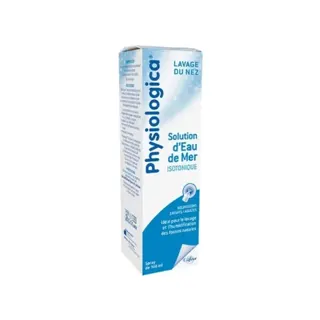 −48 %GifrerIsotonic seawater nasal spray, 100 ml – Gifrer29 DH
instead of 56 DHView product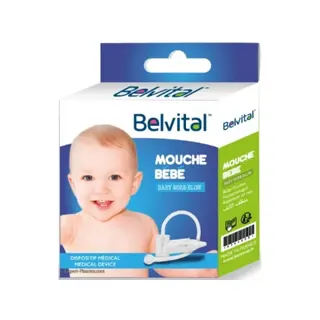 −41 %BelvitalManual baby nasal aspirator, from birth – Belvital41 DH
instead of 70 DHView product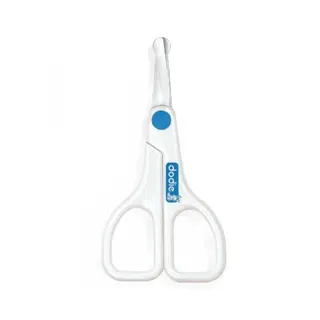 −48 %DodieBaby scissors, from 6 months – Dodie44 DH
instead of 84 DHView product −48 %Laboratoires GilbertGilbert Liniderm oleo-calcareous liniment, 250 ml26 DH
instead of 50 DHView product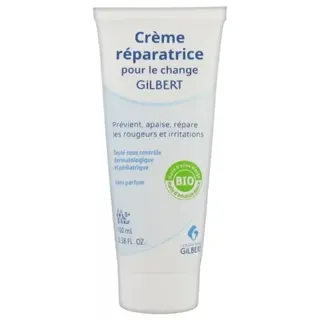 −49 %Laboratoires GilbertRepairing nappy cream, 100 ml – Gilbert35 DH
instead of 68 DHView product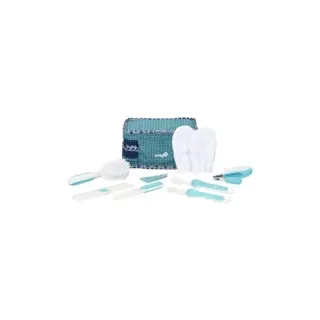 −48 %Safety 1stArctic newborn baby care kit, 8 pieces – Safety 1st156 DH
instead of 300 DHView product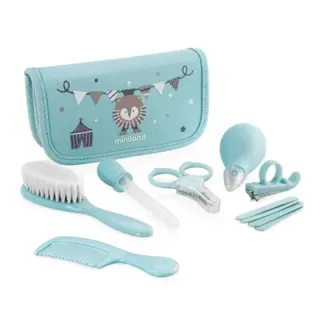 MinilandBaby care kit, 7 accessories, blue – Miniland300 DHView product
 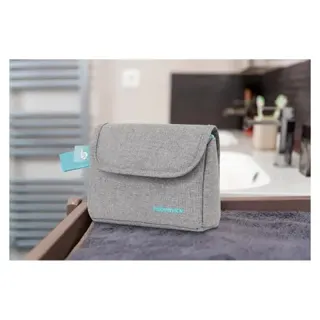 −9 %BabymoovTravel baby care kit – Babymoov346 DH
instead of 380 DHView product- The whole aisle · Baby care kits14 products online, delivered anywhere in Morocco.Open the aisle
Products sold by La Maison du Bébé, publisher of this magazine. Prices as of 12 October 2026; please check the product page.
Frequently asked questions
Which thermometer should go in a baby medicine cabinet?
A digital thermometer. The NHS Healthier Together service recommends taking the temperature under the arm in babies for everyday monitoring, and our article on fever explains when to prefer the rectal method, which is more accurate. Do not confuse it with the bath thermometer that comes with some baby baths: that one measures the water, not your baby’s temperature.
Can I keep an opened bottle of syrup for next time?
Generally not. France’s public health information service Santé.fr points out that syrups, sprays and eye drops only keep for a few weeks after opening: write the opening date on the bottle. France’s medicines agency, the ANSM, asks parents not to keep leftovers from a finished treatment and never to give them to another child without medical advice, even if the symptoms look similar.
Where should I store medicines when it is very hot?
In the coolest room, away from light and damp, up high and in a closed cupboard. Santé.fr recommends a temperature of about 25 °C, and Quebec’s Naître et grandir advises against the bathroom cabinet. Medicines that need to be kept in the fridge say so on their leaflet. In summer, never leave them in the car or in the sun.
Can I give my baby a medicine bought without a prescription?
Only after asking for advice. The ANSM recommends consulting a doctor or pharmacist before giving any medicine to a child, stating their age and symptoms. Naître et grandir points out that the dose is preferably calculated by weight, and that cough and cold syrups must never be given before age 6.
What should I do with expired medicines or leftovers from a treatment?
Do not keep them, and do not throw them down the toilet or the sink. Santé.fr advises sorting through the medicine cabinet regularly: expired products, those whose appearance has changed, bottles open for too long. In France they are taken back to the pharmacy; in Morocco, ask your pharmacist how to dispose of them safely.
Sources
- Une pharmacie bien penséeMieux vivre avec notre enfant, INSPQ · Canada (Québec)
- Les médicaments en vente libreNaître et grandir · Canada (Québec)
- Recommandations générales aux parents et aux prescripteursFrench National Agency for the Safety of Medicines and Health Products (ANSM) · France
- Trier son armoire à pharmacie : pourquoi ? comment ?Santé.fr, French public health information service · France
- Diarrhée et gastro-entérite de l'enfant : que faire et quand consulter ?ameli.fr, Assurance maladie · France
- What to keep in your Medicine CabinetHealthier Together, NHS · United Kingdom
- When to get urgent medical help for babies and children under 5NHS · United Kingdom