





Article contents
Key points
- Watering without a red eye: often an immature tear duct, which usually opens before age 1.
- Red eye, pus, eyelids stuck together: think conjunctivitis, most often viral.
- Saline, one gauze pad per eye, from the inner corner outwards.
- No kohl, and no other child’s eye drops, in your baby’s eyes.
- Newborn with red, sticky eyes: medical advice the same day.
On waking, an eyelid stuck shut by a yellowish crust; during the day, an eye that waters for no reason. Behind these runny little eyes lie two very different situations: a tear duct that is still blocked, which is common and harmless, or baby conjunctivitis (pink eye), an inflammation of the eye that calls for medical advice in the youngest babies.
Here is how to tell them apart, how to clean your baby’s eyes safely, and what should never go into them, kohl included.
Watery eye, sticky eye, red eye: how can you tell the difference?
The first clue is the white of the eye. As long as it stays white, it is most often a problem with tear drainage. When it turns pink or red, think conjunctivitis.
| Blocked tear duct | Conjunctivitis | |
|---|---|---|
| White of the eye | Stays white | Pink or red, eyelid sometimes slightly swollen |
| Tears | Constant watering, in one eye or both | Heavy watering, gritty feeling in older children |
| Discharge | “Dirty”, yellowish eye despite cleaning | Discharge or pus, lashes stuck together on waking, crusts at the corners of the eye |
| Course | Usually clears before age 1 | Often viral, it generally clears in one to two weeks |
| Contagious? | No | Yes, when it is infectious |
These pointers come from mpedia, the French paediatricians’ website, the Canadian Paediatric Society and the UK’s NHS. The two situations can also combine: a blocked duct can become infected, and then you need to see a doctor.

A blocked tear duct in babies
Tears normally drain towards the nose through a small duct at the inner corner of the eye. In many newborns, this duct is not yet fully open: tears overflow, the eye waters constantly and yellowish discharge builds up. Doctors call it tear duct stenosis, or dacryostenosis. According to mpedia, it is very common and usually resolves during the first year.
What you can do:
- clean the eyes with saline as often as needed, using the steps described below;
- gently massage the inner corner of the eye, as mpedia advises: ask your paediatrician to show you how the first time;
- watch for redness, swelling or pus, signs of infection that call for medical advice;
- see a paediatric ophthalmologist if the eye is still watering after the first birthday: they may suggest probing the duct.
Some mothers put a few drops of breast milk in the eye. The gesture is gentle, but no study proves it works, mpedia stresses. Saline remains the standard.
Conjunctivitis: virus, bacterium or irritation?
Conjunctivitis is an inflammation of the conjunctiva, the transparent membrane that covers the white of the eye and the inside of the eyelids. According to the Canadian Paediatric Society, it is most often caused by a virus, sometimes by a bacterium, and frequently comes with a baby’s cold. It can also come from an irritation: allergy, chlorine in the swimming pool, tobacco smoke.
Are antibiotic eye drops needed? Not necessarily. Purulent conjunctivitis, with thick pus, is generally bacterial: antibiotic drops or ointment, prescribed by the doctor, help it heal and limit its spread. Non-purulent conjunctivitis, with a clear discharge, is most often viral, and antibiotics do nothing for it. The two forms are hard to tell apart with the naked eye: it is for the doctor to decide. The NHS points out that conjunctivitis often clears in one to two weeks, even without treatment.
How to clean your baby’s eyes, step by step
- Wash your hands.
- Soak a sterile gauze pad in saline or, failing that, in cooled boiled water.
- Wipe from the inside outwards, from the corner near the nose towards the temple, always in the same direction, using a clean part of the pad for each wipe.
- Use a new pad for the other eye.
- If the lashes are stuck together on waking, first rest a pad soaked in lukewarm water on the eye for a few moments to soften the crusts, without rubbing.
- Pat dry with a clean pad or a disposable tissue, throw everything away, then wash your hands again.
Repeat several times a day, whenever the discharge returns. These steps draw on the advice of France’s Assurance maladie, the Canadian Paediatric Society and the NHS.
From the shop
A pouch to keep care essentials at hand
Saline vials and sterile gauze pads are bought at the pharmacy. These pouches keep them together with the thermometer and small care accessories, so you can find everything in one place, even at 3 a.m.
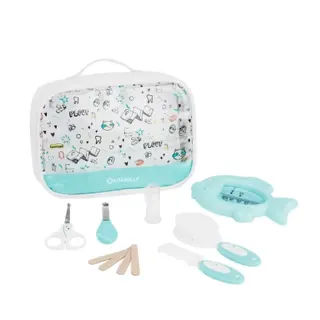 −57 %BadabullePlouf baby care kit – Badabulle138 DH
instead of 320 DHView product −48 %Safety 1stArctic newborn baby care kit, 8 pieces – Safety 1st156 DH
instead of 300 DHView product MinilandBaby care kit, 7 accessories, blue – Miniland300 DHView product
  −9 %BabymoovTravel baby care kit – Babymoov346 DH
instead of 380 DHView product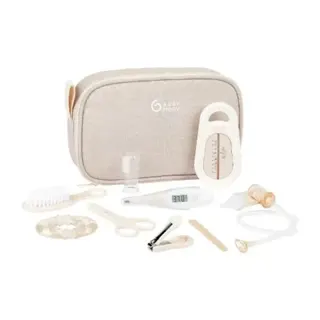 −9 %BabymoovBaby toiletry kit, sand, 9 accessories – Babymoov410 DH
instead of 450 DHView product- The whole aisle · Parapharmacy (outside mega menu)64 products online, delivered anywhere in Morocco.Open the aisle
Products sold by La Maison du Bébé, publisher of this magazine. Prices as of 12 October 2026; please check the product page.
Kohl, old eye drops: what does not go in your baby’s eyes
Kohl, the traditional eyeliner, holds sentimental value in many families, and the habit of putting it on toddlers’ eyes has not disappeared. It is better to give it up. A thesis from the Faculty of Medicine in Fez (2014) points out that galena, a lead sulphide, is the main ingredient of kohl, and cites analyses in which Moroccan kohls contained 75% and 78% lead. In Quebec, public health authorities described lead poisoning in children aged 7 months, 11 months and two and a half years who had been exposed to this cosmetic. And, as UNICEF Morocco points out, no level of lead exposure is safe for a child.
Also avoid:
- eye drops that have already been opened, or that belong to a brother, sister or adult: for a baby, no eye drops without medical advice;
- rubbing the eye, which makes inflammation worse according to the Assurance maladie: keep your baby’s nails short so they do not scratch themselves;
- tobacco or shisha smoke, which the Assurance maladie lists among the irritants to eliminate.
Contagion and nursery: hygiene rules
Infectious conjunctivitis spreads easily: via hands that have touched the discharge, via objects such as tissues and towels, and via droplets when it comes with a cold. The right habits:
- wash your hands, and your child’s, after each eye care session;
- keep a towel and washcloth just for your baby;
- wash pillowcases and washcloths in hot water, and throw tissues away straight away.
For nursery, the rules vary from country to country. The Canadian Paediatric Society allows a return after medical advice for viral conjunctivitis, and 24 hours after starting antibiotics for bacterial conjunctivitis. The NHS does not require children to stay away, unless the child feels very unwell. Check with your nursery, and see our article on common nursery illnesses.
The special case of newborns
In the first weeks, red, sticky eyes are never treated at home without medical advice. The Canadian Paediatric Society explains that newborn conjunctivitis can come from germs passed on by the mother during birth, including those of gonorrhoea and chlamydia. The form caused by gonorrhoea, which is rare, can scar the eye and cause blindness if it is not treated immediately. Hence its advice: any eye discharge before one week of age should be reported to the doctor without delay.
Other countries are just as cautious. The NHS asks for an urgent appointment for any baby under 30 days old with red, sticky eyes, and the Assurance maladie wants conjunctivitis under age 2 to be seen the same day by an ophthalmologist. The eye care given at birth is described in our article on the first days at the maternity ward, and daily washing in our guide to bathing and caring for your newborn.
Frequently asked questions
Can I put breast milk in my baby’s eye?
It is a very widespread practice. The French paediatricians’ website mpedia notes that some mothers use it, but that no study has proven it works. Saline remains the standard for cleaning a watery eye. If the eye becomes red or swollen, or if there is pus, have your baby seen by a doctor rather than trying more remedies.
Is baby conjunctivitis contagious?
Yes, when it is caused by a virus or a bacterium. It spreads via hands that have touched the discharge, via objects such as towels or tissues, and via coughing when it comes with a cold, the Canadian Paediatric Society explains. Watering caused by a blocked tear duct, on the other hand, is not an infection and cannot be passed on.
Are antibiotic eye drops needed to treat conjunctivitis?
Not always. Antibiotics only work on bacterial conjunctivitis, which is often pus-filled; they are useless when the cause is a virus or an irritation. Only the doctor can tell the difference and prescribe the right treatment. Never use another child’s eye drops or a bottle opened for another occasion: for a baby, no eye drops without medical advice.
How long does conjunctivitis last?
Usually one to two weeks, according to the UK’s NHS, which advises seeing a doctor if symptoms have not gone after 7 days. Treated bacterial conjunctivitis stops being contagious sooner: the Canadian Paediatric Society allows a return to childcare after 24 hours of antibiotics. For a baby under 2, seek medical advice from the start.
My baby’s eye has been watering since birth: will it need an operation?
Rarely. A blocked tear duct is very common and usually clears on its own during the first year, mpedia says. In the meantime, clean the eye with saline and gently massage the inner corner, as your paediatrician shows you. If the eye is still watering after the first birthday, a paediatric ophthalmologist may suggest probing the duct.
Sources
- Conjonctivite : que faire et quand consulter ?ameli.fr, Assurance maladie · France
- De retour de maternité : les premiers bobos de bébémpedia.fr, French Association of Ambulatory Paediatrics (AFPA) · France
- La conjonctiviteCaring for Kids, Canadian Paediatric Society · Canada
- La prévention de la conjonctivite chez le nouveau-néCaring for Kids, Canadian Paediatric Society · Canada
- ConjunctivitisNHS · United Kingdom
- Le khôl, un cosmétique responsable d'intoxications au plomb (2006)Environmental health information bulletin (BISE), INSPQ · Canada (Québec)
- Les intoxications par le plomb chez les fabricants artisanaux de khôl dans la région de Fès (medical thesis, 2014)Faculty of Medicine and Pharmacy of Fez, Sidi Mohammed Ben Abdellah University · Morocco
- Les dangers du plomb sur la santé des enfants au MarocUNICEF Morocco · Morocco