




Article contents
Key points
- Before babies can move around, the WHO recommends at least 30 minutes of tummy time a day, spread out.
- Playing on the floor several times a day beats long stretches in a bouncer.
- Talking, reading and singing from birth feeds their language, in your home language.
- Spoons, cups, scarves: everyday objects make excellent baby toys.
- Turning away, jerky movements, crying: signs they need calm.
Your baby is awake, fed and happy, and you are wondering what to do together. Do you need a special mat, "educational" toys, baby music? In reality, the most useful baby activities are very simple: your face, your voice, the floor at home and a few everyday objects.
Here are practical ideas by age group, from birth to 1 year, based on advice from paediatricians and health authorities, along with what to avoid: screens and too much stimulation. For month-by-month developmental milestones, our series starts with your baby at 1 month.
Play starts with you
Before any toy, it is your interactions that stimulate your baby. Naître et grandir, the Quebec parenting resource, reminds parents that these exchanges nourish social development and language, and that expensive or complicated toys are unnecessary: a baby is interested first and foremost in the world around them.
Ordinary moments become baby activities: naming what they are looking at, singing at bath time, keeping them close at mealtimes, chatting your way through a walk to the market or the park. The WHO recommends that infants be active several times a day in different ways, particularly through floor-based play with an adult. It also advises not keeping them restrained for more than an hour at a time, in a pushchair, high chair or back carrier.

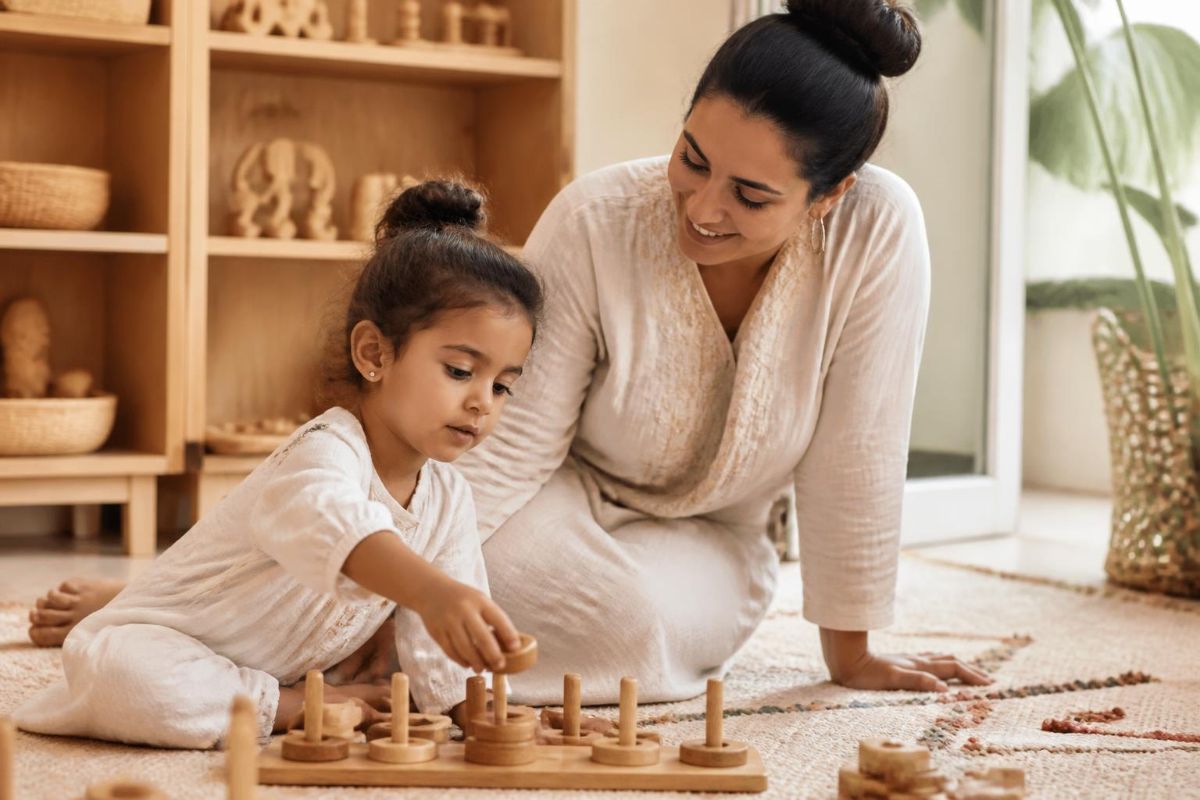
Tummy time, from the very first days
This is the cornerstone of the first months. The American Academy of Pediatrics (AAP) suggests starting as soon as you are home, with 2 to 3 short sessions of 3 to 5 minutes a day, then building up to 15 to 30 minutes a day by around 7 weeks. The WHO then sets a target of at least 30 minutes a day, spread across the day, for a baby who is not yet mobile.
Tummy time always happens while your baby is awake and watched by an adult: France's Haute Autorité de santé (HAS) describes it as a special moment of connection. For sleep, babies stay on their back, as explained in our article on safe sleep. Varying positions also helps prevent flat head syndrome.
0 to 3 months: faces, voices and first sounds
At this age, babies are stimulated mostly by people. The CDC, the US public health agency, suggests for the first months:
- placing your baby on their tummy while awake, with toys at eye level;
- talking, reading and singing to them;
- shaking a rattle on one side of their head to see if they look for the sound;
- responding to their coos with enthusiasm, smiling and talking back.
Before 6 months, Naître et grandir suggests action songs, with facial expressions, touch and imitation. For the milestones at this age, read your baby at 2 months and your baby at 3 months.
3 to 6 months: grasping, rolling, mouthing
Your baby discovers their hands and wants to grab everything. The CDC recommends playing with them every day on the floor or on a play mat, placing them on their tummy or back with toys just out of reach, to encourage them to stretch out an arm and roll. The HAS describes the same set-up: a baby on their back, on a firm mat on the floor, with toys placed around them.
Everything they catch ends up in their mouth: that is how they explore. Offer light rattles, teething rings and a cloth book, and check that nothing around them can be swallowed. The milestones of this period are covered in your baby at 4 months and your baby at 5 months.
6 to 12 months: hiding, emptying, stacking, moving
Sitting up, then crawling, your baby handles things and tries to work them out. The games suggested by the CDC at 6 and 9 months:
| Game | How to play | What they discover |
|---|---|---|
| Peekaboo | Cover your head with a cloth and let them pull it off | Things that disappear still exist |
| The hidden toy | Hide a toy under a blanket while they watch | Looking for what they can no longer see |
| Fill and empty | Tip blocks out of a box and put them back together | In, out, cause and effect |
| The toy just out of reach | Put a toy a little way off on the mat | The urge to crawl and move forward |
| Running commentary | Describe what they are looking at: "a red ball, all round" | The names of things |
Between 6 months and 1 year, Naître et grandir also suggests a little obstacle course with musical toys and mats of different textures to cross or go around. Once they start pulling themselves up, push-along toys take over: our article on first steps covers this stage. Month-by-month milestones are in your baby at 9 months and your baby at 12 months.
Reading, singing and listening to music
Books and songs are part of play from birth. The CDC advises talking, reading and singing to your baby from the first weeks, then, around 6 months, "reading" every day by looking at colourful pictures and talking about them, as well as singing songs and playing music. At this age, reading mostly means talking about the pictures.
The WHO encourages reading and storytelling by an adult during quiet times. Read and sing in your home language, whether that is Darija (Moroccan Arabic), Amazigh, Arabic, French or English. Our ideas for reading stories to your baby and our nursery rhymes and songs for babies will get you started.
Screens, on the other hand, do nothing for development: the WHO recommends no screen time at all before age 1.
Too much stimulation? The signs that say stop
A baby needs stimulation, but also calm. Australia's Raising Children Network describes the signs of overstimulation: your baby becomes irritable or tired, turns their head away, moves in a jerky way, clenches their fists, waves their arms or kicks, then cries if nothing changes.
Naître et grandir lists common causes such as loud noises, electronic toys, fast-moving images and a baby being passed from arm to arm. On celebration days or during big family visits, when everyone wants a cuddle, make sure your baby gets breaks. What helps: talking softly and taking them somewhere calm and dimmer until they settle.
Household items or toys: what do they really need?
Very little. A wooden spoon, stacking cups, a light scarf, a cardboard box with a lid, a small plastic bottle filled with rice with the cap glued on: your cupboards already hold plenty of baby toys. Just check that each object is clean, large enough not to be swallowed, and has no small parts that can come off.
A few well-chosen toys complete these treasures: a baby play mat for the first months, easy-grip rattles, an arch or hanging toys, then stacking toys. To choose by age, our guide to developmental and Montessori toys by age sorts it all out. And to let your baby move freely between games, read our article on free movement for babies.
From the shop
For floor play, grasping and listening
A play mat or activity arch for the first months, easy-grip rattles, a book to chew on: a few well-chosen items are enough, and the rest is already in your cupboards.
 −48 %LudiMagic bath book, from 6 months – Ludi52 DH
instead of 100 DHView product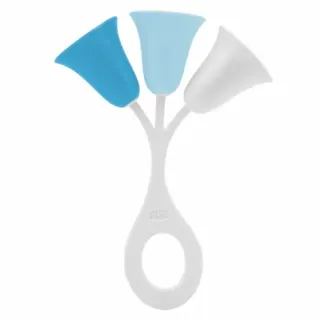 −48 %ChiccoTulip bell rattle, blue – Chicco78 DH
instead of 150 DHView product −46 %Tiny LoveBoho Chic sloth rattle – Tiny Love107 DH
instead of 200 DHView product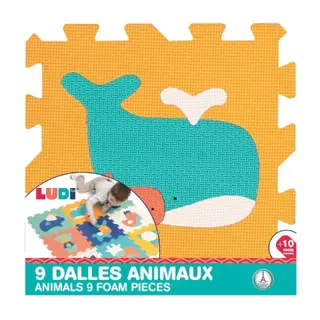 −42 %LudiAnimal tiles play mat, from birth – Ludi143 DH
instead of 245 DHView product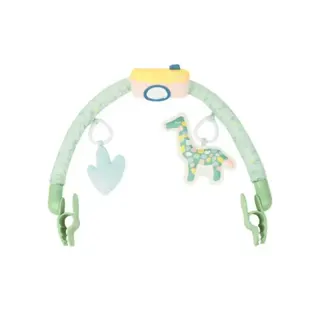 −11 %BadabulleSafari universal activity arch – Badabulle319 DH
instead of 360 DHView product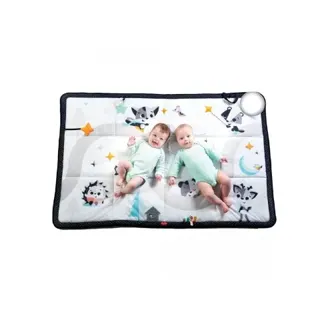 −54 %Tiny LoveBlack & White giant activity mat – Tiny Love365 DH
instead of 790 DHView product- The whole aisle · Activity mats21 products online, delivered anywhere in Morocco.Open the aisle
Products sold by La Maison du Bébé, publisher of this magazine. Prices as of 12 October 2026; please check the product page.
Frequently asked questions
How much time should I spend playing with my baby each day?
There is no ideal amount. The WHO recommends that infants be physically active several times a day in a variety of ways, particularly through interactive floor-based play with an adult, and adds that more is better. For a baby who is not yet mobile, it sets at least 30 minutes of tummy time a day, spread through the day. The rest of the time, everyday moments count too.
My baby cries as soon as I put them on their tummy. What should I do?
Start small. The American Academy of Pediatrics suggests 2 to 3 sessions a day of 3 to 5 minutes, then gradually making them longer. Try it on your chest while you lie on your back: your baby lifts their head to see your face. On the floor, get down in front of them or place a toy just ahead. Right after a nappy change or a nap works well, according to the AAP.
Do I really need a baby play mat?
No. France's Haute Autorité de santé simply describes a baby lying on their back on a firm mat on the floor, with toys around them. A clean, firm play mat does the job. An activity gym adds comfort, an arch and textures that babies enjoy in the first months, but it replaces neither your presence nor tummy time.
Can I show my baby videos to help their development?
No. The WHO recommends no screen time before age 1, and the CDC advises limiting screens to video calls with loved ones. Fast-moving images are also among the things that can overstimulate a baby, according to Naître et grandir. A book you look at together, a song or a walk where you describe what you see stimulate them far more.
Sources
- To grow up healthy, children need to sit less and play moreWorld Health Organization (WHO) · International
- Back to Sleep, Tummy to Play: Give Your Baby a Safe, Strong StartAmerican Academy of Pediatrics (HealthyChildren.org) · United States
- Milestones by 2 MonthsCenters for Disease Control and Prevention (CDC), Learn the Signs. Act Early. · United States
- Milestones by 6 MonthsCenters for Disease Control and Prevention (CDC), Learn the Signs. Act Early. · United States
- Milestones by 9 MonthsCenters for Disease Control and Prevention (CDC), Learn the Signs. Act Early. · United States
- Stimuler bébé par le jeuNaître et grandir · Canada (Quebec)
- Overstimulated baby, toddler or child: signs and what to doRaising Children Network · Australia
- Fiche mémo : Prévention des déformations crâniennes positionnelles et mort inattendue du nourrissonHaute Autorité de santé (HAS) · France