




Article contents
Key points
- You can start reading to your baby from birth, ideally every day.
- More than the number of words, it is the back-and-forth around the book that counts.
- Read, tell stories or sing in the language you are most comfortable in.
- Before age 3, a paper book beats a tablet.
- Asking for the same story every night is normal, and useful.
They are three weeks old, and they fall asleep halfway through page two. Reading to your baby at this age might feel a little odd. Yet it is exactly what Canadian paediatricians recommend: reading, talking and singing with your child every day, from birth.
There is nothing academic about it. The point is not to teach a newborn to read, but to share a moment, a voice, some pictures. Here is why this little ritual matters so much, how to adapt it to each age, and how to bring books in Arabic, Darija or French to life in a Moroccan family.
Why read to a baby who does not understand yet?
Because from the very first weeks, shared reading nourishes your bond and lays the foundations of language. The Canadian Paediatric Society (CPS) made it one of its recommendations in 2021, in a position statement called "Read, Speak, Sing".
It is based on several findings:
- Vocabulary. Programmes that encourage family reading enrich the vocabulary of preschool children, one of the best predictors of later success at school.
- School readiness. The CPS describes a direct link between reading aloud to young children and their readiness for school.
- The parent-child bond. Shared reading is associated with more secure attachment, more cooperative behaviour in children and, in mothers, less stress and fewer depressive symptoms.
- Long-term health. According to the CPS, literacy is a better predictor of lifelong health than occupation or income.
The World Health Organization (WHO) agrees: for children under 5, it encourages reading and storytelling with a caregiver during quiet times, rather than screens.
When should you start reading stories to your baby?
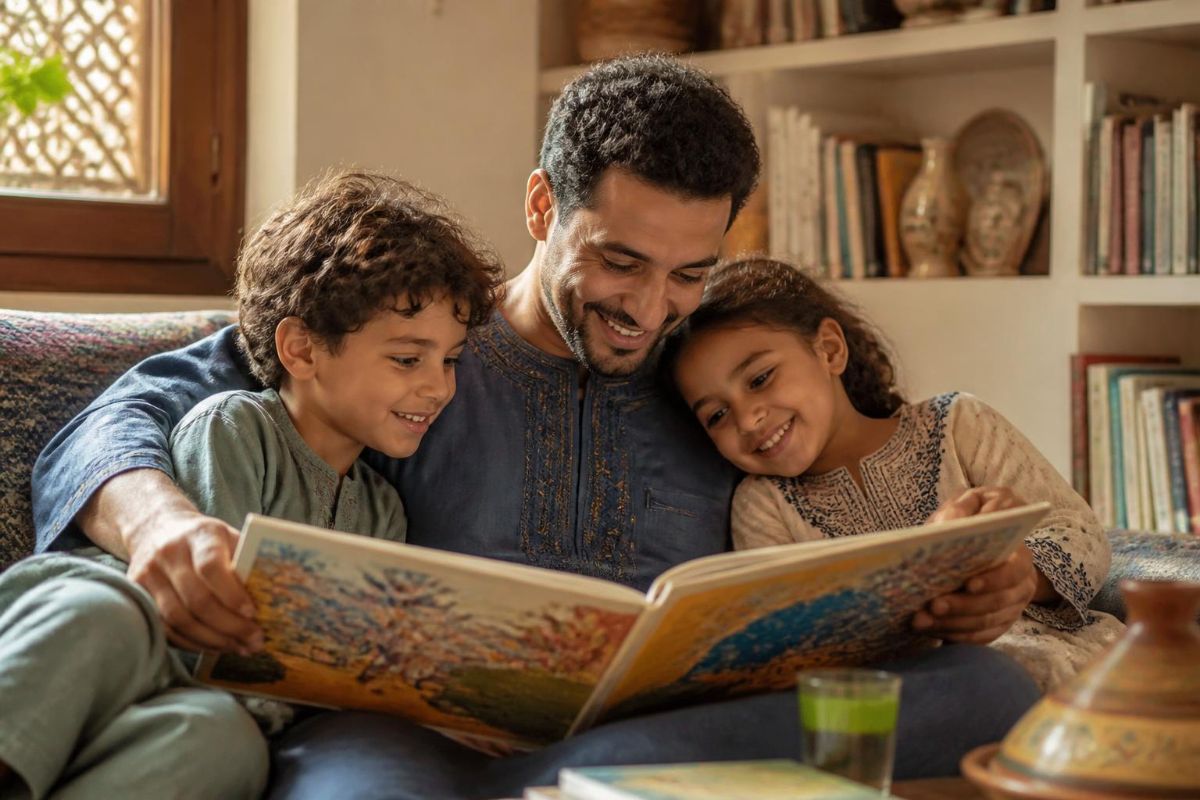
From birth. The CPS invites health professionals to raise it with parents even before the baby arrives, and sees the bedtime story as a natural first step, to begin from the very first days.
At this age, the text is not what matters. Newborns are soothed by your voice and your face close to theirs. In the first months, a page or two is sometimes enough: you follow their attention, not the book.
How to read at each age
The way you read changes as your child grows. Here are the milestones drawn from the CPS statement:
| Age | What your child does | How to read together |
|---|---|---|
| Under 1 | Listens, looks, grabs the book and puts it in their mouth; then, with the pincer grip between thumb and index finger, starts turning pages | Snuggled against you, read in an expressive voice, answer their babbling with smiles and words |
| 1 to 3 | Points, names things, picks their own book, wants to turn the pages | Have a conversation: questions, taking turns, links with their own life ("just like our cat!") |
| 3 to 6 | Asks for the same stories, tells them in turn | Let them guess what happens next, tell the story, make up a different ending |
Between 18 and 24 months, the CPS points out, back-and-forth exchanges matter more for language than the number of words heard. So three pages talked through together are better than a whole book read in one go. To follow their speech development, see our milestones for your baby's language from 0 to 3.
Dialogic reading: the method that gets them talking
The CPS describes a way of reading called "dialogic reading". All it takes is a little attention:
- Point at the pictures and name what you see.
- Ask simple questions: "Where's the dog?", "What's he eating?"
- Let them finish a sentence they know by heart, or say what comes next.
- Invite them to copy: roar like the lion, hide like the rabbit.
- Repeat the same books and the same phrases, looking them in the eye.
Your child is not an audience but your reading partner. And if they get up in the middle of the story, that is not a failure: they will come back.
The bedtime story, a calming ritual
The bedtime story is often the easiest way in, the CPS notes. It becomes part of a routine: bath, pyjamas, story, song, sleep. The CPS also suggests replacing some screen time with story time.
A few pointers to make it work:
- Same time, same place, as far as possible, including at the grandparents'.
- One or two books announced in advance, to avoid endless negotiation.
- Soft lighting and a voice that slows down as the story goes on.
- No screens just before: our guide to screens and young children explains why.
The rest of the bedtime routine, from the last feed to the night light, is covered in our article on getting your baby to sleep.
Arabic, Darija, French, Amazigh: which language to read in?
The one you are most comfortable in. The CPS encourages families to tell stories, talk and sing in their home language. It explains that a solid grounding in a first language supports learning a second one, and that frequent family reading helps vocabulary even when the home language is not the language of school.
In practice, several approaches sit happily side by side:
- Read in Modern Standard Arabic from a book written in Arabic, commenting on the pictures in Darija (Moroccan Arabic).
- Tell a story in Darija or Amazigh from a book written in French, using the pictures.
- Alternate books depending on which parent is reading: one evening in French with dad, one evening in Arabic with mum.
The CPS also points out that singing and storytelling count as much as books, especially in cultures with a strong oral tradition. Grandma's tales, the hkayat (stories) passed down by word of mouth, are therefore reading in their own right. To go further, see our article on children growing up with several languages, and our ideas for lullabies and nursery rhymes to share.
Which books to choose for a little one
Books that can stand being loved. Before age 1, books get chewed and thrown: thick board, fabric and bath books are made for exactly that. Next come picture books, lift-the-flap books and short, repetitive stories, then storybooks.
The CPS prefers printed books to e-books for young children. In front of a screen, the conversation is more about the device than the story, and the statement concludes that the simpler the technology, the better for brain development. Song books, meanwhile, help vocabulary and sound awareness in preschool children.
Finally, the CPS recommends visiting the library, which lets you vary books without breaking the bank. For little ones, our shop offers picture books in its early learning department, and bath books among its bath toys.
From the shop
First books and picture books for little hands
Before age 1, books get touched and chewed: bath books and picture books stand up to it better. For storybooks, the library and the bookshop take over.
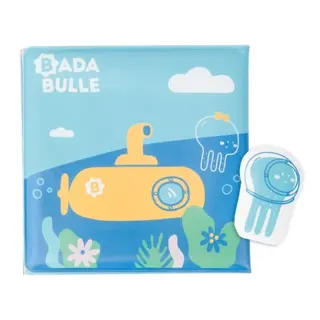 −60 %BadabulleBath book and puppet – Badabulle36 DH
instead of 90 DHView product −48 %LudiMagic bath book, from 6 months – Ludi52 DH
instead of 100 DHView product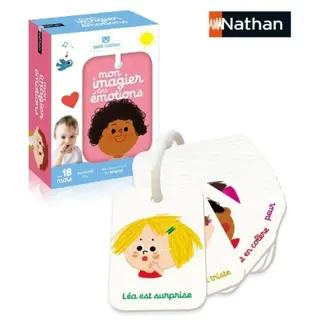 −48 %NathanTake-anywhere emotions picture book – Nathan75 DH
instead of 145 DHView product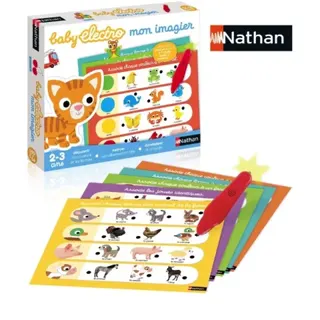 −48 %NathanElectro My Picture Book game – Nathan127 DH
instead of 245 DHView product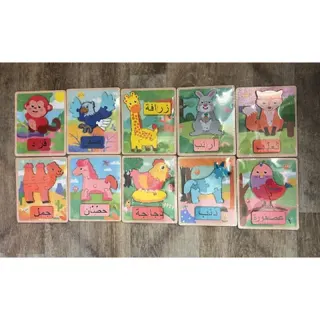 −19 %China Divers BrandWooden animal puzzle in Arabic21 DH
instead of 26 DHView product- The whole aisle · Early learning25 products online, delivered anywhere in Morocco.Open the aisle
Products sold by La Maison du Bébé, publisher of this magazine. Prices as of 12 October 2026; please check the product page.
Giving a book at birth: an idea from elsewhere
Several countries have made books a welcome gift. In the United Kingdom, the Bookstart programme, presented by the charity BookTrust as the world's first national book-gifting programme, gives a bag of books to every baby in England and Wales before their first birthday, usually through the health visitor who supports the family. A 2009 study cited by BookTrust shows the effect is strongest in families that rarely shared books.
In France, the "Premières pages" (First Pages) scheme, launched by the Ministry of Culture and run by libraries, encourages families to read with children from 0 to 3, with a stated goal of reducing inequalities in access to books.
In Morocco, nothing stops you from starting the tradition in your own family. A first book is a lovely gift for the sbou3 (the naming celebration on the seventh day) or a birth, and it easily finds its place on a baby registry. For more ideas, see our guide to baby gifts.
Frequently asked questions
How long should you read to a baby each day?
No minimum time has been set. The Canadian Paediatric Society stresses regularity, every day if possible, and the quality of the exchange rather than the number of words heard. With a newborn, a few pages are sometimes enough. Follow their attention: when they turn away, squirm or cry, close the book without insisting, and try again later or the next day.
My baby chews books instead of looking at them: is that normal?
Yes. Canadian paediatricians describe it as a normal stage: before turning pages, babies explore books with their mouth and hands. Give them sturdy books, in thick board, fabric or plastic for the bath, and keep fragile storybooks for when you are holding the book. Turning pages will come with the pincer grip between thumb and index finger.
Do you have to read the text exactly as written?
Not necessarily. Dialogic reading, recommended by the Canadian Paediatric Society, is precisely about pausing, pointing at pictures, asking questions and letting the child finish sentences. You can also tell the story in your own language, in Darija for example, using the pictures from a book written in French or Arabic. Telling a story counts as much as reading one.
Are stories on a tablet as good as a paper book?
Not for little ones. According to the Canadian Paediatric Society, printed books support learning and bonding better than e-books: in front of a screen, the conversation is more about the device than the story. E-books can help language if they are read together, but they do not replace paper. At this age, the simpler the technology, the better.
Sources
- Read, Speak, Sing: Promoting early literacy in the health care setting (27 January 2021)Canadian Paediatric Society · Canada
- For lifelong health, read, speak and sing to your baby from birth: PaediatriciansCanadian Paediatric Society (press release) · Canada
- To grow up healthy, children need to sit less and play more (24 April 2019)World Health Organization (WHO) · International
- About BookstartBookTrust · United Kingdom
- Dispositif Premières pages par commune (updated 27 August 2025)French Ministry of Culture, on data.gouv.fr · France
- Screen use and young children (updated March 2025)Caring for Kids, Canadian Paediatric Society · Canada