




Article contents
Key points
- Bilingualism causes no speech delay or language disorder; a real disorder shows up in every language.
- A bilingual child's vocabulary: add up the words from all their languages.
- Mixing Darija and French in one sentence is normal; by age 3, children choose according to who they are talking to.
- Speak to your child in the language you are most comfortable in.
- Do not give up your home language when your child starts school.
At home, you speak Darija (Moroccan Arabic). Grandma sings lullabies in Tachelhit, the nursery runs in French, and school will teach Modern Standard Arabic. Many Moroccan parents then ask the same question: is this too much for a toddler? Will a bilingual child, or a trilingual one, start talking later, or mix everything up?
The research is reassuring. American paediatricians and the speech-language specialists of ASHA put it plainly: learning several languages does not cause language disorders. Here is what studies say, how to organise languages at home, and when to genuinely worry.
Growing up with several languages: a Moroccan reality
In Morocco, multilingualism is not the exception. According to the 2024 census presented by the High Commission for Planning (HCP), 91.9% of Moroccans use Darija, 24.8% speak Amazigh in one of its forms and 0.8% speak Hassaniya. Amazigh is spoken by a third of rural residents (33.3%) and one in five city dwellers (19.9%).
These figures are debated: AMREC, an Amazigh association, believes the questionnaire underestimates the number of speakers, especially in cities. Either way, they paint a picture of a multilingual country, where Amazigh is recognised as an official language in the Constitution. On the birth certificate, the first name is written in Arabic, in Tifinagh (the Amazigh alphabet) and in Latin letters, as explained in our article on baby names and the law in Morocco.
Morocco is far from unique. According to experts quoted by a researcher at the ENS de Lyon, nearly half the world's population is bilingual, and multilingualism is more widespread than monolingualism. The Montreal Children's Hospital sums it up: no study has shown that a young child's brain is built for just one language.
Does bilingualism delay speech?
No. Children learning two languages at once go through the same stages, at the same pace as other children, the Montreal Children's Hospital points out. The American Academy of Pediatrics (AAP) and ASHA give the same milestones for everyone: first words around 12 months, first two-word combinations around 24 months.
The nuance concerns vocabulary. A bilingual child sometimes knows fewer words in each of their languages than a monolingual child, but their total vocabulary, across all languages, is comparable. A researcher quoted by RTBF notes that they may take a little longer to fully master a given language, and that the gap closes quickly.
So to track their progress, count all their words: khobz (bread) counts just as much as "bread". The main stages from 0 to 3 years are covered in our article on your baby's first words.
Is mixing Darija and French a sign of confusion?
No, it is a skill. Slipping a French word into a Darija sentence, or the other way round, is normal for bilingual children just as it is for adults. The Montreal Children's Hospital explains that this mixing follows grammatical rules, and often fills a gap when a word is missing in the language being spoken.
Toddlers tell their languages apart very early. According to the AAP, by age 3 most know which language to use with which person. There is no need to correct every mix: you can simply repeat the sentence in your language, as you would in any ordinary conversation.
Which language should you speak to your baby?
The one you are most comfortable in. That is the core advice of the AAP and ASHA. Spontaneous, funny, tender Darija is worth more than careful but limited French or English: songs, wordplay and stories come naturally in the language you master.
There is no single right way to be multilingual, American paediatricians remind us. Several set-ups can work:
| Family situation | One possible approach |
|---|---|
| Parents speak two different languages | "One parent, one language": each parent sticks to their own |
| Darija at home, French at nursery | The family language at home, the second one provided by nursery or school |
| An Amazigh-speaking grandmother | She speaks Tamazight, Tachelhit or Tarifit to the child, without forcing herself to translate |
| Family living abroad | Darija or Amazigh at home, the local language outside |
The "one parent, one language" strategy may help a baby distinguish the two systems earlier, according to the RTBF article. It is not compulsory. The Montreal Children's Hospital notes that a child can also pick up a second language through nursery or the neighbourhood. What matters, for the AAP, is regular exposure.
Darija, Standard Arabic, Amazigh: a place for each language
The Moroccan situation has one particular feature: the language of home is not always the language of writing. Darija is spoken, Standard Arabic (fusha) is read and written, and many children also learn French. This diversity is not an obstacle. It simply means making room for each language in the child's life.
A few practical ideas:
- Books and nursery rhymes let children hear Standard Arabic long before school, without any lessons.
- Grandparents can be precious keepers of Amazigh: let them take on that role.
- Picture books and games can be named in every language. An animal puzzle becomes a vocabulary game in Darija, Arabic, French or English. Our shop offers a selection of early learning toys that work well for this.
From the shop
Picture books and games to name in all your languages
An animal puzzle, a picture book or a bilingual play mat can be named in Darija, Amazigh, Arabic, French or English: you choose the words.
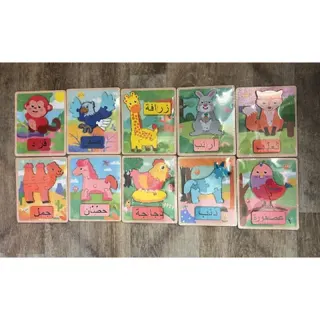 −19 %China Divers BrandWooden animal puzzle in Arabic21 DH
instead of 26 DHView product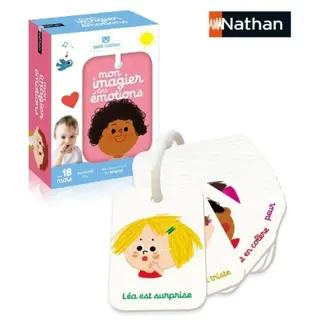 −48 %NathanTake-anywhere emotions picture book – Nathan75 DH
instead of 145 DHView product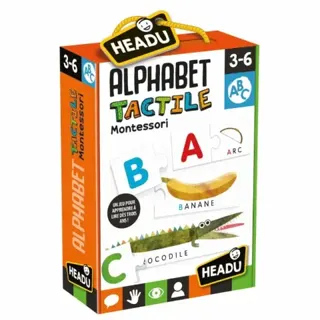 −48 %HeaduTactile Alphabet Montessori game – Headu65 DH
instead of 125 DHView product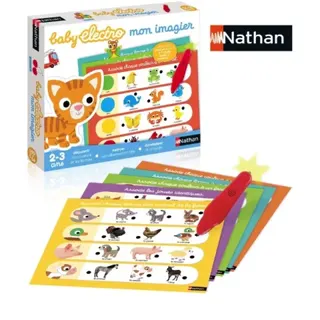 −48 %NathanElectro My Picture Book game – Nathan127 DH
instead of 245 DHView product −48 %ChiccoBilingual French-English interactive farm play mat – Chicco205 DH
instead of 395 DHView product- The whole aisle · Early learning25 products online, delivered anywhere in Morocco.Open the aisle
Products sold by La Maison du Bébé, publisher of this magazine. Prices as of 12 October 2026; please check the product page.
Nursery and school: when the classroom language changes
This is when many families hesitate. Should you switch to French at home to "help" your child? The AAP and ASHA say no. Keeping the family language does not slow down learning the school language. Multilingualism is even linked to academic and social advantages: problem-solving, focus, self-control.
Children who already have a solid language often make quick progress in a new one at school, the same sources note. When choosing a school, ask how the team welcomes a child who does not yet speak the classroom language. Our guides to choosing a preschool in Morocco and finding the right nursery list other questions to ask.
When should you worry about a bilingual child's speech?
When difficulties show up in all their languages. The AAP and ASHA are clear: learning several languages does not cause language disorders. A real disorder appears in each of the child's languages. Bilingualism should therefore never be used as a reason to wait and see.
Even when there is a difficulty, there is no need to drop a language. The same sources say that children with a language or developmental disorder can also learn several languages, with plenty of exposure and practice.
Frequently asked questions
How do you count a bilingual child's words?
By adding up the words from all their languages. American paediatricians and the speech-language specialists of ASHA give a simple example: 25 words in one language and 25 in the other make 50 words. A bilingual child sometimes knows fewer words in each language than a monolingual child, but their total vocabulary is comparable. Count words in Darija or Amazigh too, even if they are not the language of school.
Should we stop speaking Darija or Amazigh when our child starts a French-speaking school?
No. According to the American Academy of Pediatrics and ASHA, keeping the home language does not slow down learning the school language and does not cause confusion. Multilingualism is even linked to advantages at school, such as problem-solving. Keep talking, singing and reading in your language at home, and let school bring its own.
My 2-year-old understands everything but always answers in French. What should I do?
This is common: children often use one language more than the others, and that can change over time, American paediatricians point out. Keep speaking your language without forcing them to answer in it. Create plenty of moments where it is useful and alive: a call with grandma, a song, a story, a game. Regular exposure matters more than perfection.
Is it too late to teach my child a language after age 3?
No. Young children pick up languages easily in the early years, but older children and adults can learn new ones too, the AAP and ASHA note. Children who already have one well-established language often make quick progress at school. What matters most, at any age, is regular practice.
Sources
- Young Children Learning Multiple Languages: Parent FAQs (updated 20 November 2025)American Academy of Pediatrics and American Speech-Language-Hearing Association (HealthyChildren.org) · United States
- Bilingualism / MultilingualismMontreal Children's Hospital, McGill University Health Centre · Canada
- Comment les bébés peuvent apprendre deux langues en même temps ? (20 March 2024)RTBF (article by Cameron Morin, ENS de Lyon) · Belgium
- Benmoussa : 25% des Marocains parlent l'amazigh, 57,7% savent lire et écrire le français (17 December 2024)Hespress FR · Morocco
- Les défis démographiques et socioéconomiques du Maroc révélés par le recensement 2024 (17 December 2024)Le Matin · Morocco
- RGPH 2024 : l'AMREC met en doute les chiffres sur la langue amazighe (21 December 2024)Hespress FR · Morocco