




Article contents
Key points
- Law 36-21 (Official Bulletin of 22 July 2021) repealed law 37-99.
- Article 34 drops the "Moroccan character" requirement of the old law.
- No more than two names, with no title such as Moulay, Sidi or Lalla, and no number.
- If in doubt, the registrar records the name and refers it to the High Commission for Civil Status.
- Abroad, consuls act as civil registrars.
At the maternity ward, you are handed the birth notice. From then on the clock is ticking: in practice you have 30 days to register the birth with the civil registry, and therefore to settle on a baby name. In Morocco, that choice is not entirely free. The law sets limits, and it has changed: if you read online that a first name must have a "Moroccan character", you have landed on the old law 37-99, which has since been repealed.
Here are the rules currently in force, checked on 12 October 2026 against the text of law 36-21 and the Moroccan press coverage of its implementing decree. You will also find what happens if the civil registrar hesitates, the situation of families living abroad, and a simple method for choosing together.
Which law governs the choice of a first name today?
Law no. 36-21 on civil status, enacted by dahir (royal decree) no. 1-21-81 of 14 July 2021 and published in Official Bulletin no. 7006 of 22 July 2021. Its article 58 repeals law 37-99, which had governed civil status since 2002.
Its implementing decree, decree no. 2-22-04, was adopted on 1 June 2023 and published in the Official Bulletin of 6 July 2023. Among other things, it sets out what a civil registrar must do when a first name raises questions. The law also sets up a national digital civil status register, hosted on a Ministry of the Interior platform.
What does article 34 of law 36-21 say about first names?
Article 34 does not give a list of approved names: it sets conditions. The name chosen by the person registering the birth must not:
- offend public decency or public order;
- be a family name;
- lend itself to mockery;
- be the name of a town, village or tribe;
- combine more than two names.
It also sets three rules of form: the first name is written before the family name, it cannot be accompanied by any title such as Moulay, Sidi or Lalla, and it cannot be followed by a figure or number.
In practice, Fatima-Zahra or any compound of two names is fine; a triple name is not. "Lalla" or "Moulay" can remain a family habit, but they do not appear on the certificate.
The "Moroccan character": what has changed since law 37-99
The old law 37-99 required, in its article 21, that a first name have a "Moroccan character". For years this wording was used to refuse names, Amazigh names in particular. Article 34 of law 36-21 does not repeat it.
| Date | Text or decision | What it changed for first names |
|---|---|---|
| 1996 | List of "authorised names" issued under Interior Minister Driss Basri | Almost all Amazigh names are excluded. |
| 2002 | Law 37-99, article 21 | A name must have a "Moroccan character"; the 1996 list is withdrawn the following year. |
| April 2010 | Ministry of the Interior circular (N.D 3220) | Registrars are asked to accept Amazigh names. |
| 25 April 2013 | Ministry of the Interior circular 32-20 | A fresh reminder, after repeated refusals of Amazigh names. |
| 17 March 2014 | Statement by the High Commission for Civil Status | Freedom to choose a name, without distinction between Arabic, Amazigh, Hassani and Hebrew names. |
| July 2021 | Law 36-21, articles 19 and 34 | No more "Moroccan character"; names are also written in Tifinagh and Latin letters. |
| July 2023 | Decree no. 2-22-04 | A registrar can no longer refuse a name alone: they refer it to the High Commission. |
Refusals did not vanish overnight. As late as 2014, parents were refused the Amazigh name Anir, and a Moroccan consulate in Belgium refused to register a baby girl called Yuna. That is what gives the procedure set in 2023 its full weight. For name ideas and their history, see our article on Amazigh baby names.
What happens if the civil registrar refuses the name?
Since the 2023 decree, they can no longer refuse alone. If they think a name does not comply with the law, they must accept the registration provisionally and refer the question to the High Commission for Civil Status. The commission issues a reasoned decision, sent to the registrar through the digital civil status system; the registrar then informs the person who registered the birth.
Under article 35 of the law, the High Commission is chaired by the government authority in charge of the Interior. Its members include the Historiographer of the Kingdom and a judge appointed by the Supreme Council of the Judiciary. It has three tasks: checking that chosen names comply with the law, examining requests to change foreign first names held by Moroccan citizens, and settling disputes over names referred to it by registrars.
If you disagree with its decision, the law provides for an appeal before the administrative court in Rabat.
Spelling, Tifinagh, Latin letters: what the certificate shows
Article 19 of law 36-21 states that civil status records are drawn up in Arabic, with names also shown in Tifinagh and in Latin letters. The Tifinagh used in Morocco is the alphabet standardised by the Royal Institute of Amazigh Culture (IRCAM), known as Neo-Tifinagh. Article 47 allows the registrar to add or correct these transcriptions, with the authorisation of the central authority.
For you, the takeaway is simple: decide on the Latin spelling of the name in advance. The same Arabic name can be written in several ways, Rachid or Rashid, Douaa or Doua. Pick the one that reads most easily in the languages your child will speak, then use it everywhere.
Families living abroad: registering at the consulate
Law 36-21 applies to all Moroccans, whether they live in Morocco or abroad. Civil registry offices operate in diplomatic missions and consulates (article 4), where consuls and diplomatic agents act as civil registrars (article 7). Registrations made abroad are added to the national civil status register. Article 19 even allows a birth to be registered at any civil registry office, in Morocco or abroad, through the information system.
Name refusals were long reported especially in embassies and consulates. Since consuls are civil registrars, the 2023 rule should in principle apply to them too. A few precautions help avoid unpleasant surprises:
- check that the name complies with article 34 before registering it in your country of residence, so that both certificates show the same name;
- use the same Latin spelling on the foreign certificate and the Moroccan one;
- ask your consulate about the deadline and the documents required, which may differ from those that apply in Morocco.
Choosing the name together: a five-step method
Choosing a name is often a couple's first big negotiation, with the wider family in the background. A simple method keeps the discussion from dragging on.
- One list each. Separately, write down ten names you like, without censoring yourselves, then compare. Names that appear on both lists are your starting point.
- A veto, no explanation needed. Each of you can rule out a name you dislike, for a personal reason or a bad memory. A veto is not up for debate, but it should not be used to block the whole list.
- The out-loud test. Say each name with the family name, in Darija (Moroccan Arabic), in Arabic and in French or English. Write it in Latin letters. Picture it at age 3 and at age 40.
- The check. Verify the meaning and the Arabic spelling in at least two reliable references, and reread the conditions of article 34.
- Decide before the big day. Arrive at the maternity ward with a name, or two finalists at most, and its Latin spelling. If you plan to announce it to the family at the sbou3, the naming celebration held on the seventh day, remember that registering the birth has its own deadline.
As for the family, one rule often helps: listen to every suggestion, then decide as a couple. There are plenty of ideas in our selections of Arabic girl names and Arabic boy names. For the paperwork and a step-by-step guide, see our article on registering a birth in Morocco.
From the shop
Keepsakes to go with the name
Name chosen and registered, it is time for keepsakes: imprint boxes and frames, from a simple model to a double frame with a photo.
 −9 %Tiny LoveTiny Creations Magic Box baby print kit, square metal box – Tiny Love146 DH
instead of 160 DHView product −9 %Tiny LoveTiny Creations Simple Frame baby print frame, white – Tiny Love209 DH
instead of 230 DHView product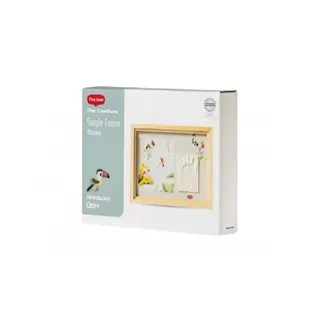 −9 %Tiny LoveTiny Creations Simple Frame baby print frame, wood – Tiny Love209 DH
instead of 230 DHView product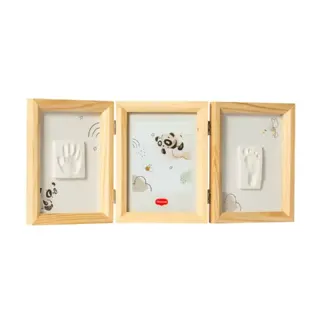 −9 %Tiny LoveTiny Creations wooden double photo and print frame – Tiny Love291 DH
instead of 320 DHView product- The whole aisle · Baby keepsakes6 products online, delivered anywhere in Morocco.Open the aisle
Products sold by La Maison du Bébé, publisher of this magazine. Prices as of 12 October 2026; please check the product page.
Frequently asked questions
Can I give my child a foreign name in Morocco?
Article 34 of law 36-21 no longer requires a name to have a "Moroccan character", unlike article 21 of the old law 37-99. A name of foreign origin is therefore not ruled out in principle. It must meet the same conditions as any other: no family name, town or tribe, nothing mocking, no more than two names. If in doubt, the High Commission for Civil Status decides.
How long do I have to register the birth and the name?
In practice you have 30 days after the birth, as the UNHCR notes in its page on birth registration in Morocco, updated in January 2026. Law 36-21 leaves the exact deadline to an implementing regulation. After that, registration requires authorisation from the administration and, if it is refused, you have to go to court.
Can Moulay, Sidi or Lalla be registered with the first name?
No. Article 34 of law 36-21 forbids adding a title such as Moulay, Sidi or Lalla to a first name, or following it with a figure or number. On the birth certificate, your child will be registered under the first name alone, at most a compound of two names, followed by the family name.
Can I change my child's name after registering it?
Law 36-21 gives the High Commission for Civil Status responsibility for requests to change foreign first names held by Moroccan citizens. Since the implementing decree, the request is filed on the national registry website or at a civil registry office, then sent, with a note on the reasons, to the commission, which decides. For any other situation, ask your civil registry office.
Can an Amazigh name still be refused?
It should not be. As early as March 2014, the High Commission for Civil Status restated the freedom to choose a first name, without distinction between Arabic, Amazigh, Hassani or Hebrew names. Law 36-21 even provides for names to be written in Tifinagh on certificates. And since 2023, a hesitant registrar can no longer refuse alone: they record the name and refer the case to the High Commission.
Sources
- Dahir n° 1-21-81 du 14 juillet 2021 portant promulgation de la loi n° 36-21 relative à l'état civil (BO n° 7006 du 22 juillet 2021), articles 4, 7, 19, 21, 34, 35 et 58Adala legal portal, Ministry of Justice · Morocco
- État civil : les officiers n'ont désormais plus le droit de refuser l'inscription de prénomsTelQuel (14 July 2023) · Morocco
- Ce qui change avec la digitalisation de l'état civil (décret n° 2.22.04)Le Matin (14 July 2023) · Morocco
- Ouverture aux prénoms internationaux et digitalisation au cœur de la réforme de l'état civilTelQuel (29 June 2021) · Morocco
- Trois vérités toujours bonnes à rappeler sur les prénoms autorisésTelQuel (24 March 2014) · Morocco
- Choisir un prénom pour son enfant constitue toujours un problèmeLa Vie éco (8 May 2014) · Morocco
- Enregistrement de la naissance (updated 20 January 2026)UNHCR, United Nations High Commissioner for Refugees, Morocco · International
- Language policy and planning of Amazigh languages in Morocco: a study of the language ideology of IRCAM (PhD thesis, 2026)Leiden University · Netherlands