




Article contents
Key points
- Lists of approved first names circulated in 1996 contained very few Amazigh names.
- Circulars in 2010 and 2013 and a 2014 statement kept reminding registrars before the 2021 law.
- Since 2023, a registrar in doubt must register the name and refer it to the High Commission for Civil Status.
- IRCAM published a small book of nearly 440 Amazigh first names.
- Every name in our selection has a meaning confirmed by two sources.
Tiziri, Amayas, Itri: perhaps you are looking for one of the many Amazigh baby names because it speaks of your roots, of nature or of North African history. As recently as 2014, that choice could still run into a refusal at the civil registry office, and sometimes at a Moroccan consulate abroad.
The rules have changed since then, and this page explains how. It also offers a particular kind of name list: we only kept names whose meaning matches in at least two reliable sources. So the list is short. It will grow as we verify more names.
What is an Amazigh name?
It is a first name that comes from the Amazigh languages, also known as Berber languages, spoken in Morocco (Tachelhit, Tamazight, Tarifit), in Algeria (Kabyle in particular) and beyond. Many are everyday words that became names: moonlight, star, flower, freedom. Others come from history, like the Numidian kings of antiquity.
The same name can be written in several ways in Latin letters, depending on transcription habits: Tiziri or Thiziri, Tanina or Thanina. None of them is wrong. What matters is choosing one spelling and sticking to it.
Why were Amazigh names refused in Morocco?
Because of lists. In 1996, under Interior Minister Driss Basri, lists of approved first names were sent out to civil registrars. They contained very few Amazigh names, as the Moroccan magazine La Vie éco recalls. That is where the refusals began.
Law 37-99 on civil status later put an end to those lists. In practice, though, some registrars kept refusing Amazigh names for years. Three cases particularly caught public attention: Numidia in Al Hoceima, Anir in Casablanca and Massin in Tata. In spring 2014, the Moroccan consulate in Antwerp, Belgium, was still refusing to register a little girl named Yuna.
The old law also required a name of "Moroccan character", a phrase that Law 36-21 did not keep. The detail of the texts, past and present, is in our article on what Moroccan law says about first names.
Circulars, a statement, a new law: how things changed
Step by step, and slowly. The Ministry of the Interior first sent out reminder after reminder: a circular in April 2010, then another one, circular 32-20, on 25 April 2013, asking registrars to stop refusing Amazigh names.
On 17 March 2014, the High Commission for Civil Status issued a clear statement: every citizen is free to choose their child's name, with no distinction between Arabic, Amazigh, Hassani and Hebrew names, as long as it does not offend public morals or public order. It asked registrars to show the greatest flexibility. Yet a few weeks later, La Vie éco noted that refusals had not entirely stopped.
Two texts changed the game:
- Law 36-21 on civil status, published in July 2021. Its Article 34 sets the conditions for a first name without bringing back the "Moroccan character" requirement. Its Article 19 provides that names appear on records in Arabic, in Tifinagh and in Latin letters.
- Implementing decree no. 2-22-04, published in July 2023. According to the Moroccan news magazine TelQuel, a registrar who has doubts must accept the declaration provisionally and pass the question on to the High Commission, which decides. He can no longer refuse a name on his own initiative.
IRCAM's work on first names
The Royal Institute of Amazigh Culture (IRCAM) played a double role. First, it stood up for families: according to researcher Ahmed Assid, a member of IRCAM, the institute took on the first case, that of the three refused names. An inter-ministerial commission then visited the three towns concerned. IRCAM's rector, Ahmed Boukous, was also a member of the High Commission at the time of the 2014 statement.
IRCAM then gave parents a practical tool. It published a small book of nearly 440 Amazigh first names, co-written by Brahim Lasri Amazigh and Karim Aguenaou. That is the book to look for if you want more ideas than our selection.
Amazigh girl names: our verified selection
For each name, the meaning given matches in at least two of our sources. We only show the Tifinagh spelling when a reliable source provides it.
| Name | Tifinagh | Meaning | Notes |
|---|---|---|---|
| Tiziri | ⵜⵉⵣⵉⵔⵉ | Moonlight | Variant: Thiziri. Masculine form: Ziri. Tifinagh spelling given by Behind the Name |
| Titrit | Star | Feminine form of Itri; the word also means asterisk, the "little star" of writing | |
| Tilelli | Freedom | It is also the ordinary noun for "freedom". Variant: Tilleli | |
| Tanina | Legendary bird | A bird of great beauty, compared to an eagle or a phoenix. Variant: Thanina | |
| Tajddigt | Flower | Our sources also give the forms Ajeddig and Tajeǧǧigt (Kabyle variant) | |
| Dihya | Meaning unknown | Name of the Amazigh queen known by the nickname Kahina, who fought the Arab armies |
Amazigh boy names: our verified selection
| Name | Tifinagh | Meaning | Notes |
|---|---|---|---|
| Itri | Star | Feminine form: Titrit | |
| Amayas | Cheetah | ||
| Amastan | Protector, defender | ||
| Ameqran | Great, the eldest | The word is also used to refer to the eldest child | |
| Massinissa | "Their lord" | Numidian king, founder of the unified kingdom of Numidia; his name appears in Libyco-Berber script (MSNSN) on his tomb at Cirta, today's Constantine | |
| Yugurten (Jugurtha) | "He surpassed them" | Numidian king, grandson of Massinissa, who fought Rome from 111 to 105 BCE |
For Massinissa and Yugurten, the meaning comes from the etymology of very old names, established by specialists and repeated by both of our sources. They are first and foremost names from history.
Why is this list so short?
Because we chose caution. The meaning of the same Amazigh name sometimes varies from one list to another, and many lists online cite no source at all. So we cross-checked an etymology database (Behind the Name), a list compiled from reference works such as those by Dallet, Taïfi and IRCAM, a lexicon published by Algeria's High Commission for Amazighity and, for the Numidian kings, historical entries.
Other well-known names are not included yet, because we have not found a second matching source so far: Idir, Izem, Tifawt, Anir, Ziri, Ayur, Illi or Izlan, for example. Their absence does not mean the meaning usually given to them is wrong, only that we have not checked it twice yet. This selection will grow as we keep verifying. For more ideas, see our rare and unusual baby names.
Tifinagh and Latin letters: getting the spelling right
On the birth certificate, your child's name will appear three times: in Arabic, in Tifinagh and in Latin letters, as Article 19 of Law 36-21 provides. A few precautions will save you years of hassle:
- Settle on the Latin spelling before the birth and use it everywhere: birth certificate, passport, nursery enrolment.
- Check all three spellings on the certificate before leaving the civil registry office.
- Make sure the name is not a place or tribe name. Article 34 of Law 36-21 rules out the names of towns, villages or tribes, a rule worth keeping in mind for names taken from geography.
- If you live abroad, use the same spelling on the birth record of your country of residence and on the Moroccan record drawn up by the consulate.
The documents you need and the deadlines are set out in our guide to registering a birth in Morocco. And if you would like your child to hear the language of their name too, our ideas for Amazigh lullabies and Moroccan nursery rhymes are a good place to start.
From the shop
Keepsakes to go with their name
Once the name is chosen and registered, a hand or footprint keeps a trace of those first days: a metal keepsake box, a simple frame or a double frame with a photo.
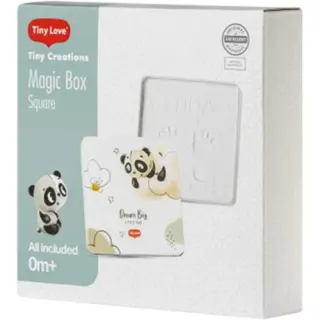 −9 %Tiny LoveTiny Creations Magic Box baby print kit, square metal box – Tiny Love146 DH
instead of 160 DHView product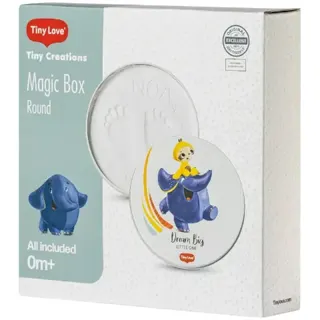 −9 %Tiny LoveTiny Creations Magic Box baby print kit, round metal box – Tiny Love146 DH
instead of 160 DHView product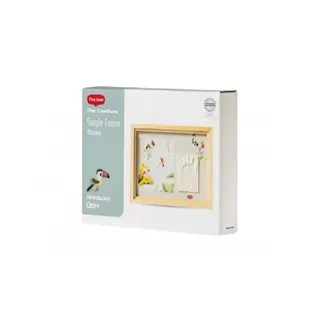 −9 %Tiny LoveTiny Creations Simple Frame baby print frame, wood – Tiny Love209 DH
instead of 230 DHView product −9 %Tiny LoveTiny Creations Double Frame baby print frame, white – Tiny Love291 DH
instead of 320 DHView product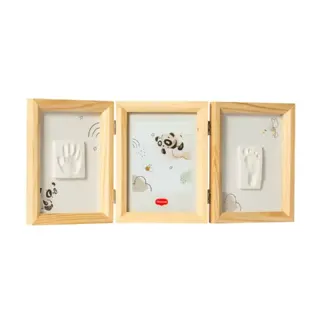 −9 %Tiny LoveTiny Creations wooden double photo and print frame – Tiny Love291 DH
instead of 320 DHView product- The whole aisle · Baby keepsakes6 products online, delivered anywhere in Morocco.Open the aisle
Products sold by La Maison du Bébé, publisher of this magazine. Prices as of 12 October 2026; please check the product page.
Frequently asked questions
Where can I find a reliable list of Amazigh names?
The Royal Institute of Amazigh Culture (IRCAM) published a small book of nearly 440 Amazigh first names, co-written by Brahim Lasri Amazigh and Karim Aguenaou, to help parents. There is, however, no longer any official list of approved names in Morocco: Law 36-21 sets conditions, not a list. Be wary of unsourced lists online, where the meaning of the same name changes from one website to the next.
Will my child's name be written in Tifinagh on the birth certificate?
Yes. Under Article 19 of Law 36-21 on civil status, records are drawn up in Arabic, and names also appear in Tifinagh and in Latin letters. Check all three spellings before you leave the civil registry office: a mistake is far easier to fix on the day than years later, when you apply for a passport or enrol your child at school.
Tiziri or Thiziri, Tanina or Thanina: which spelling should I choose?
Both forms exist: the Behind the Name database lists Thiziri and Thanina as variants of Tiziri and Tanina. Pick the Latin spelling you find easiest to read both in Morocco and abroad, then keep it on every one of your child's documents, from the birth certificate to the passport.
Do I need to speak Tamazight to give my child an Amazigh name?
No. Law 36-21 does not link the first name to the parents' language: it only requires the name to meet the conditions of its Article 34, such as not being a family name, the name of a town, village or tribe, and not exposing the child to ridicule. Simply take the time to check its meaning and pronunciation with people who speak the language.
Sources
- Choisir un prénom pour son enfant constitue toujours un problème (8 mai 2014)La Vie éco · Morocco
- État civil : les officiers n'ont désormais plus le droit de refuser l'inscription de prénoms (14 juillet 2023)TelQuel · Morocco
- Dahir n° 1-21-81 du 14 juillet 2021 portant promulgation de la loi n° 36-21 relative à l'état civil (BO n° 7006 du 22 juillet 2021), articles 19 et 34Adala legal portal, Moroccan Ministry of Justice · Morocco
- Berber NamesBehind the Name, etymology database of first names · International
- Liste de prénoms berbères (compilée notamment d'après Dallet, Taïfi et Lasri et Aguenaou)French-language Wikipedia · International
- Lexique de didactique et des sciences du langage, français-amazigh / amazigh-français (Mohand Mahrazi, 2013)Haut Commissariat à l'Amazighité (High Commission for Amazighity) · Algeria
- Massinissa (étymologie d'après l'Encyclopédie berbère)French-language Wikipedia · International
- Jugurtha (étymologie d'après M. A. Haddadou, 2004)French-language Wikipedia · International