




Article contents
Key points
- Before 2: no screens, except video calls with family.
- From 2 to 5: one hour a day at most, ideally watched with an adult.
- No screens at meals, in the bedroom, or in the hour before bedtime.
- TV off when nobody is watching: background noise counts too.
- Your own phone matters: children copy you and compete for your attention.
At the restaurant, the next table is quiet: the 2-year-old is eating, eyes glued to a phone propped against the water jug. At home, the TV runs from morning till night, and a cartoon has become the only way to get the soup down. Screen time has crept into every corner of children’s lives, and many parents wonder where to draw the line.
Guidelines do exist. They come from the World Health Organization (WHO), the Canadian Paediatric Society and, since 2025, the French authorities. They do not say quite the same thing, and that is instructive in itself. Here is what they recommend, why, and how to do things differently without turning every evening into a battle.
How much screen time by age?
None before 2 for the WHO and Canadian paediatricians, none before 3 in France. After that, one hour a day at most. The table sums up the three sources:
| Age | WHO (2019) | Canadian Paediatric Society (2025) | France, child health record (2025) |
|---|---|---|---|
| Under 1 | No screens | No screens, except video calls | No screens |
| 1 year | No screens | No screens, except video calls | No screens |
| 2 years | 1 hour a day at most, less is better | About 1 hour a day at most | No screens |
| 3 to 4 years | 1 hour a day at most, less is better | About 1 hour a day at most | Occasional use, educational content, with an adult |
| 5 to 6 years | Outside the scope of these guidelines | 1 hour a day at most up to age 5 | Occasional use, educational content, with an adult |
The WHO refers to time spent sitting in front of a screen. Canadian paediatricians target “routine” or sedentary use. And the WHO adds: less is better.

Why do the recommendations differ?
Because the evidence consists mostly of associations, not certainties. In April 2025, five French medical societies, including the French Society of Paediatrics, called for screens to be banned before age 6, citing language delays and attention problems observed by health professionals and teachers. The same news report notes that researchers do not agree on how harmful screens are.
This call does not change the official guidelines, but it sets a direction: as little screen time as possible up to age 6. The signatories, their arguments and the four screen-free times (morning, meals, bedtime, bedroom) are covered in our feature on the “no screens before 6” recommendation.
France has opted for caution. The child health record (carnet de santé) in use since 1 January 2025 states “no screens before age three”, then occasional use, limited to quality educational content and accompanied by an adult. Since 3 July 2025, a ministerial order of 27 June 2025 has also banned exposing children under 3 to screens in nurseries and with registered childminders. This rule does not apply in family homes.
For you, the common ground is enough: nothing or almost nothing before 2, little after that, and never in place of sleep, play and conversation.
What screens take away from toddlers
The real problem lies in what the screen replaces. A toddler learns to talk by listening to adults who respond to them, by playing and by moving. Canadian paediatricians point out that before age 2, children do not learn from screens, and that time spent in front of them is taken from the interactions that build language.
The Canadian Paediatric Society links excessive use with:
- poorer language skills and school readiness;
- shorter, more disrupted sleep;
- inattention, aggression and more difficulty calming down alone;
- a higher risk of excess weight and short-sightedness.
Handing over the phone to stop a meltdown works in the moment. But your child needs to learn other ways to calm down, with your help. Our guide to toddler tantrums offers ideas for getting through those moments.
Background TV, phones at the table: everyday traps
The most useful rules are about times and places rather than minutes. The Canadian Paediatric Society advises:
- turning screens off during meals, reading and family activities;
- stopping all screens at least an hour before bedtime, to protect falling asleep;
- keeping screens out of the child’s bedroom;
- turning the TV off when nobody is watching, including as background noise.
If in your home the TV stays on all day without anyone really watching, it fills the sound space where conversations and songs would usually find their way in.
In France, data from the Elfe cohort study also show that young children’s average screen time exceeds the recommendations and rises between age 2 and 5½. So you are not alone in finding it hard.
Your phone counts too
Children copy what they see. The Canadian Paediatric Society encourages parents to limit their own use, on every device, and to watch out for “technoference”: those moments when a phone interrupts a meal, a game or a conversation. A child whose parent is absorbed in a screen may act up more and more to win back their attention.
Nobody is asking you to live without a phone. A few simple rules already change the atmosphere: the phone left away from the table during dinner, no scrolling during bath time or the bedtime story, messages read once your child is asleep.
Video calls, cartoons, tablets: what to keep?
Video calls with family are an exception, even before age 2, according to Canadian paediatricians. For a grandfather in Agadir or an aunt living in Belgium, it is a real conversation: your child sees a familiar face, hears a voice that answers back and can respond.
Cartoons and apps, from age 2, are best chosen carefully and shared. Canadian paediatricians advise you to:
- watch with your child and talk about what you see;
- choose age-appropriate programmes with a clear learning goal;
- try an app yourself before handing it over;
- limit advertising and commercial content.
E-books can support language if they are read together, but they do not replace paper books, the same source notes. For the joy of reading together, see our article on reading stories to your baby.
What to offer instead? Practical ideas
The WHO sets the direction: between ages 1 and 4, at least three hours of physical activity a day, in all its forms, and during quiet times, reading and storytelling with an adult. Before age 1, floor play and tummy time, several times a day.
In practice:
- Under 1: a mat on the floor, your funny faces, nursery rhymes, things to grab. You will find ideas in our play and development activities from 0 to 12 months.
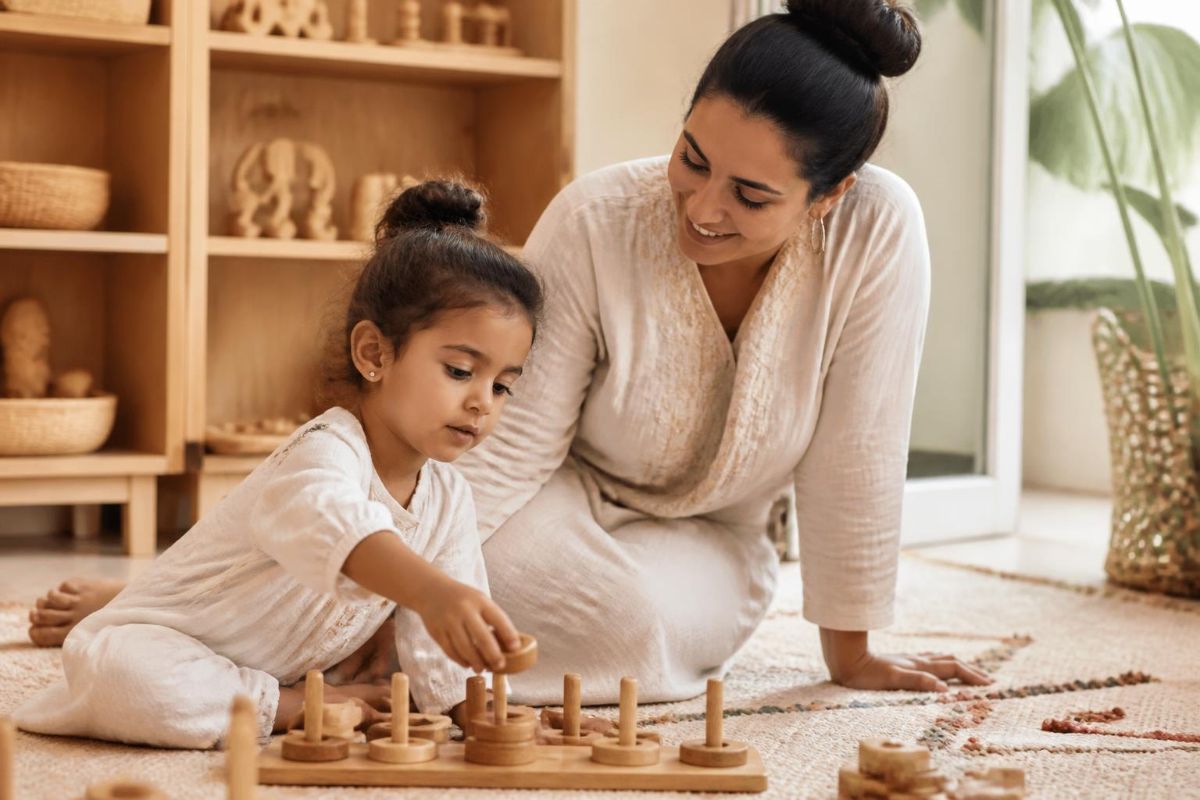
- From 1 to 3: pouring water from one container to another, stacking, fitting shapes, drawing, “helping” in the kitchen, singing. Our nursery rhymes and songs for toddlers make good rituals.
- From 3 to 6: building sets, puzzles, colouring, simple board games, and outdoors whenever possible, at the park or the beach. See our outdoor play ideas.
The shop offers early learning games and creative activities for these moments. None of them is worth as much as an available adult, but a box of crayons or a puzzle brought out at the right time can help switch the TV off.
From the shop
Hands-on games, no screen needed
No toy replaces an available adult, but these simple games, chosen according to the recommended age, help build other habits: drawing, fitting, stacking, climbing.
 −41 %NathanColoréo magic water colouring, On the farm – Nathan59 DH
instead of 100 DHView product −48 %HapeWho’s in the House wooden peg puzzle – Hape65 DH
instead of 125 DHView product −48 %HapeRainbow stacking game, 12 months-3 years – Hape101 DH
instead of 195 DHView product −48 %MinilandPegs 20 mm mosaic game – Miniland104 DH
instead of 200 DHView product −42 %LudiPlay course – Ludi348 DH
instead of 595 DHView product- The whole aisle · Early learning25 products online, delivered anywhere in Morocco.Open the aisle
Products sold by La Maison du Bébé, publisher of this magazine. Prices as of 12 October 2026; please check the product page.
Grandma, nanny, nursery: getting everyone on the same page
Rules only hold if they are shared. At the grandparents’, with the nanny or at nursery, a screen is sometimes used to keep a child busy while the adult does something else. Rather than a blanket ban, agree on a few simple points: no screens at mealtimes, none before naps, and programmes chosen in advance.
When you visit a nursery, ask whether a TV or tablet is used, and under what conditions. Our tips for choosing a nursery list the other questions to ask. And if the conversation with family gets stuck, the principles of positive parenting help set a limit without conflict.
Frequently asked questions
Are educational cartoons OK before age 2?
Canadian paediatricians do not recommend them: before 2, a child learns very little from a screen, even one billed as educational. They learn from people who talk to them and respond. The WHO also recommends no screen time before 2. If your 2-year-old watches a programme, choose one suited to their age, watch it with them and talk about what you see.
Do video calls with family count as screen time?
Canadian paediatricians make an exception for them, even before age 2: talking on video with adults who love them, such as grandparents or an aunt living abroad, is still a real exchange. Your child sees a face, hears a voice that answers back, and can respond. Hold them on your lap and join in the conversation.
My child will only eat in front of a cartoon: how do I stop?
Canadian paediatricians advise turning screens off during meals. Take it step by step: tell your child the day before, sit them at the table with you, and make the meal a time to chat, naming the foods and talking about the day. Keep to the same approach at every meal, with the whole family. Our article on mealtimes for 1 to 3-year-olds helps keep expectations realistic.
Is having the TV on in the background a problem?
Yes, if it stays on all day. The Canadian Paediatric Society recommends turning screens off when nobody is watching, especially background TV. It points out that screens take time away from the exchanges that build language. A quieter home leaves more room for conversation, songs and play.
Sources
- To grow up healthy, children need to sit less and play more (24 April 2019)World Health Organization (WHO) · International
- Screen use and young children (updated March 2025)Caring for Kids, Canadian Paediatric Society · Canada
- Catherine Vautrin ne veut plus que les enfants de moins de trois ans soient exposés aux écrans (17 June 2025)VIDAL (AFP dispatch) · France
- Enfants : des experts demandent à proscrire les écrans, très néfastes, avant six ans (29 April 2025)VIDAL (AFP dispatch) · France
- Enfants et écrans : promises depuis plus d'un an, les mesures restent limitées (9 September 2025)VIDAL (AFP dispatch) · France
- Les écrans interdits dans les lieux d'accueil pour jeunes enfants (2 July 2025)info.gouv.fr, French Government · France
- Exposition aux écrans des jeunes enfants : en France, les temps moyens excèdent les recommandations (12 April 2023)Le Quotidien du Médecin · France