




Article contents
Key points
- The fun of making matters more than the result: no model to copy.
- From around 2½, children can handle round-tipped plastic scissors.
- Under 3: no small parts, and no toys marked “not suitable for children under 36 months”.
- Homemade play dough takes five minutes with flour, salt, water and oil.
- A craft corner stored at child height makes the activity more independent.
A rainy afternoon in Casablanca, or a Sunday when the chergui (the hot desert wind) is blowing and nobody wants to go out. A sheet of paper, three crayons, an old milk carton, and your child is busy for half an hour. Crafts for kids are nothing complicated: what matters is offering something your child can manage, then letting them do it their own way.
Here are ideas sorted by age, using what you already have at home, a safe play dough recipe, the safety rules to know and a simple way to tidy up.
What do crafts do for young children?
Crafting works far more than the fingers. Naître et grandir, Quebec’s go-to website on child development, sums up the benefits: painting, cutting, gluing and modelling refine fine motor skills, the control of small movements that will later help your child hold a pencil. Children describe what they are doing and name their creations, which feeds their language. They touch different textures, choose a colour, express themselves.
They also learn patience and perseverance. Finishing a collage, even a lopsided one, makes them proud, and that pride feeds their self-confidence. Finally, crafting is a school of trial and error: the glue does not hold, so you try another way.

Which crafts at which age?
The ages below are guidelines drawn from Naître et grandir and the UK’s NHS. A child who crafts often progresses faster, and one who would rather run around is not behind.
| Age | What they can do | Ideas using things at home |
|---|---|---|
| Around 18 months - 2 years | Scribble with the whole hand | Chunky crayons, finger painting, a sock puppet, tearing paper |
| 2 - 3 years | Hold a crayon, squish, stick | Play dough, collage with torn paper, printing with a sponge or a bottle cap |
| Around 2½ - 3 years | First cutting movements | Round-tipped plastic scissors, snipping a fringe into a strip of paper |
| 3 - 4 years | Three-finger pencil grip | Building with boxes and yoghurt pots, paper-plate masks |
| 4 - 6 years | Better brush control, cutting along a line | Cardboard models, brush painting, small objects to stick, Eid cards |
No need to buy drawing pads: the NHS suggests the inside of cereal boxes or old envelopes opened out. Boxes, bottle caps, fabric scraps, string or shells picked up at the beach also make great treasures to stick.
Homemade play dough: recipe and precautions
It takes five minutes, with kitchen ingredients. The recipe published by Naître et grandir:
- Put 300 g of flour, 100 g of salt, 250 ml of water and 80 ml of oil into a bowl.
- Add a little food colouring.
- Mix with a spoon, then by hand, until you have a soft ball.
Make it together: pouring, measuring and kneading are already part of the fun. Then hand over a rolling pin, cookie cutters and a plastic knife. Classic salt dough works on the same principle, with a firmer dough that hardens as it dries. It lets you keep a handprint or model little decorations to paint.
Two precautions. This dough is very salty: you play with it, you do not eat it, and you put it away out of reach after the session. And if your toddler swallows a large amount, call the Poison Control Centre (0801 000 180, free number in Morocco).
Paint, glue, scissors: how to choose safe supplies
The basic rule applies to all supplies: they must be non-toxic, because little ones still put things in their mouths, and an adult stays close by to prevent choking. A few practical pointers:
- Under 3, keep away anything that fits in the mouth: beads, buttons, pompoms, thick stickers, felt-tip pen caps. The NHS advises against giving a child under 3 a toy marked “not suitable for children under 36 months”.
- Scissors: round-tipped plastic ones to start, then small scissors with short metal blades once your child cuts well, Naître et grandir recommends. Spring-loaded or patterned scissors are not necessary.
- Paint: washable poster paints or children’s finger paint. One of dad’s old T-shirts makes a perfect apron.
- Button batteries in light-up or musical toys are dangerous if swallowed: check that the compartment is screwed shut.
In Morocco, an order published in the Official Bulletin in 2015 requires toy manufacturers and importers to meet safety requirements and display clear warnings on the product. Read them, especially the minimum age. To go further in choosing games, our guide to educational toys by age reviews the main families of toys.
From the shop
Creative play without the mess
A few games that take homemade activities further: water colouring that does not stain, mosaics for precise hand movements and a bath book to colour.
 −41 %NathanColoréo magic water colouring, On the farm – Nathan59 DH
instead of 100 DHView product −41 %LudiAquacolor draw-and-wipe bath game – Ludi97 DH
instead of 165 DHView product −48 %LudiColouring bath book, from 18 months – Ludi62 DH
instead of 120 DHView product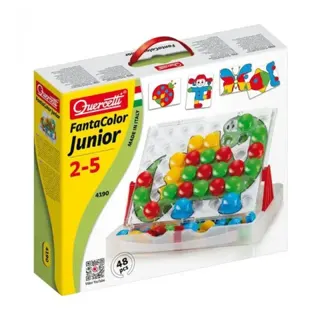 −42 %QuercettiFantaColor Junior mosaic activity toy – Quercetti149 DH
instead of 255 DHView product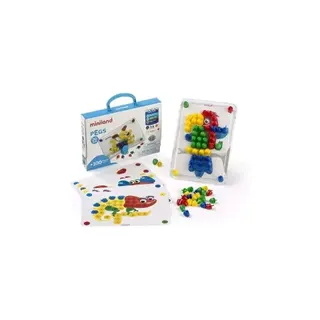 −48 %MinilandPegs 20 mm mosaic game – Miniland104 DH
instead of 200 DHView product- The whole aisle · Creative play38 products online, delivered anywhere in Morocco.Open the aisle
Products sold by La Maison du Bébé, publisher of this magazine. Prices as of 12 October 2026; please check the product page.
How to stop the activity ending in tears
A successful activity is one that fits your child. Too easy, they get bored; too hard, they give up. A few habits help:
- Short and prepared: get the supplies out before calling them. At 2, ten minutes is already good.
- Limited choice: two colours rather than twelve, one activity at a time.
- No model to copy: a purple cat with five legs is a perfectly good cat.
- Accept the mess: a plastic tablecloth on the floor, or painting just before bath time.
- Change the surface: on the floor, on cardboard taped to the wall, on the balcony when the weather is mild.
If your child loses interest quickly, it is not a failure. Offer something else, a more active indoor game for example, and come back to crafts another day.
Tidying up: a craft corner at their height
Tidying up is part of the activity. A tub or a low shelf, with only a few things on show, lets your child choose and tidy up alone. It is the idea behind the Montessori approach at home: accessible materials, in limited quantities, everything in its place.
In practice:
- One pot for crayons, another for brushes, a box for play dough.
- A folder or a washing line to display the week’s masterpieces.
- A sort-out every month: photograph the creations, keep the most treasured ones and recycle the rest.
Scissors, liquid glue and paint stay stored up high before age 3, and only come out with an adult.
Crafts and screens: a good replacement
Many parents hand over a phone for lack of ideas. A “surprise” box prepared in advance, with paper, age-appropriate stickers and a few cardboard tubes, is a great alternative to a screen in the paediatrician’s waiting room or at grandma’s. For screen time guidelines by age, see our article on screens and young children. And to see where your child is with hand skills and language, our portrait of the 3-year-old offers useful pointers.
Frequently asked questions
What craft activity can I do with a 2-year-old?
At 2, focus on big movements: scribbling with chunky crayons, painting with fingers or a sponge, squishing play dough, tearing paper and sticking it onto cardboard. Sessions are short, often ten minutes. Stay right beside your child, because everything still goes in the mouth, and choose non-toxic materials with no small parts.
At what age can a child use scissors?
Around 2½, many children can handle round-tipped plastic scissors, which cut neither skin nor hair. Around 3, they manage complete cutting movements, then learn to follow a line between 3 and 6. When plastic is no longer enough, move on to small scissors with metal blades and rounded tips.
How do I store homemade play dough?
Keep it in an airtight container or a well-sealed bag, in the fridge if your kitchen is warm. It will keep for several days that way. Throw it away if it smells bad, goes mouldy or turns sticky. Because it contains a lot of salt, remind your child that it is not for eating and store it out of reach.
My child never wants to do crafts. Is that a problem?
No. Some children prefer moving, building or pretend play, and that is just as rich. Offer without insisting, with very short activities linked to what they love: sticking pictures of trucks, painting a box for their cars. Sitting beside them and doing the same thing yourself often makes them want to join in.
Sources
- Les bienfaits du bricolageNaître et grandir · Canada (Québec)
- Apprendre à utiliser crayons, pinceaux et ciseauxNaître et grandir · Canada (Québec)
- Ma propre pâte à modelerNaître et grandir · Canada (Québec)
- Baby and toddler play ideasNHS · United Kingdom
- Le Maroc instaure un contrôle plus strict sur la sécurité des jouets (27 October 2015)Médias24 · Morocco