








Article contents
Key points
- Before age 1: less than 1 g of salt a day, already supplied by the foods themselves.
- Honey is off the menu before age 1, even cooked, even on a dummy.
- Fruit juice: unnecessary before age 1; after that, well diluted and only at mealtimes.
- No sugar water, neither for hiccups nor to soothe.
- Party sweets are not banned after age 1: keep them for mealtimes, and occasional.
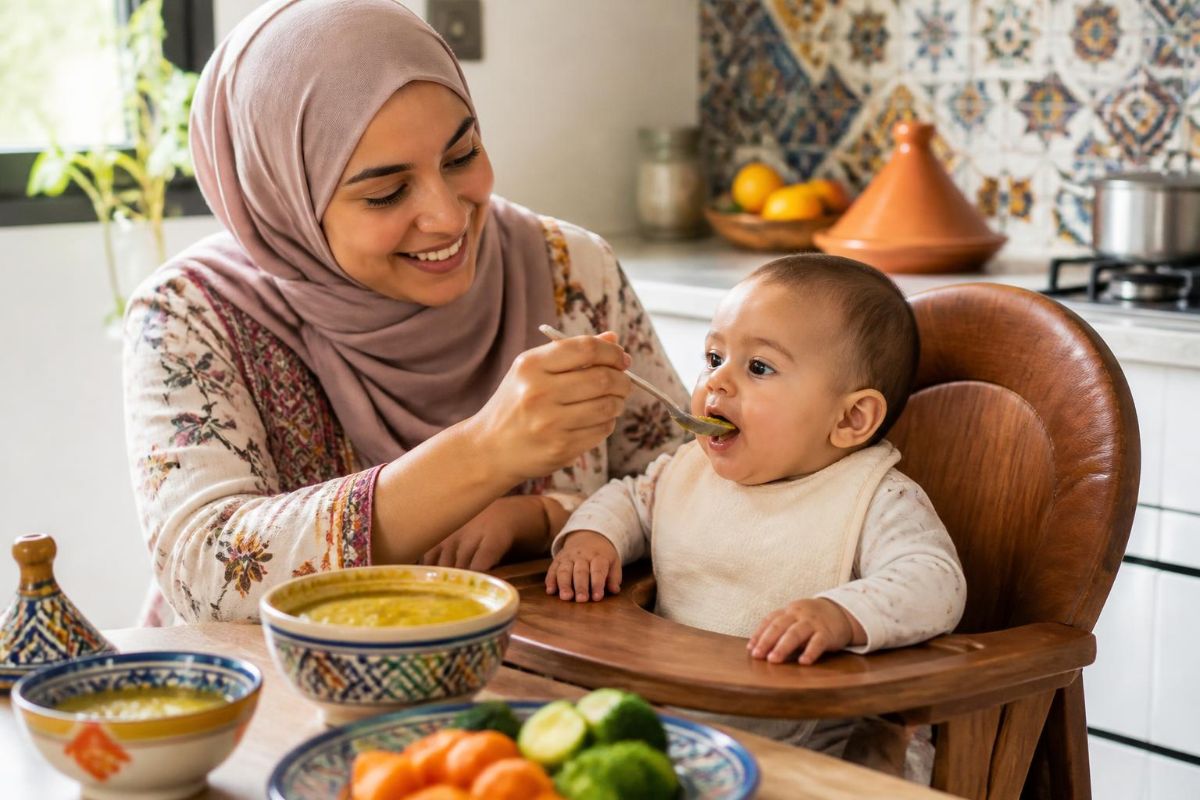
“That purée is bland, add a pinch of salt.” The remark often comes with the best of intentions, from a grandmother or an aunt. Yet salt has no place on a baby’s plate before age 1, any more than sugar or honey. This is not a fashion: it is the position of the WHO, of British and Canadian health authorities and of French paediatricians.
What seems bland to an adult is not bland to a baby discovering the taste of courgette. Here are the guidelines by age, the reasons behind each rule, and how to deal with hidden sugars, juices and festive sweets.
Why no salt before age 1?
Because a baby’s kidneys are not yet mature enough to get rid of excess salt, the NHS explains. Before age 1, he should have no more than 1 g a day, and that amount is already supplied naturally by milk and food. The WHO puts it simply: no salt or sugar is added to complementary foods.
In practice, that means:
- no salt in the purée, nor in the cooking water for vegetables or pasta;
- no stock cubes, often very salty, the NHS reminds us;
- no salty condiments: olives, preserved lemon, soy sauce, very salty cheeses;
- no cured meats, apart from skinless cooked ham according to French paediatricians.
French paediatricians allow a single exception: salting very lightly the vegetables of a baby who stubbornly refuses bland ones. Before it comes to that, count on mild spices and herbs, which they encourage. Our article on Moroccan cooking adapted for babies shows how to set his portion aside before seasoning.
After age 1: how much salt a day?
After age 1, salt is no longer forbidden, but it is still capped. Here are the maximum daily amounts set by the NHS, all foods combined:
| Age | Salt per day, maximum |
|---|---|
| Under 1 year | Less than 1 g |
| 1 to 3 years | 2 g |
| 4 to 6 years | 3 g |
| 7 to 10 years | 5 g |
| 11 years and over | 6 g |
For an adult, the WHO recommends less than 5 g a day. In Morocco, according to Ministry of Health estimates reported by Allo Docteurs, half the population eats nearly 12 g, notably through bread. A child who eats “like the grown-ups” therefore quickly exceeds his ceiling. The best strategy is a family one: salt the pot less, and let everyone adjust on their own plate.
Sugar: what the WHO and paediatricians say
Before age 1, no added sugar, and the NHS asks you to avoid sugary foods and drinks up to age 4, including the “natural” sugars of honey, syrups, fruit juice and smoothies. Whole fruit, by contrast, remains welcome.
For 6 to 23 months, the WHO asks that foods high in sugar, salt or trans fats be avoided, as well as sugary drinks. French paediatricians keep to a share of free sugars below 5% of the day’s intake for children, and advise using fruit to sweeten dairy.
The issue is not only weight. Sugar damages teeth, even when diluted, the NHS reminds us. Our tips on protecting baby teeth complete these guidelines.
Honey before age 1: why the answer is no
Honey can contain spores of a bacterium that produces a toxin in a baby’s gut and causes infant botulism, a very serious illness, the NHS explains. Health Canada states that honey is the only food directly linked to infant botulism in the country, and that cooking does not reliably destroy the spores.
So no honey until age 1:
- not in purée or yoghurt;
- not in cakes, even baked: chebakia (honey-dipped sesame pastries), honeyed briouates (small filled pastries) or amlou (almond, argan oil and honey spread) will have to wait;
- not on a dummy to soothe baby, a habit that is still widespread and that Health Canada explicitly advises against.
After age 1, honey is no longer dangerous for this reason, but it is still a sugar, to be treated as one.
Hidden sugars: learning to read the label
Sugar often hides where you do not expect it. Health Canada notes that commercial baby foods are unnecessary and may contain a lot of added sugar. French paediatricians also point out that “baby” dairy desserts are often sweetened.
Products to watch:
- flavoured yoghurts, sweetened raïb (Moroccan fermented milk), custards and fruit fromage frais;
- breakfast cereals and “baby” biscuits;
- fruit purée pouches made with concentrated juice;
- “fruit juice” drinks.
On the ingredients list, sugar goes by several names: sugar, glucose syrup, dextrose, sucrose, honey, concentrated fruit juice. The earlier it appears in the list, the more there is. For first meals of the day, our ideas for a balanced breakfast avoid most of these traps.
Juice, sugar water, tea: what stays out of his cup
Before age 1, your baby needs only his milk and, from 6 months, a few sips of water at mealtimes. The NHS considers fruit juice unnecessary before 12 months. After that, if he drinks any, it is diluted heavily (one part juice to ten parts water) and served only at mealtimes.
What to avoid:
- sugar water, neither for hiccups, nor to calm crying, nor “to hydrate him”;
- fizzy drinks, syrups and “fruit” drinks, sugary even when diluted (NHS);
- tea, even weak, even mint tea, which is not suitable for young children (NHS);
- diet or sweetened drinks, also discouraged by the NHS, because they keep the taste for sweetness alive.
Our article on water for babies in Morocco details which water to choose and how much.
Sweets, cakes, parties: how to cope without banning everything?
Before age 1, the answer is simple: no sweets. After age 1, the idea is not to ban the cakes of birthdays, Achoura (the Moroccan children’s festival) or the sbou3 (the baby-naming celebration a week after birth), but to keep them occasional and to serve them during a meal, rather than as grazing. Brush teeth in the evening, as always.
Hard sweets pose another problem: they are among the foods that carry a choking risk up to age 4, the INSPQ reminds us, as are whole nuts and raisins. For little ones, prefer a slice of lightly sweetened homemade cake or cut fresh fruit. Our ideas for a child’s birthday and for Achoura take this into account.
With family, a clear message helps: “we’re saving sweets for later, he’ll have a taste at dessert.” It is not a deprivation, it is a habit that is formed early.
Frequently asked questions
When can I start salting my baby’s food?
There is no age at which you should start salting. Before age 1, no added salt at all. Between 1 and 3 years, the NHS sets the limit at 2 g of salt a day, an amount quickly reached with bread, cheese and family dishes. The simplest approach is to cook with little salt for the whole family and let adults adjust at the table.
My 8-month-old ate a little honey. What should I do?
There is nothing specific to do, but watch him over the following days and call your doctor to let them know. Infant botulism remains rare. See a doctor without delay if your baby becomes unusually floppy, suckles or swallows poorly, has a weak cry or is very constipated, and call 141 if he has trouble breathing. After that, no more honey until age 1.
Are “no added sugar” fruit purées sweet?
They contain the natural sugar of the fruit, which is normal. They have no added sugar, which is the right choice. Be wary, however, of wording that hides sugar, such as concentrated fruit juice, syrup or honey in the ingredients list: the NHS classes them among the sugars to avoid up to age 4.
Can I give sugar to a baby with hiccups?
No. Sugar water for hiccups is an old habit, but no health authority recommends it, and the WHO asks that sugary drinks not be given to young children. Hiccups are common in infants and generally need no treatment. Before 6 months, your baby needs only his milk; after that, a few sips of plain water at mealtimes.
Sources
- Salt in your dietNHS · United Kingdom
- Foods to avoid giving babies and young childrenNHS · United Kingdom
- Drinks and cups for babies and young childrenNHS · United Kingdom
- Healthy dietWorld Health Organization (WHO) · International
- Nutrition for healthy term infants: recommendations from six to 24 monthsHealth Canada, Canadian Paediatric Society, Dietitians of Canada and Breastfeeding Committee for Canada · Canada
- Risques d'étouffement : à surveiller jusqu'à 4 ansMieux vivre avec notre enfant, Institut national de santé publique du Québec (INSPQ) · Canada (Québec)
- Les nouvelles recommandations du PNNS sur la diversification alimentaireComité de nutrition de la Société française de pédiatrie, Perfectionnement en Pédiatrie (2022), document diffusé par l'AFPA · France
- Hypertension, diabète... le Maroc veut moins de sel dans son pain (mis à jour le 25/06/2025)Allo Docteurs · France