









Article contents
Key points
- Most 18-month-olds walk alone, run a little clumsily and climb stairs holding a hand.
- Vocabulary varies enormously from child to child: understanding and pointing matter as much as words.
- Hitting, biting and meltdowns are mostly frustration your child cannot yet put into words.
- The best toys are simple: blocks, containers, push toys, board books, and time outdoors every day.
- No words, no pointing, no walking or lost skills: talk to your doctor.
Your 18-month-old runs more than walks, climbs onto the sofa, empties the cupboards and says “no” with brand-new confidence. They are no longer quite a baby, and progress is heading in every direction at once: body, words, emotions. It is also the age when parents start comparing, and worrying about a vocabulary that seems too small or a temper that seems too big.
Here are the milestones given by paediatricians and health authorities, why their figures differ, the games that help and the signs that should prompt a visit to the doctor.
What can an 18-month-old do?
Most 18-month-olds walk alone, still run a bit clumsily and understand far more than they can say. The leaflets from the Canadian Paediatric Society and the Quebec guide Mieux vivre describe the following skills around this age.
| Area | What you often see around 18 months |
|---|---|
| Movement | Walks without help, runs, stops and changes direction (often falling); climbs onto a chair; goes up stairs holding a hand or the rail; kicks a ball |
| Hands | Stacks 3 blocks, eats with a spoon, drinks from a cup, turns board-book pages, empties a container by tipping it |
| Understanding | Follows short sentences without gestures (“Go and get your ball”), points to body parts and familiar objects when you name them |
| Expression | Says words, copies animal noises and engine sounds, points to ask for things |
| Play and thinking | Pretends with everyday actions, uses objects as tools, matches things that go together |
| Social life | Shows affection, wants to do things alone, helps with small tasks, plays mostly beside other children and starts to play with them |
These milestones describe a “typical” child, not an exam to pass. For walking in particular, our article on first steps explains the normal range and what really helps.

How many words does an 18-month-old say?
It depends on the source, and the gap is instructive. The Canadian Paediatric Society describes an 18-month-old who says “20 words or more”. The screening booklet distributed in France by the interministerial autism delegation and the national family allowance fund sets a much lower bar: saying 5 words.
The two documents do not contradict each other. The first describes what is often seen. The second is meant to spot gaps: each skill is ticked “yes”, “sometimes” or “not yet”, and hesitant answers become something to discuss with the doctor. Between those two figures there is room for many perfectly healthy children.
The word count does not tell the whole story. Three questions matter just as much:
- Do they understand? Do they follow a simple instruction without you miming it?
- Do they point? Do they point to what they want, and look at what you show them?
- Do they look for interaction? Do they bring you an object to share it, looking for your eyes?
Their words are often approximate: “ba” for ball, “nana” for banana. They count as long as your child always uses them for the same thing. If you speak Darija, Arabic, French or Amazigh at home, also read our notes on the multilingual child, and the next stages in our guide to language from 0 to 3.
They hit, bite or throw themselves on the floor: what is going on?
At 18 months, the wish to do things alone grows faster than the words to express it. When the biscuit breaks in two or the trip to the park ends, frustration comes out through the body: screaming, hitting, biting, throwing things.
The Mieux vivre guide describes exactly this period. Between 18 and 24 months, children start to feel new emotions such as pride, shame and jealousy. They find it hard to share, which gets easier around 3 or 4, and they may hit or bite to assert themselves. This is not nastiness: they are slowly learning to manage what they feel and to respect limits.
For the Canadian Paediatric Society, a young child’s behaviour is first of all a way of communicating. Before reacting, ask yourself whether they are hungry, tired, or surrounded by too much noise. Then:
- stop the action calmly, in few words: “I won’t let you hit”;
- name the emotion: “You’re upset because your brother took the truck”;
- say what they can do instead: hit a cushion, hold out a hand to ask;
- redirect their attention to something else, an approach that works well at this age.
Two responses are best avoided. Smacking and spanking, which Canadian paediatricians say should be avoided at all times. And the “naughty corner” or time-out, which they advise against before age 3. When the whole family has an opinion, this clear position helps you stay consistent. Our article on toddler tantrums goes further.
Which games and toys for an 18-month-old?
At 18 months, your child learns by filling and emptying, pushing, stacking and pretending, and needs to move outdoors every day; saucepans, boxes and cups often keep them as busy as so-called “educational” toys, the Mieux vivre guide reminds us. One safety rule: small objects stay out of reach of under-3s, because a toy made for an older child may contain small parts. To choose suitable toys, follow our guide to educational toys by age; our stacking and fitting toys suit this period well.
From the shop
Simple toys for an 18-month-old
Stacking, fitting, pulling, riding: a few simple toys, at a range of prices, that follow what your child is learning at this age. Always check the age shown on the product page.
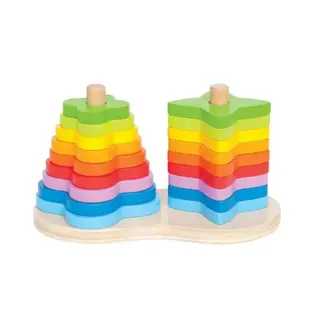 −48 %HapeRainbow stacking game, 12 months-3 years – Hape101 DH
instead of 195 DHView product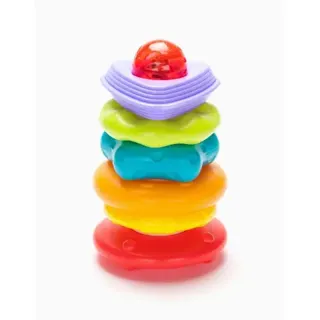 −48 %EurekakidsStacking rings, 5 pieces – Eurekakids78 DH
instead of 150 DHView product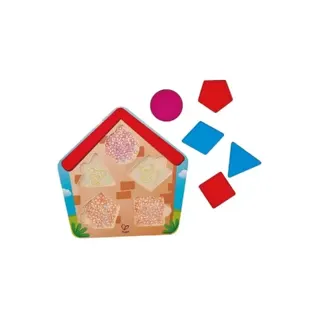 −48 %HapeWho’s in the House wooden peg puzzle – Hape65 DH
instead of 125 DHView product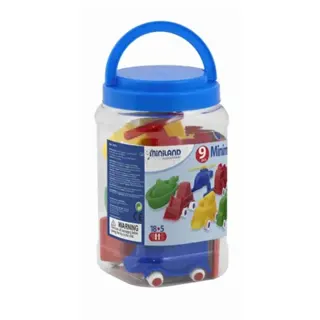 −48 %MinilandCrate of mini race cars, 9 pieces, from 18 months – Miniland125 DH
instead of 240 DHView product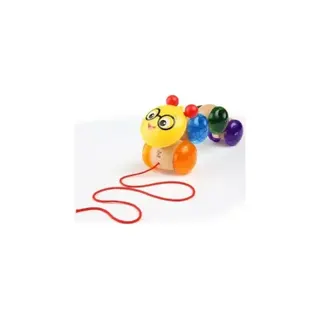 −48 %HapeInch Along Cal wooden pull-along caterpillar – Hape127 DH
instead of 245 DHView product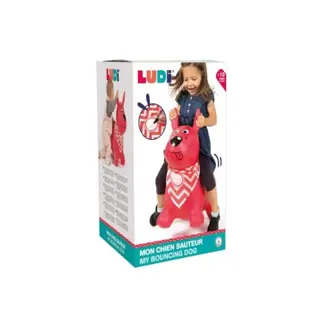 −48 %LudiMy Bouncing Dog inflatable toy, pink, from 10 months – Ludi190 DH
instead of 365 DHView product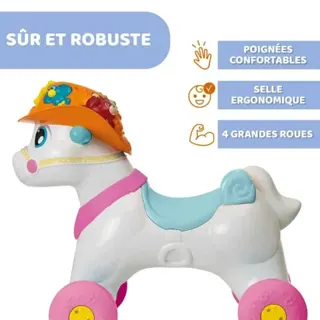 −41 %ChiccoMiss Baby Rodeo & Friends ride-on, girl – Chicco524 DH
instead of 895 DHView product- The whole aisle · Baby ride-ons11 products online, delivered anywhere in Morocco.Open the aisle
Products sold by La Maison du Bébé, publisher of this magazine. Prices as of 12 October 2026; please check the product page.
Screens and sleep: what really helps
Screens. The Canadian Paediatric Society advises avoiding them as much as possible between 12 and 24 months: toddlers learn far better by interacting with people than by watching a screen. The phone handed over at the restaurant is a lifesaver, but it replaces neither play nor conversation. Our age-by-age guidelines are in the article on screens and young children.
Sleep. Nights getting worse, bedtime dragging on: if that sounds familiar, our article on sleep regression explains what is going on and how to keep a calm routine.
Every child moves at their own pace
An 18-month-old may climb everywhere but say three words, or talk a lot and still walk cautiously. Worry is mostly justified when several areas are behind at the same time, the Canadian Paediatric Society stresses.
Santé.fr also points out that there is no point “training” a baby to speed up development. What helps is conversation, free exploration and your attentive presence, without screens. Comparing with a cousin of the same age often weighs more on parents than it sheds light on the situation.
Finally, a child born prematurely is assessed by their corrected age: born two months early, at 18 months they have the development expected of a child of about 16 months.
When to talk to the doctor
A doubt is always worth voicing, to the paediatrician, the family doctor or the doctor at the health centre. They will examine your child, have their hearing checked if language is slow, and refer you for a fuller assessment if needed. The French booklet is designed for exactly this: you fill it in, then show it to the doctor.
Frequently asked questions
My 18-month-old is not talking yet. Should I worry?
First look at whether they understand simple instructions, point to ask for things and look for your eyes to share something. If so, language often catches up a little later. A child who says no words at all at 18 months, however, should be seen by a doctor: it is a sign to check, starting with hearing, not a diagnosis.
My 18-month-old is not walking yet. Is that normal?
Most children walk alone by 18 months, and French screening checklists ask at this age whether a child takes at least five steps. If yours is not walking yet, show them to the paediatrician: often everything is fine and the child is simply cautious, but only an examination can say so. Let them practise barefoot on the floor, without a baby walker.
Why does my 18-month-old hit or bite?
Between 18 and 24 months many children hit or bite to assert themselves, because they feel strong emotions without the words to express them. Stop the action calmly, name what they feel and show what they can do instead. Do not hit back: paediatricians advise against physical punishment at any age.
My 18-month-old says “no” to everything. Is that normal?
Yes. Saying “no” is even one of the skills expected around 18 months in French observation checklists. It marks the discovery that they are a separate person with their own wishes. Offer small choices (the blue pyjamas or the red ones), keep the important rules non-negotiable and avoid turning every refusal into a power struggle.
How can I play with an 18-month-old every day?
Follow what interests them: stacking then knocking down, filling and emptying, pulling a toy along while walking, copying your cooking or cleaning, singing action rhymes. A few minutes of shared play, several times a day, matter more than the number of toys. Respect the age on the packaging: a toy made for over-3s may contain small parts that are dangerous.
Sources
- Étapes du développement de l'enfantMieux vivre avec notre enfant de la grossesse à deux ans, INSPQ · Canada (Québec)
- Le développement de votre enfant : À quoi vous attendreSoins de nos enfants, Société canadienne de pédiatrie · Canada
- Jeux, jouets et activités pour les tout-petits de 12 à 24 moisSoins de nos enfants, Société canadienne de pédiatrie · Canada
- Le trouble du spectre de l'autisme : Ce qu'il faut savoirSoins de nos enfants, Société canadienne de pédiatrie · Canada
- Une discipline positive pour les jeunes enfantsSoins de nos enfants, Société canadienne de pédiatrie · Canada
- Livret d'observations partagées Parents & Professionnels de la petite enfance (Repérer et guider)Délégation interministérielle à la stratégie nationale pour l'autisme au sein des TND et Cnaf · France
- Les étapes du développement de bébéSanté.fr, Service public d'information en santé · France
- Is your 18-month-old toddler unable to use single words to communicate with you?HealthHub, portail santé du gouvernement de Singapour · Singapour