









Article contents
Key points
- Understanding comes before speaking: pointing, gestures and reacting to their name count as much as words.
- First words around age 1, two-word sentences around 2, conversations around 3.
- Speaking several languages at home does not cause delay: speak to your child in the language of your heart.
- Before age 4, daily screen time clearly raises the risk of language delay.
- No words around 18 months, or fewer than 50 words and no sentences around 2: see a doctor.
The first “mama” gets celebrated, filmed and sent to the whole family. Yet baby language development begins long before: in cries, coos, looks and a pointing finger. And a child who talks little at 2 quickly worries their parents, especially when a cousin of the same age is already making sentences.
Here are the main stages from 0 to 3, what really helps a child talk, what changes when a child grows up with several languages, and the signs that justify a medical opinion or an assessment with a speech therapist.
How does language develop from 0 to 3?
Babies understand before they speak, and they communicate before they say words. The milestones below combine those of the Neuchâtel speech therapy centre in Switzerland and those of the CDC, the American public health agency, where each step is reached by at least 75% of children of that age.
| Age | What they understand | What they express |
|---|---|---|
| 0 to 6 months | Reacts to noises and voices, looks at you | Coos, laughs |
| 6 to 12 months | Reacts to their name, understands a few words | Babbles (“papapa”), makes gestures, points |
| Around 1 year | Pauses for a moment when you say “no” | Waves goodbye, calls their parents “mama”, “baba” or a pet name of their own |
| Around 15 months | Looks at the familiar object you name, follows an instruction accompanied by a gesture | Says one or two words besides “mama” and “baba”, points to ask for things |
| Around 18 months | Understands short sentences without gestures, follows a simple instruction | Says a few recognisable words, at least three besides “mama” and “baba” |
| Around 2 years | Points to two body parts, points to the picture you ask for | Quickly builds vocabulary, puts two words together (“more milk”) |
| Around 3 years | Says what is happening in a picture | Speaks in sentences, asks questions, holds a conversation, is understood by others most of the time |
These ages are milestones, not an exam: they help spot a gap and talk about it early. The 18-month stage, which often raises questions, is detailed in our article on the 18-month-old.

First words: when, and what counts as a word?
A baby starts saying first words around the age of 1, a guide from Helsinki University Hospital reminds us. At 1 year the CDC expects a child who calls their parents “mama”, “baba” or a pet name of their own, then, around 15 months, one or two other words.
These first words are rarely perfect. The CDC itself gives the example of “ba” for ball. What makes it a word is that it always refers to the same thing. In Morocco, it might be “mmi” (mum), “baba” or “lma” (water): everything counts, in every language of the home.
Then vocabulary grows. Around 2 years, the CDC expects two-word combinations, and the Neuchâtel speech therapists advise talking to the paediatrician if a child says fewer than 50 words or makes no short sentences. At 3, a child converses and asks “why” about everything: our article on the 3-year-old describes this stage.
How can you help your baby talk?
By talking to them a lot, and leaving them room to answer. The Neuchâtel speech therapists sum up the essentials:
- talk to them calmly and warmly, from birth, and comment on what you are doing: bath, meal, outing;
- avoid “baby talk”: simple sentences, precise words;
- name objects, actions and emotions of everyday life;
- read simple, richly illustrated books, picture books, cloth books;
- sing nursery rhymes, regularly.
The CDC adds a few actions by age. Around 1, choose touch-and-feel or flap books. Around 18 months, talk about the pictures with simple words. Around 2, repeat correctly the word they mangle, without correcting them: when they say “nana”, answer “yes, banana”. Around 3, answer with a sentence a little longer than theirs.
To go further, see our advice on reading stories to your baby from birth and our selection of nursery rhymes and songs, from French to Darija.
Darija, Arabic, Amazigh, French: several languages, a delay?
No, multilingualism does not cause language delay. The Neuchâtel speech therapy centre writes it plainly: bilingualism is not the source of a language problem, and a language disorder, when there is one, appears whatever the number of languages spoken at home.
Many Moroccan families live this every day: Darija at home, Amazigh with the grandparents, French at the crèche, Arabic at school. Specialists’ advice points the same way:
- Speak the language of your heart, the one you are most comfortable in, advises the Neuchâtel centre: it also passes on your culture and supports learning the other language.
- Each their own language, if you wish: when parents do not share a mother tongue, each can speak their own to the child, notes the Helsinki phoniatrics guide.
- Accept the mixing: until age 6, a child does not always know which language they are speaking, and that is normal.
- Allow time for the school language: it takes 4 to 7 years to master school language well, spoken and written, according to the Swiss speech therapists.
What counts is exchanges with people who speak each language, the Swiss speech therapists remind us. Our article on the multilingual child in Morocco details these family situations.
Do screens slow down language?
Yes, when they take the place of conversation. According to the Neuchâtel speech therapy centre, watching screens every day before age 4 greatly increases the risk of language delay. A child learns a language by talking with people, not in front of a video.
The CDC recommends no screens before age 2, then at most an hour a day of a children’s programme, with an adult, at 2 and 3. Our screen guidelines by age help you set realistic rules.
From the shop
Books and toys to talk, name and sing
Bath books, picture books and musical toys: they are mostly excuses to talk together. The best tool remains your voice, and no toy replaces it.
 −60 %BadabulleBath book and puppet – Badabulle36 DH
instead of 90 DHView product −48 %LudiMagic bath book, from 6 months – Ludi52 DH
instead of 100 DHView product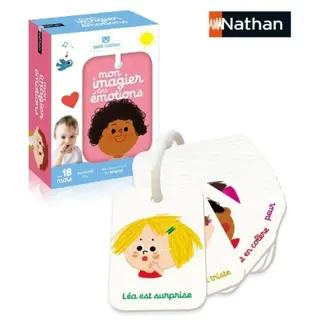 −48 %NathanTake-anywhere emotions picture book – Nathan75 DH
instead of 145 DHView product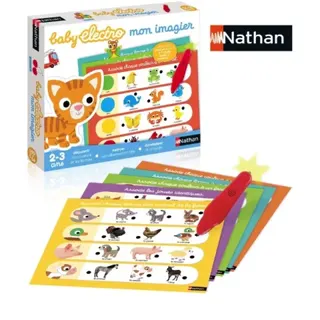 −48 %NathanElectro My Picture Book game – Nathan127 DH
instead of 245 DHView product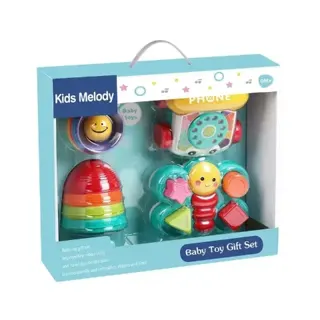 −50 %Kids MelodyBaby musical activity toy set – Kids Melody208 DH
instead of 420 DHView product- The whole aisle · Early learning25 products online, delivered anywhere in Morocco.Open the aisle
Products sold by La Maison du Bébé, publisher of this magazine. Prices as of 12 October 2026; please check the product page.
Our early learning and music sections offer more ways to play with words and sounds.
Language delay: when to worry, and who to see?
The first person to see is the paediatrician or the health centre doctor. They examine your child, may ask for a hearing check and refer you, if needed, to a speech therapist for an assessment. The Neuchâtel speech therapists advise seeing the paediatrician first for early signs, then a speech therapist from age 3 if the child does not speak in sentences or remains hard to understand.
The doctor looks at the whole picture: understanding, gestures, play and relationships, not only the number of words. In every case, it is better to see someone early: the CDC sums it up in one sentence, don’t wait.
Frequently asked questions
My 12-month-old does not say “mama” yet: should I worry?
Not at this stage, if they communicate in other ways. Look at whether they babble, point, wave goodbye, react to their name and understand a few words: these are the milestones of the end of the first year. The Neuchâtel speech therapists advise seeing a doctor if your baby communicates neither by gestures nor by sounds, stops babbling, or still says no words around 18 months.
Should I speak only one language to my baby so as not to confuse them?
No. The Neuchâtel speech therapy centre is firm: bilingualism is not the cause of a language disorder, and speaking their mother tongue helps a child learn the other. A Finnish hospital guide adds that if the parents do not share a language, each can speak their own. What matters is talking a lot, in the language you are comfortable in.
My child stutters: should I see a speech therapist?
Talk to the doctor if it worries you or if your child seems bothered by it. The Neuchâtel speech therapy centre lists stuttering that persists around age 4 among the signs that justify an appointment with a speech therapist, along with poorly built sentences or speech that is not always understandable at that age. Before then, a medical opinion lets you take stock and be referred if needed.
How can I tell if my baby hears well?
Watch their everyday reactions. Before 6 months, they react to noises and voices; between 6 and 12 months, they turn when called by name and babble. The Neuchâtel speech therapists advise talking to the paediatrician if your baby does not react to sounds or stops babbling. The doctor can then ask for a hearing check.
Sources
- 3, 2, 1… Parlez ! Développement du langage : points de repère et signaux d'alerteCentre d'orthophonie de Neuchâtel · Suisse
- 3, 2, 1… Parlez ! BilinguismeCentre d'orthophonie de Neuchâtel · Suisse
- Soutenir le développement du langage chez l'enfant multilingueUnité de phoniatrie, HUS (hôpital universitaire d'Helsinki) · Finlande
- Milestones by 1 YearCenters for Disease Control and Prevention (CDC), Learn the Signs. Act Early. · États-Unis
- Milestones by 15 MonthsCenters for Disease Control and Prevention (CDC), Learn the Signs. Act Early. · États-Unis
- Milestones by 18 MonthsCenters for Disease Control and Prevention (CDC), Learn the Signs. Act Early. · États-Unis
- Milestones by 2 YearsCenters for Disease Control and Prevention (CDC), Learn the Signs. Act Early. · États-Unis
- Milestones by 3 YearsCenters for Disease Control and Prevention (CDC), Learn the Signs. Act Early. · États-Unis