









Article contents
Key points
- Charts give an order of magnitude: every baby has their own appetite, which changes from day to day.
- Offer the bottle at the first hunger cues, without waiting for crying, and never force your baby to finish it.
- When breastfeeding you don't count millilitres: wet nappies and weight gain are the real guides.
- Adjust the amount of milk, never its concentration: watering formula down to make the tin last is dangerous.
- Fewer wet nappies, refusing to feed, unusual drowsiness: see a doctor without waiting.
He took 90 ml at the 10 o'clock bottle, 140 ml at 2 pm, and he is refusing the evening one. The chart printed on the tin says something different, and grandma thinks he isn't drinking enough. How much milk a baby should drink is one of the first worries for parents, especially with bottles, where everything can be measured.
Figures do exist, but they are orders of magnitude, not targets. The best indicator is still your baby: their hunger and fullness cues, their nappies and their weight curve.
How much milk does a baby drink at each age?
Amounts rise quickly during the first weeks, then level off. The Quebec guide Mieux vivre avec notre enfant, published by the Institut national de santé publique du Québec (INSPQ), gives ranges over 24 hours; the American Academy of Pediatrics (AAP) gives volumes per bottle. Side by side, they look like this:
| Age | Per bottle (AAP) | Total over 24 hours (INSPQ) |
|---|---|---|
| First week | 30 to 60 ml | 180 to 600 ml, rising gradually |
| First month | 90 to 120 ml | 450 to 800 ml |
| 2nd and 3rd month | Volume increases gradually | 500 to 900 ml |
| 4th to 6th month | 180 to 240 ml around 6 months, in 4 or 5 bottles | 850 to 1,000 ml |
| 7th to 12th month | Meals take over | 750 to 850 ml |
These figures are for a full-term, healthy, formula-fed baby. The charts do not take special needs into account, the INSPQ reminds us: a baby born prematurely or followed for a health problem feeds according to their doctor's instructions.

Why these figures are only guidelines
Because no research has established the exact amount a baby should drink at a given age: the INSPQ presents its charts as a general idea only. Appetite changes from one baby to the next, and from one day to the next in the same baby. Many are hungrier in the evening than in the morning.
The AAP suggests another way to calculate: about 75 ml a day for every 453 g of weight, or roughly 165 ml per kilo. A 5 kg baby would therefore drink around 830 ml a day. It also sets a ceiling: on average, no more than about 960 ml over 24 hours.
As for rhythm, the number of bottles falls over the months while each one gets bigger. And at night? Between 2 and 4 months, most bottle-fed babies no longer need to feed in the middle of the night, according to the AAP, but every baby has their own rhythm. Our tips on nights that are still broken may help.
Hunger and fullness: the cues that matter more than millilitres
Offer the bottle at the very first hunger cues, without waiting for crying: the UK's NHS points out that crying is a late sign. Before 6 months, a hungry baby:
- brings their hands to their mouth, sucks their fist or fingers;
- turns their head towards the breast or bottle, looks for the teat;
- makes sucking movements, licks or smacks their lips;
- gets restless, wriggles or clenches their fists.
When they are no longer hungry, they close their mouth, turn their head away and their hands relax, the American CDC describes. If they squirm or get distracted halfway through a bottle, they have often finished, the AAP notes.
The rule that follows, the NHS puts bluntly: never force a baby to finish their bottle. Insisting on the last mouthfuls means feeding them beyond their hunger, and the AAP reminds us that excess weight can set in as early as infancy. Throw away what is left rather than keeping it for the next feed: the time limits are in our article on preparing a bottle.
When breastfeeding, how do you know they are drinking enough?
At the breast you can't count millilitres, and that's fine. You breastfeed on demand, as often and for as long as your baby wants, the NHS recommends. The signs that they are drinking enough, according to the same source:
- from day 5, at least 6 well-wetted nappies per 24 hours (2 or 3 in the first two days);
- from day 4, at least 2 soft, yellow stools a day during the first weeks;
- steady weight gain after the first 3 or 4 days, during which a small loss is normal;
- a baby who is mostly calm after most feeds, and whom you can see and hear swallowing.
If you have doubts, ask for help early (midwife, paediatrician, lactation consultant) and reread the basics of an effective latch from the first days. If you top up with a bottle, our article on mixed feeding explains how to protect your milk supply.
A baby who drinks little: normal or worrying?
Often normal. Babies drink "little and often" and don't always finish their bottle, the NHS reminds us. Several situations explain a baby who drinks less:
- A very sleepy newborn, especially in the first 2 or 3 weeks. According to the INSPQ, there is nothing to worry about if they wake by themselves to feed, feed effectively, have at least 6 wet nappies and 3 stools a day and have regained their birth weight. To help them feed, talk to them, rub their back and legs, and uncover them a little.
- A slow little drinker, common in babies born between 35 and 37 weeks of pregnancy. A teat with a slightly faster flow may help (INSPQ).
- A teat that flows too fast: they cough, swallow noisily, spit milk back up. Switch to a slower flow and take breaks. How to choose the flow is explained in our bottle and teat guide.
- A blocked nose: they let go of the teat to breathe. Rinsing the nose just before the bottle often changes everything.
- An illness starting: fever, diarrhoea, vomiting. Then it is your baby's general state that counts (see the final box).
What should prompt a visit, according to the INSPQ: a baby who seems to be in pain, who vomits forcefully several times a day, who wets fewer nappies or who is not gaining enough weight.
From the shop
Bottles and teats suited to each age
A small bottle is enough for the first weeks, a larger one afterwards; the teat is chosen according to the flow that suits your baby. A bottle brush and a formula dispenser complete the essentials.
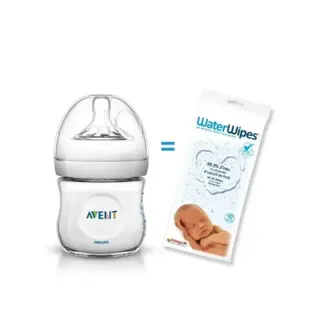 −48 %Philips AventNatural 125 ml bottle – Philips Avent + 10 free WaterWipes wipes67 DH
instead of 128 DHView product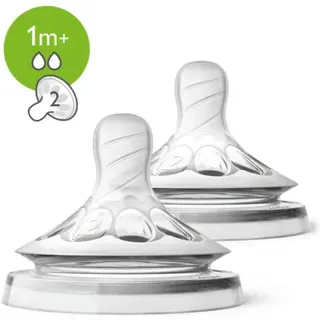 −41 %Philips AventNatural baby teat, 1 month+ – Philips Avent44 DH
instead of 75 DHView product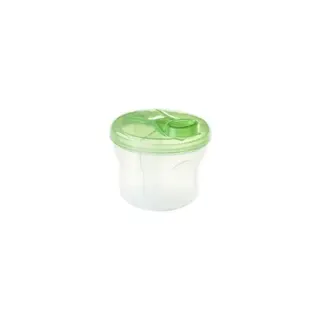 −48 %Saro3-compartment milk powder dispenser, green – Saro62 DH
instead of 120 DHView product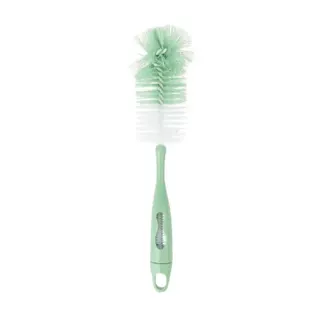 −8 %Badabulle2-in-1 bottle and teat brush, green – Badabulle55 DH
instead of 60 DHView product- The whole aisle · Baby bottles and teats5 products online, delivered anywhere in Morocco.Open the aisle
Products sold by La Maison du Bébé, publisher of this magazine. Prices as of 12 October 2026; please check the product page.
A baby who drinks too much, or keeps asking for more
Some babies empty every bottle and ask for more. If they keep sucking and smacking their lips once the bottle is empty, they may still be hungry, the AAP notes: offer a little more at the next bottle. Others mainly need to suck to calm down, without being hungry; a dummy may then be enough, it adds.
If your baby regularly asks for much more, or much less, than the averages, the AAP advises talking to the paediatrician, who will look at their weight and height curve. Feeding on demand rather than at fixed times also limits the risk of overfeeding, according to the NHS.
A 4-month-old who asks for more is not necessarily ready for purées. Chewing on their fists, waking more often at night or wanting more milk are normal behaviours, not signs of readiness, the NHS stresses. The real signs are described in our article on starting solids.
One last rule, valid both ways: you adjust the amount of milk, never its concentration. In Le Matin in 2025, a doctor of pharmacy warned Moroccan families that diluting milk or spacing out bottles to make the tin last exposes the infant to a risk of undernourishment. If money is tight, talk to the paediatrician or the health centre rather than changing the doses.
After 6 months: milk remains the foundation
With the first spoonfuls, milk does not disappear. The INSPQ still counts 750 to 850 ml a day between 7 and 12 months, a little less than at the peak of 4 to 6 months: meals gradually take over. When breastfeeding, you carry on on demand.
After 1 year, needs change again: our guidelines on feeding 1 to 3 year olds take stock of milk and dairy products. As for water, it has its own article: should you give a baby water, and which kind?
Frequently asked questions
How many bottles a day at 3 months?
There is no fixed number. During the first month, the American Academy of Pediatrics describes a bottle every 3 to 4 hours; around 6 months, more like 4 or 5 bottles of 180 to 240 ml. At 3 months your baby sits between the two: the number of bottles falls as each one gets bigger. Over 24 hours, the Quebec guide Mieux vivre puts babies of 2 and 3 months between 500 and 900 ml.
The chart on the formula tin doesn't match what my baby drinks: is that a problem?
Not necessarily. These charts give averages, and the INSPQ points out that no research has established the exact amount a baby should drink at a given age. What matters: well-wetted nappies, steady weight gain and an alert baby. If they consistently drink much more or much less than the guidelines, talk to the paediatrician, as the AAP advises. And it is the quantity you adapt, never the dosing on the instructions.
Can I add cereal to the bottle so my baby sleeps better?
No. The UK's NHS asks that nothing be added to the bottle apart from breast milk or infant formula: no cereal, no sugar. Starting solids does not help them sleep through the night either. Night feeds often remain necessary for the first few months and decrease with age. If your baby seems hungry despite full bottles, talk to the paediatrician rather than thickening the milk.
How long can a newborn go without feeding?
In the first weeks, no more than 4 to 5 hours: the American Academy of Pediatrics (AAP) advises waking a newborn who sleeps longer and skips a feed, to offer a drink. The gaps lengthen later. Between 2 and 4 months, or around 5.4 kg, most bottle-fed babies no longer need to feed in the middle of the night, again according to the AAP, but every baby has their own rhythm. If in doubt, ask your paediatrician.
Sources
- Quantité de lait au biberonMieux vivre avec notre enfant, Institut national de santé publique du Québec (INSPQ) · Canada (Quebec)
- Difficultés de l'alimentation au biberonMieux vivre avec notre enfant, Institut national de santé publique du Québec (INSPQ) · Canada (Quebec)
- Amount and Schedule of Baby Formula FeedingsHealthyChildren.org, American Academy of Pediatrics (AAP) · United States
- Signs Your Child Is Hungry or FullCenters for Disease Control and Prevention (CDC) · United States
- Feeding on demand (Best Start in Life)NHS · United Kingdom
- Breastfeeding: is my baby getting enough milk?NHS · United Kingdom
- When to get urgent medical help for babies and children under 5NHS · United Kingdom
- Pourquoi le prix du lait infantile ne cesse d'augmenter au Maroc ?Le Matin · Morocco