





Article contents
Key points
- A percentile compares your baby with children of the same age and sex: none is 'the right one'.
- What matters is a steady curve that follows its own channel.
- Some weight loss in the first days is normal; beyond 10%, see a doctor.
- No need to weigh your baby at home without a medical reason.
- A curve that 'breaks' downwards always deserves medical advice.
At the paediatrician's office, your baby is laid naked on the scales, then stretched out against the measuring board. The doctor marks a dot on the growth chart in the health record and announces: "25th percentile." Should you worry? Your cousin's baby, born the same month, is on the 75th...
Reassuring or worrying, that number says almost nothing on its own. A growth chart is read over time, like a journey. Here is how to decipher it, what is normal in the first days, and the rare situations that really should alert you.
What does a growth chart show?
At each visit, your baby's weight, length (measured lying down before age 2) and head circumference are measured, then plotted on a chart, explains the Quebec guide Mieux vivre avec notre enfant. Each point is placed in relation to children of the same age and sex.
The international reference is the World Health Organization (WHO) child growth standards, published in 2006. They were built from a large international study, the WHO Multicentre Growth Reference Study, and cover birth to 5 years: weight for age, length for age, weight for length, body mass index and head circumference.

Percentiles: how to read your baby's chart
A percentile places your baby among a hundred children of the same age and sex. At the 25th percentile for weight, 25% of babies weigh less and 75% weigh more. The 50th percentile is the median, the middle value: it is neither a target nor "the norm".
So the curves draw channels. What matters is that your baby follows theirs, steadily. The Canadian Paediatric Society sums it up: each child generally follows a trend of their own, taller or shorter, heavier or lighter than their peers.
To get your bearings, here are some values from the WHO standards:
| Age | Boys: median (3rd – 97th percentile) | Girls: median (3rd – 97th percentile) |
|---|---|---|
| Birth | 3.3 kg (2.5 – 4.3) | 3.2 kg (2.4 – 4.2) |
| 1 month | 4.5 kg (3.4 – 5.7) | 4.2 kg (3.2 – 5.4) |
| 2 months | 5.6 kg (4.4 – 7.0) | 5.1 kg (4.0 – 6.5) |
| 4 months | 7.0 kg (5.6 – 8.6) | 6.4 kg (5.1 – 8.1) |
| 6 months | 7.9 kg (6.4 – 9.7) | 7.3 kg (5.8 – 9.2) |
| 9 months | 8.9 kg (7.2 – 10.9) | 8.2 kg (6.6 – 10.4) |
| 12 months | 9.6 kg (7.8 – 11.8) | 8.9 kg (7.1 – 11.3) |
| 2 years | 12.2 kg (9.8 – 15.1) | 11.5 kg (9.2 – 14.6) |
Source: WHO, child growth standards, weight for age.
These medians show that an "average" baby roughly doubles their birth weight by about 4 months and almost triples it by 1 year. But a baby born at 2.8 kg and another born at 4 kg will not follow the same path, and that is normal.
The first days: expected weight loss
It is common for a newborn to lose weight just after birth. NICE, the UK body that sets good medical practice, explains that this loss mostly reflects adjustments in the body's water, and that it generally stops after 3 or 4 days.
Benchmarks for regaining birth weight vary: 10 to 15 days according to the Geneva University Hospitals (HUG), and by about 3 weeks at the latest for most babies according to NICE. NICE sets a clear threshold: a loss of more than 10% of birth weight calls for an examination of your baby and feeding support. A baby of 3.4 kg who drops below 3.06 kg is in this situation.
If you are breastfeeding, nappies and feeds are the best indicators between weigh-ins: our article on getting breastfeeding off to a good start covers them in detail. For bottle-feeding, see milk amounts by age.
Growth spurts: the weeks when everything speeds up
Growth does not follow a perfectly straight line. The Quebec guide describes periods of very rapid growth, more common around 7 to 10 days, 3 to 6 weeks and 3 to 4 months. Not all babies go through them at the same time. A point slightly above or below the curve from one visit to the next therefore means nothing in isolation: it is the trend over several measurements that counts.
When should a growth chart worry you?
The signal that matters is the break: a curve that drops downwards and crosses several channels. NICE offers precise benchmarks for weight, after the first weeks:
- a baby born small (below the 9th percentile): a fall of one channel or more deserves attention;
- a baby of average birth weight (between the 9th and 91st): a fall of two channels or more;
- a baby born large (above the 91st): a fall of three channels or more;
- in every case: a weight that falls below the 2nd percentile.
Here a "channel" is the space between two percentile lines on the British charts; your paediatrician will interpret it according to the charts they use. For length, NICE recommends taking both parents' heights into account.
Above all, the doctor never judges a single point: they look at the trend over several visits and at your baby's general condition.
Small babies, chubby babies: ending the comparisons
In many families, a plump baby is reassuring, and babies of the same age are readily compared. Yet height and weight also depend on sex, feeding and heredity, reminds the Quebec guide. Two perfectly healthy babies can have very different charts.
The question "how do I fatten up my baby?" comes up often. The answer always goes through the paediatrician, who looks at the whole curve before advising anything. Do not add anything to the bottle and follow the formula measures exactly, as our article on preparing a bottle explains. After 6 months, introducing solids takes over, and later meals for 1 to 3-year-olds have their own appetite benchmarks.
Weighing your baby every day does not help. The Quebec guide advises against weighing at home unless a professional asks, and NICE notes that weighing too often increases parents' anxiety. It sets minimum intervals: no more than once a day before 1 month, once a week between 1 and 6 months, every two weeks between 6 and 12 months, then once a month. Length should be measured no more than once every 3 months.
From the shop
To keep the health record in good shape
Not essential, but handy: a health record cover keeps growth charts, vaccines and prescriptions safe and ready to bring to every visit.
 −48 %Pasito a PasitoCotton health record cover, white – Pasito a Pasito234 DH
instead of 450 DHView product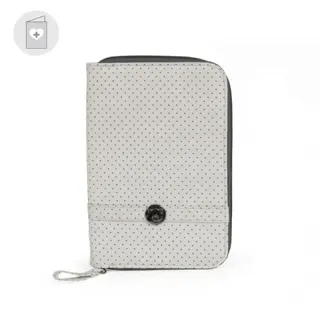 −48 %Pasito a PasitoChloé health record cover, grey – Pasito a Pasito312 DH
instead of 600 DHView product −48 %Pasito a PasitoBohemian health record cover, pink – Pasito a Pasito312 DH
instead of 600 DHView product −48 %Pasito a PasitoNido Volante health record cover, blue – Pasito a Pasito354 DH
instead of 680 DHView product- The whole aisle · Health record covers6 products online, delivered anywhere in Morocco.Open the aisle
Products sold by La Maison du Bébé, publisher of this magazine. Prices as of 12 October 2026; please check the product page.
WHO charts or national charts: why percentiles change
Not every country uses the same charts. The UK uses charts derived from the WHO's, as NICE points out. France made a different choice: in 2016, the Haut Conseil de la santé publique preferred to keep French charts for the health record rather than adopt the WHO's, notably to avoid a break in follow-up at age 5.
The practical consequence: depending on the record, the software or the country where your baby was followed, the same weight can fall on a slightly different percentile. If you change doctor or country, mention it: the important thing is to compare your baby with themselves, on a single chart.
Frequently asked questions
How much should a 4-month-old baby weigh?
There is no ideal weight. According to WHO standards, half of 4-month-old boys weigh less than 7 kg and half of girls less than 6.4 kg, but a weight between 5.6 and 8.6 kg for a boy, or between 5.1 and 8.1 kg for a girl, is within the usual range. The right weight is the one that steadily continues their own curve.
My baby is on the 3rd percentile. Is that serious?
Not necessarily. It means 3% of babies of the same age and sex weigh less. If they have always followed this channel, are alert and have plenty of wet nappies, they are probably following their own path, as the Canadian Paediatric Society reminds us. The UK's NICE, however, asks for an assessment if weight falls below the 2nd percentile or drops downwards: talk to your paediatrician.
Should I buy baby scales for home?
It is not necessary. The Quebec guide Mieux vivre avec notre enfant advises against weighing your baby at home unless a health professional asks you to. The UK's NICE even notes that weighing too often increases parents' anxiety, and sets minimum intervals: no more than once a week between 1 and 6 months, for example.
Do the parents' heights matter?
Yes, a lot. A child of short parents often follows a lower height channel, without it being a problem. NICE advises the doctor to ask for both parents' heights to work out a 'target height'. It is a large gap between the child's curve and this target that may justify tests, not a low percentile in itself.
Sources
- Child growth standardsWorld Health Organization (WHO) · International
- Weight-for-age (child growth standards)World Health Organization (WHO) · International
- Faltering growth: recognition and management of faltering growth in children (NG75), recommendationsNational Institute for Health and Care Excellence (NICE) · United Kingdom
- Croissance de votre enfantMieux vivre avec notre enfant, INSPQ · Canada (Quebec)
- Est-ce que mon enfant grandit bien?Soins de nos enfants, Canadian Paediatric Society · Canada
- L'allaitementHôpitaux universitaires de Genève (HUG), service d'obstétrique · Switzerland
- Avis relatif à la refonte du carnet de santé de l'enfant (25 mai 2016)Haut Conseil de la santé publique (document diffusé par l'AP-HP) · France