





Article contents
Key points
- Clean and dry care: lukewarm water if needed, then careful drying.
- No alcohol, no powder, no kohl and no dressing on the cord.
- It falls off by itself between day 5 and day 21: never pull on it.
- A few drops of blood when it falls off are normal; redness, pus or smell are not.
- An umbilical hernia most often closes by itself: no coin on the belly button.
At the maternity ward, you were shown the little stump of umbilical cord, held by a clamp, and the midwife cleaned it in two quick moves. Back home, grandmother suggests a coin on the belly button, an aunt talks about alcohol, a neighbour about powder. Who should you believe?
The answer from health authorities is simpler than all these recipes: a clean, dry cord, and patience. Here is the daily routine, what is normal day by day, what to avoid, and the signs that should make you see a doctor.
Why is "clean and dry" care the rule?
Because the cord needs nothing else to dry out and fall off. As early as 2014, the World Health Organization (WHO) recommended "clean and dry" care for babies born in a maternity unit. In its 2022 recommendations, it reserves antiseptic (chlorhexidine) for regions where harmful traditional substances, such as animal dung, are commonly put on the cord: it is then used to replace those dangerous practices.
Alcohol is not necessary, the American Academy of Pediatrics (AAP) specifies, and the Quebec guide Mieux vivre avec notre enfant advises against it: it delays the cord falling off. If the maternity ward or your paediatrician prescribed a specific product, follow their instructions and ask them your questions.

Cord care, step by step
- Wash your hands before touching the cord.
- Clean gently. The Quebec guide advises cleaning the folds around the cord every day with a cotton bud dipped in lukewarm water. The UK's NHS washes around the cord only if it is soiled with urine or stools.
- Dry carefully with a dry cotton bud. The cord must stay dry.
- Fold the nappy below the belly button, so urine does not wet the cord and it stays in the open air, as the Quebec guide and the AAP advise.
- Do not cover the cord: no gauze, no dressing, no band.
- Never pull on it, even if it is hanging by a thread.
This care does not hurt your baby, the Quebec guide specifies. After the bath, dry the area well. Tips for bathing a newborn safely are in our bath and bathtub guide, and the other daily care in our article on newborn bath time and hygiene.
Day by day: from birth until the cord falls off
| When | What happens | What you do |
|---|---|---|
| Birth | The cord is white | Clean and dry care at every change |
| First days | It dries and gradually darkens | Keep it in the open air, nappy folded down |
| Between day 5 and day 21 | It falls off by itself; it may stay half-detached for 2 to 3 days | Do not pull, keep up the care |
| Just after it falls off | A few drops of blood on the nappy or bodysuit | Normal: the belly button heals by itself |
| Beyond 3 weeks | The cord is still there | Show your baby to the doctor |
Based on the Quebec guide Mieux vivre avec notre enfant and the American Academy of Pediatrics.
The ranges vary a little from one source to another: between 1 and 3 weeks according to the Canadian Paediatric Society (CPS), around 3 weeks at the latest according to the AAP. In every case, keep cleaning and drying the belly button until it has healed well.
From the shop
For baby's first care
Cotton clothes that do not squeeze the tummy, nappies to fold below the belly button, a thermometer to check for fever and a changing mat to care for your baby safely.
 −74 %Pureté du bébé3-piece cotton set, 3M, beige 02 220 – Pureté du bébé153 DH
instead of 590 DHView product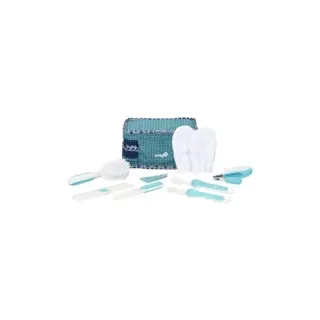 −48 %Safety 1stArctic newborn baby care kit, 8 pieces – Safety 1st156 DH
instead of 300 DHView product −48 %Green TribuEco-friendly baby nappies, size 2, 3-6 kg, x28 – Green Tribu61 DH
instead of 118 DHView product −48 %Pasito a PasitoBohemian changing mat, blue – Pasito a Pasito286 DH
instead of 550 DHView product −48 %ChiccoHygiene Set toiletry kit, blue, from birth – Chicco270 DH
instead of 520 DHView product- The whole aisle · Baby care kits14 products online, delivered anywhere in Morocco.Open the aisle
Products sold by La Maison du Bébé, publisher of this magazine. Prices as of 12 October 2026; please check the product page.
Coin, band, kohl: what do the sources say about our traditions?
These practices come from a tender intention: to protect the belly button, to help it "close properly". Yet medical sources say they do not help, and that some carry a risk.
A coin or sticky tape on the belly button. The AAP is explicit: do not put a coin or sticky tape on a baby's belly button. It does not help, even with a hernia, and can irritate the skin.
A tight band around the tummy. It covers the cord, whereas all sources ask you to leave it in the open air so it dries. A bodysuit or a cotton outfit that does not squeeze is enough.
Kohl, powders, oils. A medical thesis defended in Fez in 2014 reports that kohl is sometimes applied to newborns to speed up the cord falling off. But kohl can contain a lot of lead: in Quebec, two samples analysed after cases of child poisoning contained 78% and 92%, according to the Institut national de santé publique du Québec. Lead is toxic to the developing brain. On the cord, then, you put nothing but water, if needed.
During the sbou3, the celebration on the seventh day, visitors come one after another: this is the time to ask, kindly, that people wash their hands before holding your baby, and do not touch the cord. Our article on the sbou3 and aqiqa gives other ideas for enjoying this celebration calmly.
Cord infection: the signs to know
Infection of the cord, called omphalitis, is rare, but it must be treated quickly. The signs described by the Quebec guide, the CPS and the AAP:
- redness that appears or spreads on the skin around the cord;
- swelling around the belly button;
- a discharge, especially yellowish or purulent;
- a bad smell;
- a baby who cries when the area is touched;
- a fever, from 38 °C, in a newborn.
In a newborn, a fever always calls for quick medical advice: our article on fever in babies gives the guidelines.
Umbilical granuloma: the little lump after the cord falls off
Sometimes, after the cord falls off, a small red or brownish lump stays at the bottom of the belly button and oozes a clear yellow fluid. This is an umbilical granuloma, harmless scar tissue described by the AAP. It often goes away within about a week. If not, the paediatrician can dry it out with a small treatment at the surgery.
Umbilical hernia: the belly button that sticks out
A belly button that bulges, especially when your baby cries, is often an umbilical hernia: a small gap in the tummy muscles lets a little tissue push through. The NHS reminds us that many babies are born with one, that it is generally painless and that it measures from the size of a pea to about 2 cm.
It most often closes by itself. The timeframes vary by source: 12 to 18 months in general for the AAP, before age 5 for the NHS. Surgery is considered only if it is very large or persists, around 3 to 5 years according to the AAP. And, once again, a coin strapped on the belly button does not help it close.
A hernia that is more swollen than usual, hard, painful or changing colour is, however, an emergency, especially if your baby vomits or no longer passes stools or wind, the NHS warns.
Frequently asked questions
Can I bathe my baby before the cord falls off?
The sources consulted do not forbid it. The Quebec guide simply asks you to dry the area well after the bath. The NHS also describes a top-and-tail wash with a bowl, with no immersion, washing around the cord only if it is soiled. Choose what reassures you, and dry the belly button carefully in every case.
Does it hurt my baby when I clean the cord?
No. The Quebec guide is clear: this care does not hurt the baby. However, a baby who cries as soon as the skin around the cord is touched should be shown to a doctor: the American Academy of Pediatrics lists this sign among those of an infection.
The cord smells bad. Is that normal?
No. A bad smell is one of the signs that should make you see a doctor, according to the Quebec guide, the Canadian Paediatric Society and the American Academy of Pediatrics, especially if it comes with a yellowish discharge, redness around the base or a fever. Have your baby seen by a doctor the same day: a cord infection can be treated, but must not wait.
The belly button bleeds a little after the cord falls off. What should I do?
A few drops of blood on the nappy or bodysuit when it falls off are normal, the Quebec guide and the American Academy of Pediatrics remind us: the belly button heals by itself. Keep the area clean and dry. Bleeding that does not stop, or that stains heavily, means you should call the doctor immediately.
Sources
- WHO recommendations on maternal and newborn care for a positive postnatal experienceWorld Health Organization (WHO) · International
- Recommandation de l'OMS sur les soins du cordon (WHO recommendations on postnatal care of the mother and newborn, 2014)BIGG-REC, WHO recommendations database (PAHO/BIREME) · International
- Prendre soin du cordon ombilicalMieux vivre avec notre enfant, INSPQ · Canada (Quebec)
- La peau de votre bébéCaring for Kids, Canadian Paediatric Society · Canada
- Umbilical Cord Care in NewbornsHealthyChildren.org, American Academy of Pediatrics · United States
- Umbilical herniaNHS · United Kingdom
- Les intoxications par le plomb chez les fabricants artisanaux de khôl dans la région de Fès (à propos de 12 cas)Medical thesis, Faculty of Medicine and Pharmacy of Fez (2014) · Morocco
- Le khôl, un cosmétique responsable d'intoxications au plombBulletin d'information en santé environnementale, INSPQ · Canada (Quebec)