





Article contents
Key points
- Expect 10 to 12 changes a day for a newborn, 6 to 8 for an older baby.
- Girl: front to back. Boy: do not pull back the foreskin.
- Choose the size by the weight on the pack, then check it in use.
- Changing table: one hand always on baby; the floor remains the safest place.
- Reusable nappies: cheaper over time, but more laundry.
You probably changed your first nappy in the maternity ward, under the midwife's eye. At home, it becomes a ritual: about ten times a day at first, day and night. Well chosen and well fitted, baby nappies protect the skin; badly fitted, they leak or irritate.
Here is how many to plan for, how to change your baby step by step, the small differences between a girl and a boy, choosing the size, safety on the changing table, and an honest comparison of disposable and reusable nappies.
How many nappies a day?
The UK's NHS gives an order of magnitude: 10 to 12 changes a day for a young baby, 6 to 8 for an older one. Poos explain a good part of that gap. According to the NHS, a newborn does at least 2 poos a day in the first week; breastfed, they may do one at every feed in the first weeks, and on formula, up to 5 a day.
Nappies are also a valuable indicator. Around day 5, a breastfed baby passes urine 5 to 6 times a day, say the Geneva University Hospitals (HUG), and fewer than 4 times a day during the first month is a warning sign. The detailed benchmarks, poos included, are in our article on getting breastfeeding off to a good start.
For budgeting, a concrete example: a pack of 28 eco-friendly nappies in size 2 costs 61 DH with us. At 8 to 10 changes a day, it lasts about three days.

Changing kit
Gather everything before you start, so you never have to let go of your baby:
- a changing mat or a towel;
- lukewarm water and cotton wool, or fragrance-free, alcohol-free wipes (NHS);
- a soft towel to dry with;
- a clean nappy and, often, a spare bodysuit;
- a bag for the dirty nappy;
- a protective cream if the skin is irritated.
The Quebec guide Mieux vivre avec notre enfant advises washing the bottom with water and mild soap at every change, and keeping fragrance-free wipes for healthy skin when there is no water to hand. The American Academy of Pediatrics (AAP) also asks for wipes without alcohol or fragrance.
Changing a nappy step by step
- Wash your hands and lay baby on their back on the mat.
- Open the nappy and, if it contains poo, use the front of the nappy to wipe away the worst.
- Clean gently but thoroughly, with cotton wool and lukewarm water or a wipe, not forgetting the folds.
- Dry by patting, without rubbing. If it is warm enough, let baby have a few minutes bare-bottomed: the NHS reminds us that a nappy worn all the time encourages nappy rash.
- Slide the clean nappy under their bottom, gently lifting their hips, with the tab side at the back.
- Fasten without pulling too tight. Avoid cream on the tabs, or they will no longer stick (NHS). While the cord stump has not fallen off, fold the front of the nappy down below the navel: see our umbilical cord care.
- Dress baby again, put them somewhere safe, then wash your hands.
Talk to them, smile: a change is also a moment of connection. The NHS even advises not showing disgust at what is in the nappy.
Boy or girl: the small differences
For a girl, always clean from front to back, so as not to carry germs from the poo towards the vagina, explains the NHS.
For a boy, clean around the testicles and penis. There is no need to pull back the foreskin, the NHS specifies. Keep a cloth within reach for surprise sprays.
Which nappy size to choose?
The size is chosen by your baby's weight, shown in kilos on each pack. For example, size 2 from the Green Tribu brand covers 3 to 6 kg. Ranges vary from brand to brand: go by weight, not age.
In use, the nappy should fit snugly without being tight. The AAP notes that a nappy that is too tight, especially at night, rubs the skin. Repeated leaks or red marks on the thighs and waist signal a badly fitting nappy: check the size. The Quebec guide also notes that scented nappies can irritate baby's skin.
From the shop
The essentials for easy changes
Nappies in the right size, fragrance-free wipes for outings, a washable changing mat and, if you like, a changing table: the rest is optional.
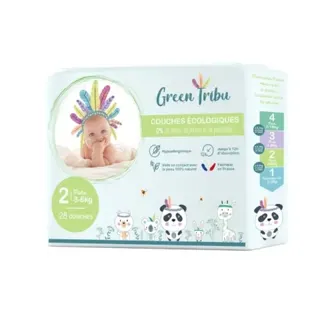 −48 %Green TribuEco-friendly baby nappies, size 2, 3-6 kg, x28 – Green Tribu61 DH
instead of 118 DHView product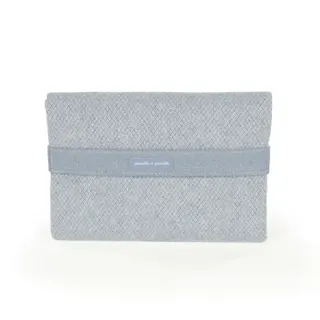 −48 %Pasito a PasitoBohemian changing mat, blue – Pasito a Pasito286 DH
instead of 550 DHView product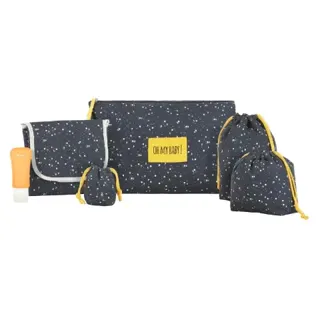 −49 %BadabulleChange & Go travel changing kit – Badabulle281 DH
instead of 550 DHView product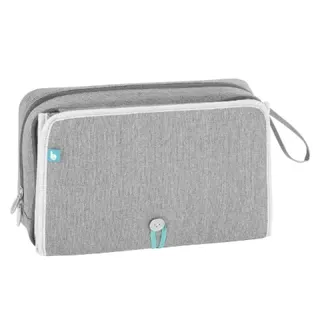 −35 %BabymoovNomadcare changing mat – Babymoov450 DH
instead of 690 DHView product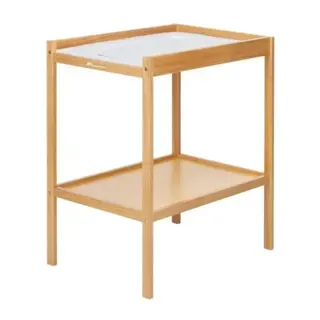 −9 %Bebe ConfortDaisy wooden changing table with changing mat – Bébé Confort1 229 DH
instead of 1 350 DHView product- The whole aisle · Nappies1 products online, delivered anywhere in Morocco.Open the aisle
Products sold by La Maison du Bébé, publisher of this magazine. Prices as of 12 October 2026; please check the product page.
Where to change your baby safely
The best place to change a nappy, according to the NHS, remains a mat or towel on the floor, sitting down to spare your back. A baby cannot fall from the floor.
On a changing table, a bed or a sofa, the rules are strict:
- never leave baby alone, even for a second (Quebec guide, NHS);
- keep one hand on them whenever you reach for something;
- do not count on the strap: the NHS asks you to watch baby at all times, strap or not;
- prepare everything beforehand before laying them down, and never turn your back.
If a fall happens despite everything, have them seen by a doctor: for a baby under one year, a bump, bruise or wound on the head after a fall warrants a call to emergency services according to the NHS. For changing baby on the go, our changing bag guide lists what to take.
Disposable or reusable nappies: the honest comparison
| Disposable nappies | Reusable nappies | |
|---|---|---|
| Convenience | Very convenient, especially out and about (NHS) | Frequent washing, organisation needed |
| Cost | Ongoing purchase, every week | Generally cheaper over the whole nappy period (NHS) |
| Absorbency | Very absorbent: crystals gel the urine and separate it from poo (INSPQ) | Generally a bit less absorbent (AAP) |
| Skin | Avoid scented models (INSPQ) | Change often, wash without fabric softener (NHS) |
| Environment | Daily waste | Water and energy for laundry |
On nappy rash, the AAP states that no data identify the best type of nappy. During an irritation, however, it suggests temporarily switching to very absorbent disposables. On the environment, the NHS invites you to weigh cost, convenience and impact, without ruling either way. Nothing stops you combining the two: reusable at home, disposable out and about or at night.
Frequently asked questions
Do I need to put cream on at every change?
Not necessarily. The Quebec guide Mieux vivre avec notre enfant considers that a protective cream is not needed to prevent irritation, and keeps zinc oxide ointment for skin that is already irritated. The UK's NHS lists it among changing supplies to protect the skin. On healthy skin, water and good drying are enough; for redness, see our article on nappy rash.
Do I need to change the nappy after every feed?
Often, yes, in the first weeks. The NHS explains that a breastfed newborn may poo at every feed, hence the 10 to 12 changes a day. The Quebec guide asks you to change the nappy regularly, and straight after a poo. A merely wet nappy is less urgent than one soiled with poo, which should be changed without waiting.
How do I change my baby when we are out?
Take a portable changing mat, nappies, fragrance-free and alcohol-free wipes, as the NHS advises, and a bag for the dirty nappy. Roll the disposable nappy up on itself, close it with its tabs, slip it into the bag, then put it in a bin. Wash your hands as soon as possible. Our changing bag guide covers the rest.
How do I wash reusable nappies?
First follow the manufacturer's instructions. The NHS advises a machine wash at 60 °C, with no fabric softener, which reduces absorbency and can irritate the skin. Detergents with enzymes pose no proven problem. Wash poo-soiled nappies separately from the rest of the laundry. Soaking beforehand is optional.
Sources
- How to change your baby's nappyNHS · United Kingdom
- Choisir et changer les couchesMieux vivre avec notre enfant, INSPQ · Canada (Quebec)
- Common Diaper Rashes & TreatmentsHealthyChildren.org, American Academy of Pediatrics · United States
- L'allaitementHôpitaux universitaires de Genève (HUG), service d'obstétrique · Switzerland
- Head injury and concussionNHS · United Kingdom