









Article contents
Key points
- Your choice is not final: you can ask for an epidural during labour.
- Moving, staying upright and changing position soothes and helps labour progress.
- A companion present throughout labour is part of the WHO recommendations.
- A warm bath or shower, massage and slow breathing help many women.
- Ask the maternity unit what is possible: ball, shower, companion, freedom to move.
Some expectant mothers have known for a long time that they want to give birth without anaesthesia. Others cannot get an epidural, have a medical reason not to have one, or reach the maternity unit when everything is already moving fast. Whatever the reason, giving birth without an epidural can be prepared for, and it is not a test of endurance to be survived with clenched teeth.
There are concrete ways to tame contractions, and some are recommended by the World Health Organization. Here is what helps, what the evidence says, and how to discuss it with your maternity unit in Morocco. For everything about the anaesthesia itself, read our guide to the epidural.
A free choice that can change along the way
Wanting a birth without an epidural commits you to nothing. The UK's NHS advises writing down your wishes but keeping an open mind: labour can be longer or more intense than expected, and you may need stronger relief. Changing your mind is not a failure.
The reverse is true too. In France, where 82.7% of women had an epidural in 2021, a growing number of women use drug-free methods such as moving about, or a bath or shower during labour (ameli). The two approaches are often combined, since these methods also help you wait until the epidural is in place.
Moving and changing position: the foundation
This is the simplest method and one of the most effective. The WHO recommends leaving women free to move during the first phase of labour and to choose their position for the birth. The INSPQ in Quebec explains that movement helps labour progress, and that keeping the upper body upright may speed it up.
Positions that soothe many women:
- standing, leaning against a wall, a table or your companion, swaying the pelvis;
- sitting on a large ball, drawing circles with your hips;
- on all fours or kneeling, leaning forward over a cushion or the back of the bed, which eases the lower back;
- squatting, with support, during contractions;
- lying on your side to rest: often better tolerated than lying on your back (INSPQ).
The CHUV in Lausanne also advises alternating movement and rest, and sitting on the toilet leaning the chest forward, a position that often helps. The stages of labour, from dilation to pushing, are described in our article on vaginal birth.
Continuous support: a companion by your side
Being accompanied throughout labour by the person of your choice is one of the WHO's 56 recommendations for a positive childbirth experience. This support is not a sentimental extra: encouragement, massage, a hand to squeeze and a cool cloth on the forehead help you get through each contraction (INSPQ).
In Morocco, the companion may be your husband, your mother, a sister or a friend. Rules for entering the birth room can vary from one establishment to another, in private clinics and in public hospitals alike. Ask during your visit, and choose someone calm who knows your wishes and can remind the team of them. Our guide to choosing a maternity unit in Morocco lists the other useful questions.
Warm water: bath or shower
Water helps many women relax and makes contractions less wearing (NHS, INSPQ). A warm shower aimed at the lower back or the belly is the most accessible option. When a birthing pool or bath is available, the water is kept at a comfortable temperature, not above 37.5 °C, and the mother's own temperature is monitored (NHS).
The HUG in Geneva, for instance, offer a bath to relax during the first part of labour. At home, during the latent phase, a hot-water bottle on the lower back or cool compresses, depending on your preference, can also soothe (CHUV).
Breathing, relaxation and massage
Breathing is a tool you carry everywhere. Breathing slowly and deeply, staying calm, and relaxing your shoulders and jaw helps you face the pain (NHS). The INSPQ also mentions visualisation, self-hypnosis and yoga, preferably learned during pregnancy, as well as music and dim lighting.
Gentle massage can ease worry and make pain more bearable; some women prefer firm pressure on the lower back during contractions, while others cannot bear to be touched (INSPQ, NHS). These gestures are worth practising before the big day, as a couple: our article on antenatal preparation presents classes and methods.
What about the other methods?
| Method | What is known |
|---|---|
| TENS (electrical stimulation) | Probably most useful early in labour, for back pain; of little help in the active phase (NHS). No known side effects. |
| Nitrous oxide (gas to inhale) | Reduces pain without removing it, works within 15 to 20 seconds; may cause dizziness or nausea (NHS). Offered as an alternative at the HUG; availability varies. |
| Acupuncture, hypnosis | Used by some women (ameli); the NHS notes that most alternative methods have not been shown to work. Choose a trained practitioner. |
| Warm or cold compresses | May reduce pain (INSPQ). |
The pain felt varies enormously from woman to woman. In France, 29.7% of women who gave birth vaginally and spontaneously described the pain as "unbearable" at the moment of birth (ameli); this also means that most did not describe it that way.
At home, the first phase of labour
Many women live through early labour at home. The CHUV advises staying home for as long as possible, eating lightly, drinking regularly, emptying your bladder often and alternating positions and rest. A large pregnancy cushion lets you prop yourself on your side between contractions, or kneel and lean forward over it; the whole range is in our pregnancy and nursing cushions section.
From the shop
Cushions to prop yourself up, before and after the birth
During pregnancy and the first phase of labour at home, a large cushion helps you rest on your side or lean forward. It will serve afterwards for breastfeeding.
 −35 %DoomooSofty nursing pillow, Flower Yellow – Doomoo403 DH
instead of 620 DHView product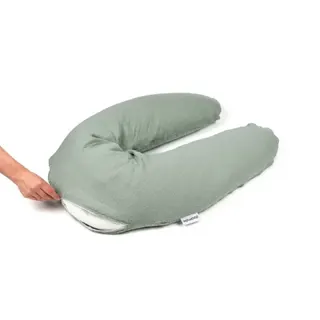 −9 %DoomooComfy Big nursing and maternity pillow, Tetra Green – Doomoo619 DH
instead of 680 DHView product −9 %DoomooBuddy maternity and nursing pillow, Mushrooms – Doomoo810 DH
instead of 890 DHView product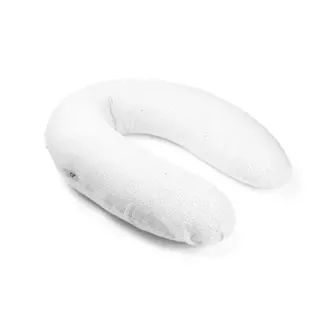 DoomooBuddy nursing and maternity pillow, Silver Dots – Doomoo890 DHView product
 - The whole aisle · Pregnancy and nursing pillows20 products online, delivered anywhere in Morocco.Open the aisle
Products sold by La Maison du Bébé, publisher of this magazine. Prices as of 12 October 2026; please check the product page.
Head to the maternity unit when contractions stop you talking, come every 3 to 5 minutes and last about a minute, or sooner if your waters break (CHUV). All the landmarks are in our article on the signs of labour.
Frequently asked questions
Can I ask for an epidural if I had planned to give birth without one?
Yes. The NHS advises writing down your wishes but keeping an open mind, because you may need more pain relief than you expected. An epidural is placed by an anaesthetist, so only where one is available. Ask your maternity unit in advance whether an anaesthetist is on site day and night, and up to what point in labour an epidural can still be given.
How long does a birth without an epidural take?
The length depends less on the epidural than on labour itself. According to the CHUV, the first phase, before 4 cm of dilation, can last a few hours, may even stop and restart, and is longer with a first baby. The WHO points out that dilation slower than 1 cm per hour is not, on its own, a reason to intervene.
Is a birth ball useful during labour?
It is often offered in the birth room and can be used at home during the first phase. Sitting on a large ball lets you move your pelvis, stay upright and rest without lying down, which can help labour progress according to the INSPQ. Keep something to hold on to within reach, such as a bed, a table or your companion.
Can I eat and drink during labour without an epidural?
During the first phase at home, the CHUV advises eating lightly (slow-release carbohydrates, fruit) and drinking regularly. Once at the maternity unit, rules vary from one establishment to another and depend on your medical situation, so ask beforehand. Drinking in small sips helps you keep your energy up during a long labour.
Sources
- Techniques et positions pour apprivoiser la douleur pendant le travailMieux vivre avec notre enfant, INSPQ · Canada (Quebec)
- Pain relief in labourNHS · United Kingdom
- Comment se déroule un accouchement ?Assurance Maladie (ameli.fr) · France
- Making childbirth a positive experienceWorld Health Organization (WHO) · International
- Mise en route du travail de l'accouchementCHUV, Department of Women, Mothers and Children · Switzerland
- Vous attendez un bébéGeneva University Hospitals (HUG) · Switzerland