










Article contents
Key points
- The due date is an estimate: being born between 37 and 42 weeks is normal.
- From 41 weeks, close monitoring checks baby's heart and the amniotic fluid.
- A membrane sweep may avoid an induction, with your prior agreement.
- An induction often takes many hours, sometimes over a day: plan for it.
- You can ask all your questions, and refuse a scheduling made without medical reason.
Your due date passed five days ago. The phone rings constantly (“so, still nothing?”), your mother-in-law recommends herbal teas, and you watch for every twinge. Then, at the monitoring appointment, the words come: induction of labour. For many mothers-to-be, it is the unknown, with the fear of a “forced” and more painful birth.
Yet induction is nothing exceptional. In France, about one birth in four is induced (25.8% in 2021 according to the Assurance Maladie). Here is when it is offered, what actually happens, how long it can take and the questions to ask the team.
Overdue: from when?
The due date, calculated at 40 weeks of amenorrhoea (weeks since the last period), is only an estimate. A baby is full term from 37 weeks and can be born without problems up to 42 weeks; most are born between 39 and 41 weeks (INSPQ). Our article on calculating weeks of pregnancy explains this difference between weeks of amenorrhoea and months.
The words vary between countries, which creates misunderstandings:
| Term | France (CNGOF) | Switzerland (CHUV) |
|---|---|---|
| Term | 37 weeks to 41 weeks and 6 days | 39 to 41 weeks |
| Prolonged or late-term pregnancy | from 41 weeks | 41 to 42 weeks |
| Post-term (overdue) | from 42 weeks | beyond 42 weeks |
In France, 15 to 20% of pregnancies go past 41 weeks, but only about 1% reach 42 weeks. In Morocco, ask your gynaecologist which date they use and from when they plan monitoring: in France, it is the dating from the first-trimester ultrasound that counts.

What is monitored after the due date?
From 41 weeks, French recommendations provide for monitoring two to three times a week. It rests on two simple examinations:
- recording baby's heartbeat (cardiotocography);
- measuring the amniotic fluid on ultrasound: too little fluid can lead to induction.
Between appointments, your best tool remains how you feel. If your baby moves less, do not wait for the next check: go to the maternity unit.
Why not wait indefinitely? Because certain risks rise slowly week by week: falling amniotic fluid, a bigger baby, stained fluid (meconium), more frequent caesareans. Perinatal mortality thus goes from 0.7 per 1,000 at 37 weeks to 5.8 per 1,000 at 43 weeks (CNGOF). These figures remain low, but they justify not letting a pregnancy run past 42 weeks without monitoring or discussion.
When is induction offered?
For an overdue pregnancy, with no other problem, the CNGOF recommends offering induction between 41 weeks and 42 weeks and 6 days. The exact timing depends on your situation, your preferences and how the maternity unit is organised. The CHUV in Lausanne, for example, does not induce before 41 weeks and 3 days without a risk factor, and induces routinely at 42 weeks. In the UK, the NHS offers it from 41 weeks.
For a medical reason, it can happen earlier: waters broken without contractions, diabetes, high blood pressure, cholestasis, a baby who is growing poorly (ameli, NHS).
“Elective” induction, without a medical reason, is possible in France only from 39 weeks and if the cervix is already favourable, meaning softened and slightly open (HAS). It is a choice to discuss, not a formality.
Membrane sweep: the first step
Before turning to medication, the midwife or doctor may offer a membrane sweep. During an internal examination, a finger is passed between the cervix and the bag of waters to separate them, which releases hormones that can start labour. The NHS offers it from 39 weeks.
According to the CNGOF, this reduces the use of induction by 41% at 41 weeks, without raising the caesarean rate or the risk of infection. It can be uncomfortable, and cause contractions and light bleeding. It should never be done without your knowledge during a routine examination: your agreement is asked first.
Methods of induction, step by step
The choice depends mostly on the state of the cervix and on whether it is a first baby (INSPQ). Products and doses are decided by the team.
- Prepare the cervix if it is closed: hormones (prostaglandins) as a gel, tampon or tablet, placed in the vagina or taken by mouth, soften the cervix and open it by a few centimetres. A second application is sometimes needed (HAS).
- Or open it mechanically: a small catheter fitted with a balloon, inflated in the cervix, helps it to open. It causes fewer excessive contractions (CNGOF).
- Break the bag of waters when the cervix allows. This is no more painful than an examination of the cervix and does not hurt the baby (INSPQ).
- Start or strengthen contractions with an oxytocin drip, the natural hormone of labour, if they do not establish themselves.
As soon as labour starts, baby's heartbeat is recorded continuously (HAS). If you have already had a caesarean, some methods are avoided and induction is discussed with more caution, because the risk of rupture of the uterine scar rises, especially with prostaglandins (CNGOF).
How long does an induction take, and what is it like?
You need patience. Hormones often take many hours to act (NHS). An induction can last several hours, sometimes an extra night, and end in a caesarean, a Moroccan obstetrician-gynaecologist reminds readers in TelQuel. He also notes that some devices or medicines are hard to obtain or poorly reimbursed in Morocco: ask your maternity unit which methods it uses.
As for sensations, induced contractions are often intense and can be more painful than a spontaneous start to labour (HAS, NHS). All pain relief options remain possible: the epidural, once labour is sufficiently advanced, and in the meantime positions, the ball, a hot shower or breathing, detailed in our article on methods for giving birth without an epidural.
Possible drawbacks: a longer stay, more examinations, slightly more births with forceps or vacuum (NHS), and sometimes contractions that are too strong or dilation that stops, which can lead to a caesarean. These difficulties are a little more frequent when the cervix was not favourable at the start (HAS).
Preparing for a scheduled induction
Eat lightly before leaving, bring something to occupy you (book, music, charger) and plan a comfortable outfit for walking in the corridor. Your companion should know the wait can be long. The full list is on our maternity bag page, and the other end-of-pregnancy preparations in our article on the ninth month.
From the shop
A bag ready for the big day
An induction is sometimes scheduled to within a few days: you may as well have your maternity bag ready from the eighth month. Here are some models, from the simplest to the roomiest.
 −48 %Pasito a PasitoElodie maternity bag, blue – Pasito a Pasito676 DH
instead of 1 300 DHView product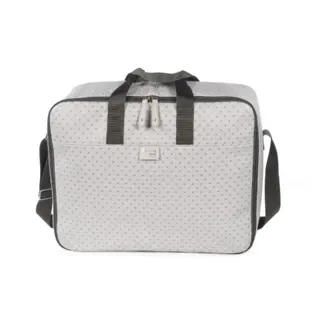 −41 %Walking MumArchie maternity bag – Walking Mum755 DH
instead of 1 290 DHView product −48 %Pasito a PasitoBohemian maternity bag, blue – Pasito a Pasito780 DH
instead of 1 500 DHView product −48 %Pasito a PasitoSherwood maternity bag, grey – Pasito a Pasito832 DH
instead of 1 600 DHView product −48 %Pasito a PasitoLittle Stars maternity bag, pink – Pasito a Pasito858 DH
instead of 1 650 DHView product- The whole aisle · Maternity bags12 products online, delivered anywhere in Morocco.Open the aisle
Products sold by La Maison du Bébé, publisher of this magazine. Prices as of 12 October 2026; please check the product page.
And if labour starts by itself before the appointment? All the better. Revisit the signs that labour is starting to know when to leave.
Frequently asked questions
Can you refuse an induction?
Yes, it is your choice, after clear information on the benefits and risks. In the UK, a woman who declines induction beyond 42 weeks is offered enhanced monitoring of the baby. In France, the HAS also states that you can refuse a scheduling decided for organisational reasons, without any effect on the quality of care.
Does induction hurt more than a spontaneous labour?
Often a little more: induced contractions are generally intense and can be more painful than a natural start to labour, according to the HAS and the NHS. Induction does not deprive you of any pain relief: the epidural can be placed once labour is sufficiently advanced, and other means are offered in the meantime.
Can dates, pineapple or herbal teas bring on labour?
No home method has been shown to start labour, the NHS reminds us: neither hot baths, nor foods, nor drinks. Plants and infusions sold to “open the cervix” are not controlled and can be dangerous for you or the baby. Dates are part of a normal diet, but do not count on them to replace monitoring.
What happens if the induction does not work?
If the cervix does not change enough, the team may offer another method, pause and reassess a few hours later or, depending on the situation, offer a caesarean. The risk of failure is a little higher when the cervix was closed and firm at the start. Ask in advance how your maternity unit proceeds in that case.
Sources
- Grossesse prolongée et terme dépassé : recommandations pour la pratique clinique (2011)Collège national des gynécologues et obstétriciens français (CNGOF) · France
- Fiche d'information destinée aux femmes enceintes concernant le déclenchement artificiel de l'accouchementHaute Autorité de santé (HAS) · France
- Quand mon enfant devrait-il naître ?CHUV, Département femme-mère-enfant · Suisse
- Inducing labourNHS · Royaume-Uni
- Déclenchement artificiel du travailMieux vivre avec notre enfant, INSPQ · Canada (Québec)
- Comment se déroule un accouchement ?Assurance Maladie (ameli.fr) · France
- [Tribune] Pourquoi pratique-t-on autant de césariennes au Maroc ?TelQuel · Maroc