










Article contents
Key points
- A high-risk pregnancy points to a maternity unit with a neonatal unit on site.
- Ask whether the anaesthetist and the obstetrician on call are present at night, not just reachable.
- A written quote should itemise vaginal birth, caesarean, epidural, room and neonatal care.
- Visit before choosing, and test the journey at rush hour.
Choosing a clinic to give birth in Casablanca, or a public hospital in Rabat, Marrakech or elsewhere, is often done by word of mouth: the cousin's clinic, the gynaecologist's, the one closest to home. These are good starting points. But they do not answer the questions that really matter on the day, especially at night, and especially if something does not go as planned.
We do not rank establishments: each has its strengths, and your situation counts as much as their reputation. Instead, here are the criteria to check, and the questions to ask before you decide.
Public hospital or private clinic: what changes?
The difference lies mostly in organisation. In a clinic, you are generally followed and delivered by the gynaecologist of your choice, in a more private room, at higher cost. In a public hospital, the on-call team, midwives and doctors, takes charge of you, often with less privacy but a much lower cost.
University hospital centres (CHU) take the most complicated pregnancies and generally have the most complete services for sick or premature newborns. A clinic can be very well equipped, or much less so: it all depends on the establishment. Hence the value of asking the same questions everywhere.
| What to check | Why it matters |
|---|---|
| Neonatal unit on site | A premature or sick baby is treated without transfer |
| Anaesthetist present day and night | Epidural and emergency caesarean possible at any hour |
| Dedicated or nearby operating theatre | An urgent caesarean is decided within minutes |
| Midwife present throughout labour | Continuous monitoring while waiting for the doctor |
| Private room and companion's bed | Rest, privacy, your partner's presence at night |
| Written quote and AMO cover | No unpleasant surprise at discharge |

The first criterion: baby's safety
The first question to ask: is there a neonatal unit in the establishment, with paediatricians available day and night? If a baby is born too early, has trouble breathing or needs close monitoring, they are treated on site, a few metres from you. In some European maternity units, the neonatal unit sits right inside the department and parents have access 24 hours a day.
Without a neonatal unit, a newborn who needs intensive care must be transferred, sometimes to another city, while the mother stays in hospital elsewhere. For an uncomplicated pregnancy, the risk is low. For a twin pregnancy, diabetes, high blood pressure, a history of prematurity or a baby known to need care, this criterion becomes the priority. Discuss it with your gynaecologist: they can tell you what level of care your pregnancy requires.
Epidural, theatre, on-call: who is there at 3 a.m.?
A birth does not choose its hour. So ask who is physically present at night and at weekends, not just “reachable”: an anaesthetist, an obstetrician-gynaecologist, a midwife, a paediatrician. At the Hôpitaux universitaires de Genève, for example, the anaesthesia team is available day and night, and more than 80% of women there choose an epidural. In France, it was nearly 83% in 2021.
If you want an epidural, ask whether it is possible at any hour, and whether an anaesthesia consultation is needed before your due date. Our article on the epidural explains how it goes. Same question for a caesarean: where is the theatre, and how long does it take to operate in an emergency? The situations that lead there are detailed in our article on the caesarean.
Room, partner, visitors: the comfort that counts too
The stay lasts a few days, and the quality of your rest affects how breastfeeding gets going as well as your mood. Find out about:
- the room: private or shared, private bathroom, bed or armchair for your companion;
- your partner's presence: in the delivery room, during the epidural, in theatre for a planned caesarean, and at night in the room;
- visitors: hours, number of people, rules for children;
- baby in the room: day and night, or in the nursery;
- meals: suited to breastfeeding, and whether you may bring your own.
Some European maternity units protect an afternoon rest period and limit visitors outside the family circle. What happens during these days is detailed in our article on the first days in the maternity unit.
The team's practices: skin-to-skin, breastfeeding, freedom to move
Two equally safe maternity units can work in very different ways. Ask about skin-to-skin from birth, recommended even after a caesarean. Ask whether a midwife or lactation consultant can help you with the first feeds. If you want to move during labour, ask about balls, the bath or the “natural” rooms that some units offer.
Finally, ask how the team welcomes a written birth plan, and bring yours to the visit if you have already drafted it.
How much does it cost? Insist on a written quote
We do not give prices: they vary from one establishment to another and change often. Ask instead for a detailed written quote, and check that it states:
- the package for a vaginal birth, and the one for a caesarean;
- the epidural, and the anaesthetist's fees;
- the room price per night, private or shared, and that of the companion;
- the gynaecologist's and paediatrician's fees;
- the cost of a day in neonatal care, if baby has to be admitted;
- what is billed separately: medicines, tests, consumables;
- the amount to advance on admission, and the accepted means of payment.
Then show this quote to your health insurance body (AMO) and your top-up insurer, if you have one. Pregnancy follow-up is covered by the AMO under the conditions set by regulations: ask in black and white what will be reimbursed for the birth and the stay, and within what time. Our article on baby's budget in Morocco helps you plan for the rest.
From the shop
Once you have chosen your maternity unit
A bag ready by the seventh month and a document holder to keep your pregnancy file, test results and blood group card in one place: two purchases that make leaving for the hospital simpler.
 −48 %Pasito a PasitoElodie maternity bag, blue – Pasito a Pasito676 DH
instead of 1 300 DHView product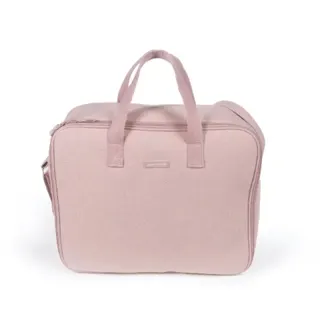 −48 %Pasito a PasitoBohemian maternity bag, pink – Pasito a Pasito780 DH
instead of 1 500 DHView product −48 %Pasito a PasitoChelsea maternity bag, blue – Pasito a Pasito858 DH
instead of 1 650 DHView product −35 %DoomooMommy Vanity maternity pouch, Sand, beige corduroy – Doomoo774 DH
instead of 1 190 DHView product −48 %Pasito a PasitoCotton health record cover, white – Pasito a Pasito234 DH
instead of 450 DHView product −48 %Pasito a PasitoBohemian health record cover, grey – Pasito a Pasito312 DH
instead of 600 DHView product- The whole aisle · Maternity bags12 products online, delivered anywhere in Morocco.Open the aisle
Products sold by La Maison du Bébé, publisher of this magazine. Prices as of 12 October 2026; please check the product page.
Distance and journey: a criterion not to underestimate
A well-regarded but distant maternity unit can become a trap on a traffic-jam evening. In Quebec, Naître et grandir advises, for a second baby, leaving as soon as contractions are 10 minutes apart if the place of birth is more than 30 minutes away. In France, the Assurance Maladie can even cover accommodation near the maternity unit, close to the due date, for women living more than 45 minutes away.
In Casablanca as in other big cities, do the journey at rush hour before choosing, locate the night emergency entrance and the car park. Our article on the signs of labour then helps you know when to set off.
The list of questions to ask during the visit
Take a screenshot, and tick them off as you go:
- Is there a neonatal unit on site? Do parents have access day and night?
- Who is present at night and at weekends: anaesthetist, gynaecologist, paediatrician, midwife?
- Is an epidural possible at any hour? Is an anaesthesia consultation needed beforehand?
- Who delivers me if my gynaecologist is not available?
- What is your caesarean rate? And your episiotomy rate?
- Can my partner attend the birth, and a caesarean?
- Is skin-to-skin offered straight away? Who helps me with breastfeeding?
- How many days does the stay last after a vaginal birth, and after a caesarean?
- Private or shared room? Can my companion sleep on site?
- What are the visiting rules?
- Can you give me a detailed written quote?
- How do you work with my health insurance?
Frequently asked questions
When should you choose your maternity unit?
As early as possible, ideally during the second trimester. That leaves time to visit, compare quotes, sort out the paperwork with your insurer and, if the unit offers it, meet the anaesthesia team. If a gynaecologist in private practice follows you, the question often comes up in the first consultations: ask where they deliver.
Can you change maternity unit during pregnancy?
Yes, most of the time. A complication, a move or a bad feeling during the visit are good reasons to change. Then ask for a complete copy of your file (scans, tests, blood group, reports) and pass it to the new establishment, or to your new gynaecologist, before the end of the eighth month.
What if my gynaecologist is not available on the day?
It can happen: a birth cannot be scheduled, except for an induction or planned caesarean. Ask in advance who stands in, whether a colleague from the clinic or the on-call team, and who follows the labour until they arrive. A clear answer to this question says a lot about how the establishment is organised.
Do you need insurance approval before giving birth in a clinic?
Find out from the second trimester from your health insurance body and your top-up insurer, if you have one: documents to provide, possible prior approval, share reimbursed, timescales. Then ask the clinic how it works with your insurer. You will know what sum to advance on the day, and what will be reimbursed afterwards.
Sources
- Giving birthHôpitaux universitaires de Genève (HUG) · Suisse
- Naître au CHU de Liège (brochure Bonjour naître, 2023)CHU de Liège · Belgique
- Comment se déroule un accouchement ?Assurance Maladie (ameli.fr) · France
- Quand se rendre au lieu de naissance ?Naître et grandir · Canada (Québec)
- Maternité et travail : quels sont vraiment les droits des mères salariées ?Femmes du Maroc · Maroc