





Article contents
Key points
- The type of placenta, seen at the first-trimester scan, shapes all your antenatal care.
- Shared placenta: a scan about every two weeks; separate placentas: about every month.
- Between half and six in ten twins are born before 37 weeks.
- Vaginal birth is often possible, especially if the first baby is head down.
- Breastfeeding two babies is possible: milk production follows demand.
Two sacs, two hearts beating on the screen: it is twins. Once the shock has passed, joyful or dizzying, the questions come thick and fast. A twin pregnancy is not simply a pregnancy “times two”: the check-ups are more frequent, the tiredness more marked, the birth often earlier, and organising the household changes scale.
The good news is that the essentials can be prepared. Here is what really matters, from the placenta to the pushchair.
Identical or non-identical twins: how do they form?
According to the UK’s NHS, a third of twins are identical (monozygotic) and two thirds non-identical (dizygotic).
Identical twins come from a single fertilised egg that splits in two. They have the same genes and are always the same sex. No one knows what causes this split: it happens in about one pregnancy in 250, and it is not hereditary.
Non-identical twins come from two eggs fertilised at the same time. They are no more alike than any two siblings. They are more common after 35, when there is a history on the mother’s side, depending on ethnic background and after IVF. Assisted reproduction and later pregnancies also explain why multiple births have become more common.

Monochorionic or dichorionic: why the placenta changes everything
This is the first question the doctor asks, and the most important. It is settled at the first-trimester scan, ideally before 14 weeks, when it is easiest to see whether the babies share a placenta.
| Type of pregnancy | Placenta and amniotic sac | What it means |
|---|---|---|
| Dichorionic | One placenta and one sac per baby | The most common case; non-identical twins in 90% of cases |
| Monochorionic diamniotic | One shared placenta, two sacs | Always identical twins; closer monitoring |
| Monochorionic monoamniotic | One placenta and a single sac | Very rare; specialist care |
A shared placenta carries a specific complication: twin-to-twin transfusion syndrome. Blood vessels connect the two babies’ circulations and unbalance the blood exchange between them. It affects 10 to 15 monochorionic pregnancies in 100 according to the NHS, 15 in 100 according to the Louis-Mourier maternity hospital in Paris. The scans are so frequent precisely to spot it early and treat it in a specialist centre.
What does antenatal care for twins look like?
Appointments are more frequent than for a single baby, especially towards the end of pregnancy. The Louis-Mourier hospital’s booklet plans a monthly appointment with an obstetrician, and a scan:
- about every month for a dichorionic pregnancy;
- about every two weeks for a monochorionic pregnancy.
Each scan checks the growth of both babies. What each scan is for is set out in our article on pregnancy ultrasound scans.
Countries do not all make the same choices. The NHS includes a measurement of cervical length between 16 and 20 weeks, while a presentation from Strasbourg University Hospital points out that in France this screening is not routine in the absence of symptoms.
This monitoring exists because complications are more common. The first is premature birth: between half (according to Naître et grandir) and six in ten twins (according to the NHS) are born before 37 weeks. Low birth weight, iron-deficiency anaemia and pre-eclampsia are also more common.
In Morocco, this risk matters when choosing where to give birth: a nearby maternity unit with a neonatal department becomes a priority. Our pointers for choosing a maternity unit in Morocco will help you ask the right questions.
Fatigue, nausea, appetite: daily life with two babies
With twins, the body changes faster and more intensely, explains Quebec’s Mieux vivre guide: tiredness can be very strong and discomforts more marked. Nausea is often worse, and a womb pressing on the stomach quickly takes away your appetite.
You will need to eat a little more than for one baby. The same guide suggests:
- snacks or small meals in addition to your usual meals;
- nutrient-rich foods rather than empty calories;
- nourishing drinks, such as milk or smoothies;
- vitamin and mineral supplements, only if they are prescribed for you.
The basic rules remain those of eating well during pregnancy. As for rest, the Louis-Mourier hospital makes relative rest the first measure to prevent premature birth. Talk to your doctor about work early on, and find out about your rights with our article on maternity leave in Morocco.
How are twins born?
The timing of the birth depends on the placenta. When all is well, the NHS offers a planned birth at:
- 37 weeks for dichorionic twins;
- 36 weeks for monochorionic diamniotic twins;
- 32 to 33 weeks for twins who also share the same sac.
In France, practice allows more leeway: the Louis-Mourier hospital considers birth from 37 or 38 weeks, without going beyond 40, and Strasbourg University Hospital places the birth of monochorionic diamniotic twins between 36 and 38 weeks.
The birth takes place in hospital, with a larger team: in the United Kingdom, two midwives, an obstetrician and two paediatricians. Each baby’s heartbeat is recorded continuously, and an epidural is generally recommended, so the team can act quickly if needed.
Vaginal birth is often possible, especially when the first baby is head down. A caesarean is more likely to be planned if the first baby is breech, if one of the two is lying sideways, if the placenta is low or if the babies share a single sac. The NHS also mentions a shared placenta, whereas in France the 2009 guidelines do not favour one method over the other in that case. Sometimes one twin is born vaginally and the second by caesarean. Twins more often need neonatal care after birth.
Breastfeeding twins: it is possible
Yes, and Naître et grandir sums it up: the more the breasts are stimulated, the more milk they produce, so two babies feeding keep up enough milk for two. A few pointers:
- start early, as soon as possible after the birth;
- one baby at a time at first, then both together once they are feeding well, to save time;
- alternate breasts from one feed or one day to the next; a coloured bracelet helps you remember;
- if the babies are premature, express your milk every two to three hours until they can breastfeed.
Breastfeeding twins requires an extra 500 to 1,000 calories a day, according to the same source. Positions for two are illustrated in our article on breastfeeding positions.
Equipment: what you really need two of
Double up on anything to do with safety and sleep. Keep everything else simple.
| Two of | One is enough |
|---|---|
| Sleeping space: a crib or cot per baby | Changing table |
| Car seats | Baby bath |
| Pushchair for two (or double) | Baby monitor |
| Bodysuits, sleepsuits, sleeping bags | Changing bag, if it is large |
Each baby sleeps on their back, in their own cot, with no bumper or duvet: the rules are in our article on safe sleep. A travel cot makes a second bed at the grandparents’. For the pushchair, the choice between side-by-side and tandem models is explained in our guide to choosing a pushchair, and our range of twin pushchairs shows the options available.
From the shop
Equipping for two, without doubling everything
A suitable pushchair, a safe place to sleep for each baby and a large cushion for feeding both at once: a few ideas, to adapt to your home and lifestyle.
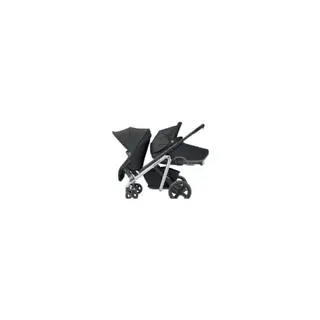 −48 %Maxi Cosi - Bébé ConfortAdditional seat for Lila stroller, Black – Maxi-Cosi1 976 DH
instead of 3 790 DHView product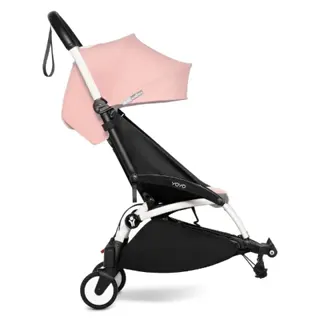 −48 %BabyzenYOYO Connect frame, white – Babyzen2 912 DH
instead of 5 600 DHView product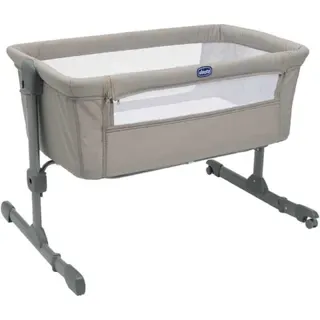 −48 %ChiccoNext2Me Essential bedside crib, Dune Re_Lux – Chicco1 347 DH
instead of 2 590 DHView product −46 %Bebe ConfortTravel playpen cot, Gray Mist – Bébé Confort857 DH
instead of 1 590 DHView product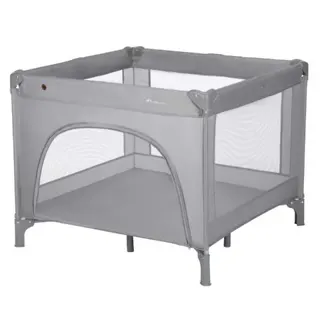 −9 %Bebe ConfortAdonis playpen and travel cot, Mineral Gray – Bébé Confort1 174 DH
instead of 1 290 DHView product −9 %BabymoovB.Love XXL pillow, Wind Blue – Babymoov683 DH
instead of 750 DHView product- The whole aisle · Twin strollers2 products online, delivered anywhere in Morocco.Open the aisle
Products sold by La Maison du Bébé, publisher of this magazine. Prices as of 12 October 2026; please check the product page.
A baby registry is a chance to share these double purchases with family and friends.
Getting help: the key to the first months
Naître et grandir advises talking with your partner about the help you want before the birth, and asking for it at the first signs of tiredness, without waiting until you are exhausted. At night, the father can bring the babies, change nappies and put them back down. Relatives can cook, shop or look after older siblings.
In Morocco, the extended family is often present during the nfissa, the forty days after the birth: this is the time to share out roles clearly. Our article on the mental load of new mothers offers ideas for sharing without guilt.
Frequently asked questions
How do you know whether twins are identical or non-identical?
Twins who share a placenta are always identical, coming from a single egg. With two placentas, they can be identical or non-identical: according to the Louis-Mourier maternity hospital in Paris, 90% of dichorionic pregnancies are non-identical twins. Babies of different sexes are necessarily non-identical. If in doubt, only a DNA test after birth gives a definite answer.
At how many weeks are twins born?
Often earlier than a single baby: between half and six in ten twins are born before 37 weeks. When all is well, the UK’s NHS offers a planned birth at 37 weeks if each baby has its own placenta, at 36 weeks if they share one, and at around 32 to 33 weeks if they also share the same amniotic sac. In France, practice allows a little more leeway.
Can twins be born vaginally?
Yes, it is often possible, particularly when the first baby is head down. A caesarean is more likely to be planned if the first baby is breech, if one of the two is lying sideways, if the placenta is low or if the babies share the same sac. The birth takes place in hospital, with a larger team, and an epidural is generally recommended.
Do you need to buy two of everything for twins?
No. Double up on what relates to safety and sleep: one sleeping space per baby, two car seats, a pushchair for two. One changing table, one bath and one baby monitor are enough. Buy more clothes, but babies grow fast: do not overdo it in any one size.
Sources
- Pregnant with twinsNHS · United Kingdom
- Antenatal care with twinsNHS · United Kingdom
- Giving birth to twins or moreNHS · United Kingdom
- Les grossesses gémellaires (livret d'information, mai 2015)Louis-Mourier maternity hospital, AP-HP · France
- Grossesses monochoriales : what's new in obstetrics ? (Journée du CPDPN, décembre 2024)Strasbourg University Hospital, Dr Chris Minella · France
- Grossesse à risque élevéMieux vivre avec notre enfant, INSPQ · Canada (Québec)
- Besoins alimentaires et grossesse multipleMieux vivre avec notre enfant, INSPQ · Canada (Québec)
- Allaiter des jumeauxNaître et grandir · Canada (Québec)