









Article contents
Key points
- Before 6 months, the American Academy of Pediatrics recommends that baby sleeps in the parents' room.
- Floor bed: firm, flat mattress, fitted sheet only, no pillow, duvet or soft toy before age 1.
- Keep the mattress away from walls and furniture so that no gap can trap the child.
- Anchor dressers, shelves and mirrors to the wall: about half of fatal tip-overs happen in a bedroom.
- Few toys, a low shelf, protectors costing a few dozen dirhams: the budget stays modest.
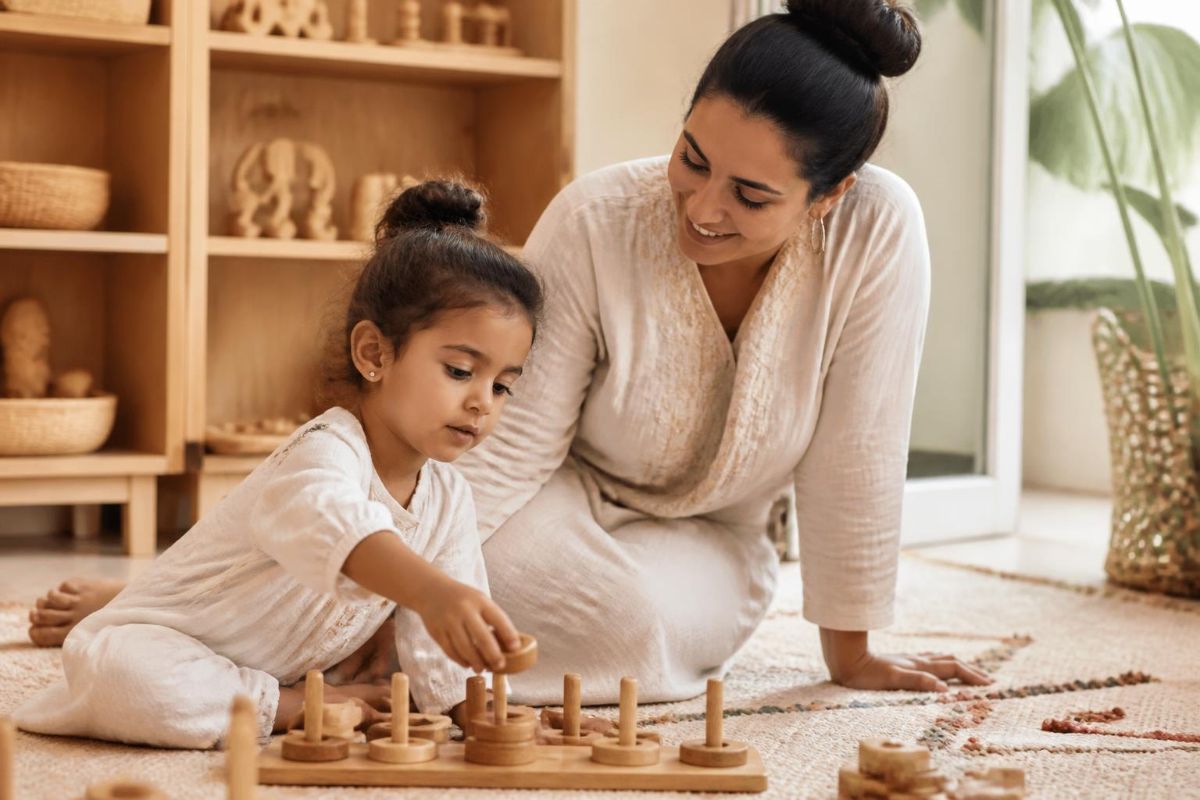
A mattress on the floor, a low shelf with three wooden toys, a mirror at skirting-board height: the Montessori bedroom appeals to a lot of parents. The idea is lovely, to give a child a space where they can move, choose and lie down on their own. It also demands rigour, because a bed with no bars turns the whole room into a playground.
Here are the principles of this set-up, the safety rules for a floor bed, how to make the room safe, and a realistic budget that does not mean buying everything.
What is a Montessori bedroom?
It is a room designed at the child's height, so that they can move around and act on their own. The Association Montessori Internationale (AMI) advises preparing the environment with clearly separate areas for sleeping, eating, being changed and moving.
In a bedroom, this generally means:
- a floor bed, which the child can get out of and return to alone;
- a movement area: a firm mat, toys within reach, sometimes a mirror;
- a low shelf with few toys, each one in its own place;
- simple decoration, at their eye level rather than yours.
An AMI trainer presents the floor bed as the most important help you can offer for sleep: the adult can sit beside the child at bedtime, then gradually step back. For the other rooms of the home, see our article on Montessori at home.

The floor bed: from what age?
Montessori texts make it a pillar of sleep without giving a precise age. The health authorities we consulted give no age either, but they set rules that apply to any sleep surface before age 1. And one of them changes the arrangement: the American Academy of Pediatrics (AAP) recommends that baby sleeps in the parents' room, on a separate sleep surface, for at least the first 6 months.
In practice, the floor bed in baby's own room can serve first for play and quiet moments, then for nights once baby leaves your room. Later on, a low bed keeps a clear advantage: the Australian safe sleep organisation Red Nose considers a low bed or a mattress on the floor preferable for a young child, because it reduces the height of a fall. Many children move from a cot to a bed between 2 and 3 years, earlier if they climb the bars, Red Nose notes.
Floor bed: the safety rules
A floor bed follows exactly the rules of safe sleep. The AAP applies them to every baby under 1: a firm, flat surface, a fitted sheet and nothing else.
The mattress deserves a proper purchase: our cot and mattress buying guide helps you choose. In summer, with the heat and the chergui (the hot, dry desert wind), our advice on keeping baby cool in hot weather helps you set the room temperature and night clothes.
Making the room safe: the whole bedroom becomes their territory
With a bed that has no bars, the child gets up whenever they like, including at night or after a nap, while you are in another room. The entire room has to be safe.
The AAP's figures on tipping furniture are striking: 77% of tip-over deaths in the United States between 2000 and 2019 involved children under 6, and about half of fatal accidents happen in a bedroom. Its advice:
- Anchor to the wall dressers, shelves, wardrobes, televisions and mirrors, preferably with metal brackets.
- Put heavy items low and light ones high.
- Leave no toy up high, on a dresser or shelf, which would tempt the child to climb.
- Fit drawer stops so they cannot pull drawers all the way out and use them as steps.
Red Nose adds: lock windows or fit window stops, put blind and curtain cords out of reach, and make heaters, lamps, fans, sockets and electrical cords inaccessible. The INSPQ in Quebec asks for socket covers pushed in firmly and reminds us that blind cords are dangerous for children. Then go round the rest of the house with our room-by-room safety checklist.
From the shop
Making a Montessori bedroom safe and ready
Socket covers, drawer locks, corner guards, a night light, a play mat: the essentials for a room where a child moves freely cost little. We include no bed reducer or baby positioner, which are discouraged for sleep.
 −10 %Safety 1stSocket covers, 12 pieces with 4 keys – Safety 1st27 DH
instead of 30 DHView product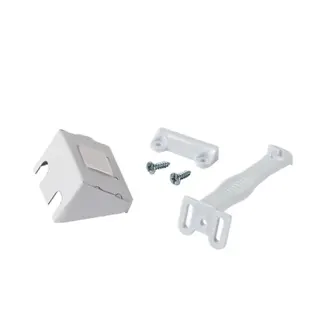 −35 %Safety 1stDrawer locks, set of 7 – Safety 1st26 DH
instead of 40 DHView product −10 %Safety 1stGel corner protectors, x4 – Safety 1st27 DH
instead of 30 DHView product −8 %Safety 1st2-in-1 door stopper – Safety 1st46 DH
instead of 50 DHView product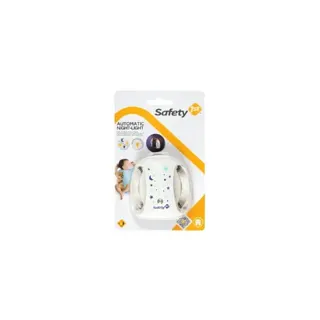 −35 %Safety 1stArctic automatic night light – Safety 1st150 DH
instead of 230 DHView product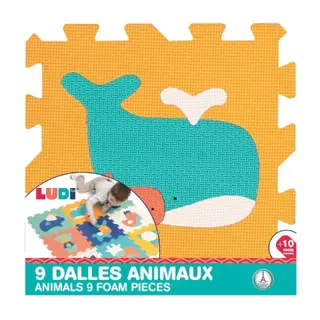 −42 %LudiAnimal tiles play mat, from birth – Ludi143 DH
instead of 245 DHView product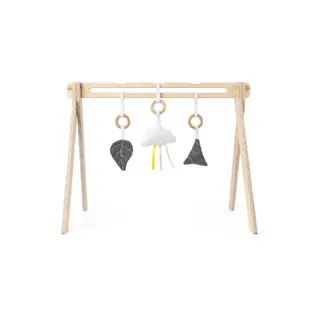 −9 %DoomooCocoon arch with removable toys – Doomoo628 DH
instead of 690 DHView product- The whole aisle · Ergonomic mattresses and cot reducers15 products online, delivered anywhere in Morocco.Open the aisle
Products sold by La Maison du Bébé, publisher of this magazine. Prices as of 12 October 2026; please check the product page.
Low shelf, mirror, play corner: setting up at their level
The low shelf is the central piece of furniture. Put only a few toys on it, four or five, each in a basket or on a tray, and rotate them according to their interests. Storage boxes and baskets keep the rest out of sight. The shelf is anchored to the wall, even though it is low.
The movement area comes down to a firm mat on the floor. The AMI insists on freedom to move, with no container that immobilises the child, and on comfortable clothes that leave movements free: we describe this principle in our article on free movement. The mirror is optional: if there is one, it is shatterproof and screwed to the wall.
Finally, keep a place for yourself: an armchair or a floor cushion to read a story or stay close at bedtime. Our decorative cushions and floor mattresses range includes some for the reading corner.
What budget for a Montessori bedroom?
Generally less than a classic bedroom, since there is no cot to buy. The non-negotiable expenses are the mattress and safety.
| Item | Essential? | Price guide |
|---|---|---|
| Firm mattress of the right size | Yes | See our guide P70 |
| Socket covers, drawer locks, corner guards | Yes | About 26 to 46 DH each in our catalogue |
| Wall fixings for furniture | Yes | Hardware store |
| Firm play mat | Useful | From 143 DH in our catalogue |
| Night light | Useful | From 150 DH in our catalogue |
| Low shelf, baskets | Useful | An existing piece of furniture can do, anchored to the wall |
| House bed, mirror, decoration | Optional | As you wish |
A successful Montessori bedroom has nothing of a decoration catalogue about it: it is a simple, safe room where the child finds what they need on their own.
Frequently asked questions
At what age can you start using a floor bed?
No health authority sets an age for the floor bed. However, the American Academy of Pediatrics recommends that baby sleeps in the parents' room, on a separate sleep surface, for at least the first 6 months. A floor bed in baby's own room can therefore serve for play first, then for nights. If it is in your room, the same rules apply: firm mattress, fitted sheet only, away from walls.
Are Montessori house beds safe?
They can be, as long as the mattress fills the frame exactly. The Australian organisation Red Nose asks you to check that no gap forms between the mattress and the wall, headboard, frame or a guard rail, because a child could get trapped in it. Choose a low, stable frame with no decoration that clothing or a cord could catch on.
What if my child gets out of bed at night?
That is the whole point of a floor bed: the child can get out alone. Safety therefore rests on the entire room: furniture anchored to the wall, windows locked or fitted with window stops, curtain cords out of reach, sockets covered, heaters and fans inaccessible. A soft night light and a baby monitor can complete these precautions.
Do you need a mirror in a Montessori bedroom?
It is not compulsory. In the Montessori spirit, it is often placed at floor level, next to the mat, so that baby can watch themselves while playing. If you do, the American Academy of Pediatrics asks that mirrors be fitted with anti-tip fixings, like furniture. Choose a shatterproof mirror with no sharp edges, firmly screwed to the wall and never just leaned against it.
Sources
- Collaborating Toward Sleep IndependenceAssociation Montessori Internationale (AMI) · International
- Meeting an Infant's Movement NeedsAssociation Montessori Internationale (AMI) · International
- How to Keep Your Sleeping Baby Safe: AAP Policy ExplainedAmerican Academy of Pediatrics (HealthyChildren.org) · United States
- Preventing Furniture and TV Tip-OversAmerican Academy of Pediatrics (HealthyChildren.org) · United States
- Moving Your Child from a Cot to a BedRed Nose Australia · Australia
- Aménager un environnement sécuritaire pour votre enfantMieux vivre avec notre enfant, INSPQ · Canada (Quebec)
- Prévenir la tête plate : conseils aux parentsHaute Autorité de santé (HAS) · France