







Article contents
Key points
- Choose your paediatrician during pregnancy: the first visit comes quickly.
- Proximity, reachability and how emergencies are handled matter as much as reputation.
- The health centre gives the national programme vaccines free of charge.
- Bring the health record book to every consultation, and write your questions down beforehand.
- In a serious emergency, call 141, not the surgery.
You are eight months pregnant, the hospital bag is nearly packed, and someone asks: "Have you chosen your paediatrician?" The question often comes late. Yet it deserves to be settled before the birth, because the first follow-up appointment arrives within weeks of leaving the maternity ward, and a feverish baby at 10 p.m. is not the moment to start looking for a doctor.
There is no "best paediatrician" in absolute terms. There is the one who suits your family: nearby, reachable, clear in their explanations. Here is how to choose, what to expect from them, and how to organise for emergencies.
Paediatrician, GP or health centre: who does what?
All three can take part in your child's follow-up, and they complement one another.
| Who | What they do best |
|---|---|
| Paediatrician (private practice or clinic) | doctor specialising in children: regular follow-up, common and chronic illnesses, development, quick opinions for infants |
| General practitioner (GP) | common illnesses, follow-up of a healthy child, especially when they already know the whole family |
| Health centre (public) | national programme vaccines, free of charge, and monitoring of weight and growth |
| Specialists (paediatric cardiologist, eye specialist, ENT…) | on referral, for a specific problem |
In Morocco, the Ministry of Health's health record book advises, during the first weeks, having your baby weighed at the health centre or a doctor's surgery. The vaccines of the National Immunisation Programme are free there; their ages are detailed in our vaccination schedule in Morocco. Many families combine: vaccines at the health centre, follow-up and illnesses with the paediatrician.

How often should you go in the early years?
The child health record book in Morocco schedules systematic check-ups at specific ages:
- at birth, in the delivery room and within the first two days;
- at the time of the BCG vaccine;
- on discharge from the maternity ward;
- at the end of months 1, 2, 4, 6, 9 and 12;
- at 18, 24 and 36 months;
- at a pre-school visit between 3 and 5 years;
- in the first year of primary school, then in the first year of middle school.
Other countries follow a similar logic. The Merck Manuals note that the American Academy of Pediatrics schedules visits at 12, 15, 18, 24 and 30 months, then once a year until age 10, with more visits if the doctor or the family find them useful. In France, the health record book also schedules an examination before day 8, then at 2, 4 and 9 months, according to La Revue du Praticien.
At each visit, the doctor measures weight, height and head circumference, checks development, eyesight and hearing, gives or checks vaccines and offers safety and feeding advice, describe the Merck Manuals. How to read the measurements is explained in our article on the growth chart.
What criteria should you use to choose a paediatrician?
Proximity. A surgery twenty minutes away rather than an hour makes all the difference when your baby is ill, when it is 40°C in the middle of the chergui (the hot desert wind) or when you do not have a car. Think also about the journey from nursery or work.
Reachability. How do you book an appointment? Can you reach the surgery by phone or message for a simple question? Are there same-day slots for sick children?
How emergencies are organised. In the evening, at weekends, during their holidays: who covers for them, and which clinic or hospital do they refer you to?
The way they communicate. Do they explain what they are doing? Do they answer questions without rushing you? Do they respect your choices, for example on breastfeeding, when these are compatible with your baby's health?
The practical setting. A separate waiting room for contagious children, pushchair access, announced fees, coverage by your health insurance: ask the surgery directly.
To find practitioners near you, also see our children's health section, where the magazine's paediatrician directory will be published.
Questions to ask at the first appointment
A few simple questions tell you a lot about how the surgery is run:
- How can I reach you if there is a problem, and at what times?
- Who covers for you in the evening, at weekends and during your holidays?
- Which signs mean we should come the same day, and when should we go straight to the emergency department?
- Do you give vaccines at the surgery, or do we need to go to the health centre?
- Which clinic or hospital do you work with in case of admission?
The Merck Manuals also encourage parents to mention their worries in advance, for example about eyesight or hearing, and to bring up topics specific to their family.
From the shop
To protect your baby's health record book
The health record book will follow you for years: a cover protects it from spilt bottles and changing bags, and a care kit keeps the essentials within reach.
 −48 %Pasito a PasitoCotton health record cover, white – Pasito a Pasito234 DH
instead of 450 DHView product −48 %Pasito a PasitoChloé health record cover, grey – Pasito a Pasito312 DH
instead of 600 DHView product −48 %Pasito a PasitoBohemian health record cover, pink – Pasito a Pasito312 DH
instead of 600 DHView product −48 %Pasito a PasitoNido Volante health record cover, blue – Pasito a Pasito354 DH
instead of 680 DHView product −48 %Safety 1stArctic newborn baby care kit, 8 pieces – Safety 1st156 DH
instead of 300 DHView product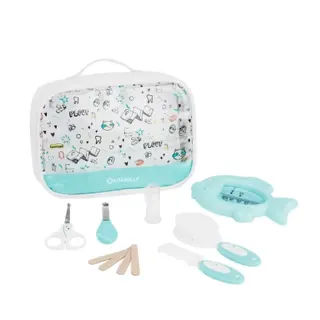 −57 %BadabullePlouf baby care kit – Badabulle138 DH
instead of 320 DHView product- The whole aisle · Health record covers6 products online, delivered anywhere in Morocco.Open the aisle
Products sold by La Maison du Bébé, publisher of this magazine. Prices as of 12 October 2026; please check the product page.
How do you prepare well for a consultation?
A twenty-minute consultation goes quickly. A little preparation makes the most of it.
- The health record book, every time. The Moroccan book states that it must be presented at every visit to a health facility and at every consultation. It brings together vaccines, measurements and examinations. Our article on the child health record book explains how to read it. A cover, like this health record book protector, keeps it intact for years.
- Your questions, written down in advance in your phone, as the days go by: sleep, stools, feeds, rash, development.
- Current treatments, including vitamin D or a syrup bought at the pharmacy.
- For a sick child: since when, the temperature measured and the time, what they are drinking and eating, the number of wet nappies.
- Clothes that are easy to take off and a spare nappy.
On-call paediatrician and emergencies: who to call, and when?
The right contact depends on how serious it is.
- For a question or minor concern (a mild cold, advice on a meal): the surgery during opening hours, or a pharmacy, including an on-call one in the evening.
- For a sick child who must be seen the same day (fever in an infant, refusing to drink, moderate breathing difficulty): your paediatrician, their cover or a paediatric emergency consultation.
- For a serious emergency: 141, the free number of the SAMU (the emergency medical service). Failing that, Civil Protection on 15, the Police on 19 or the Royal Gendarmerie on 177.
Keep in your phone the surgery's number, the cover's number, the address of the nearest paediatric emergency department and the Poison Control Centre (0801 000 180, toll-free). The signs that justify each level of care are detailed in our article on when to go to the paediatric emergency department, and what to have at home in your baby's medicine cabinet.
Frequently asked questions
When should you choose a paediatrician?
Ideally during the third trimester of pregnancy. You have time to ask around, visit the surgery and find out how they organise appointments and emergencies. Some families meet them before the birth. After delivery, discharge from the maternity ward comes quickly, and so does the first follow-up check-up: better to already know who to call.
Can you change paediatrician?
Yes, at any time and without having to justify it. The health record book is made for this: it holds the vaccines, measurements and examinations, and lets the new doctor pick up the follow-up without losing anything. Simply ask for a copy of important reports, such as an ultrasound or a hospital stay, and slip them into the book.
My baby is well: do we really need to go to the check-ups?
Yes. These visits are not only for treating illness: the doctor measures growth, checks development, eyesight and hearing, gives vaccines and answers your questions on feeding, sleep or safety. Many problems, such as anaemia, a squint or a heart murmur, are found precisely in a child who looks perfectly well.
What if my paediatrician does not answer in the evening or at weekends?
Ask them at the very first visit how they organise this: on-call number, colleague who covers, reference clinic. Save this information in both parents' phones. Outside surgery hours, an on-call pharmacy can advise on a minor concern. For a serious sign, such as difficulty breathing or fainting, call 141 directly.
Sources
- Carnet de santé de l'enfant (الدفتر الصحي للطفل)Ministère de la Santé · Maroc
- Maroc : le ministère de la Santé lance « Allô SAMU 141 »Le Desk · Maroc
- Les visites de soins de santé préventifs pour les enfantsManuels Merck pour le grand public, édition canadienne · Canada
- Le dépistage des troubles visuels doit être précoce !La Revue du Praticien · France