










Article contents
Key points
- Lochia are not periods: the return of periods comes afterwards.
- Without breastfeeding, periods often return between 6 and 8 weeks.
- While breastfeeding, they may wait until feeds decrease, or until weaning.
- You ovulate before your first period: pregnancy is possible from week 3.
- First periods are often heavier; no tampons before the postnatal visit.
Baby is two months old, the bleeding from the birth stopped weeks ago, and one morning your period is back. Or baby is nine months old, you are still breastfeeding, and still nothing. The return of periods after childbirth (retour de couches in French) is the arrival of your first periods after the birth. The timing varies enormously from one woman to another, mostly depending on breastfeeding.
Here are the markers, what these first periods look like, and the trap to know about: you become fertile again before they return.
Lochia, the "small return", periods: do not mix them up
Three different kinds of bleeding can follow one another after the birth.
- Lochia follow the delivery. Red, then pink, brown and finally yellowish, they generally last three to six weeks. They come from the wound left by the placenta, not from a cycle. Their evolution is described in our article on the first six weeks after birth.
- The "petit retour de couches", as it is often called in French, happens one to two weeks after the birth: the scab that covered the placenta site comes away, and a heavier bleed appears. It is not yet a period.
- The actual return of periods is the first true period, after a first ovulation.
In Morocco, the question often arises during the nfissa (the 40 days after birth): if the bleeding stops before day 40, what about prayer or fasting? For religious rules, ask a religious authority. From the medical side, remember that the length of lochia varies from one woman to another, and that their end does not announce the arrival of periods.

Without breastfeeding: periods return around 6 to 8 weeks
If you are not breastfeeding, the body quickly finds its rhythm again. The Geneva University Hospitals (HUG) place the return of periods between six and eight weeks after the birth. The UK's NHS specifies that first periods can arrive from 5 to 6 weeks in women who bottle-feed or who combine breast and bottle.
Ovulation itself happens about two weeks before these first periods, usually between week 4 and week 6, according to the MSD Manual. In other words, you can be fertile while nothing yet announces the return of your periods.
While breastfeeding: a very variable timeline
Breastfeeding delays the return of periods. Prolactin, the lactation hormone, blocks ovulation as long as feeds are frequent, day and night. The French obstetricians' college (CNGOF) sums it up: the restart of ovarian activity depends on how you breastfeed.
| Your situation | Return of periods, in general |
|---|---|
| No breastfeeding | Between 6 and 8 weeks, sometimes from 5 weeks |
| Breast and bottle | As early as without breastfeeding, from 5 to 6 weeks |
| Exclusive breastfeeding, day and night | Often after several months: around 6 months according to the MSD Manual, sometimes only when feeds decrease or when breastfeeding ends |
These markers remain averages. The MSD Manual points out that some women who breastfeed ovulate and have periods as early as those who do not. And according to France's national health authority (HAS), breastfeeding stops protecting as soon as feeds are spaced out or shortened, a bottle is introduced or baby reaches 6 months. Our article on mixed feeding covers these transitions, and the one on gentle weaning the end of breastfeeding.
Fertile before the first period: the trap
This is the rule to remember: the first ovulation comes before the first period. So you can get pregnant without having had a period, whether you breastfeed or not. Sources differ slightly on the timing:
- the HAS writes that there is no ovulation before day 21, and that fertility returns from then on;
- the NHS holds that pregnancy is possible from 3 weeks, even when breastfeeding;
- the MSD Manual reports conceptions as early as 2 weeks after delivery, which it considers unlikely but possible.
In practice, consider yourself fertile from week 3 if you do not want another pregnancy soon. The CNGOF recommends starting effective contraception no later than 21 days after the birth. Breastfeeding only protects if every condition of LAM (called MAMA in French) is met: exclusive feeds, day and night, no return of periods, and baby under 6 months. Methods compatible with breastfeeding are presented in our article on contraception after childbirth.
What do the first periods look like?
They are often heavier and longer than usual, according to the HUG, then the cycle regulates itself. It sometimes takes a few cycles to find your usual rhythm again.
To protect yourself, prefer sanitary pads or a washable period pant. The NHS advises against internal products, tampon or menstrual cup, until the 6-week postnatal check: the wound left by the placenta and any stitches must heal first. Products for this period are gathered in our mum's hygiene section.
From the shop
For your first periods after baby
A washable period pant, in three sizes, complements sanitary pads during periods that are often heavier, and a shower sprayer makes intimate washing easier during lochia. Choose the size that fits your body today.
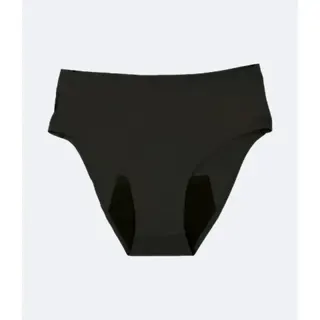 −21 %DoomooFlowly postpartum and period underwear, Black, XS-S-M – Doomoo355 DH
instead of 450 DHView product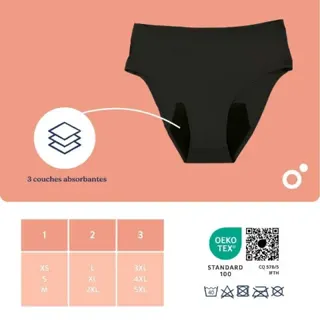 −21 %DoomooFlowly postpartum and period underwear, Black, L/XL/2XL – Doomoo355 DH
instead of 450 DHView product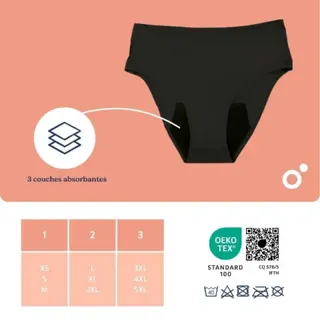 −21 %DoomooFlowly postpartum and period underwear, Black, 3XL/4XL/5XL – Doomoo355 DH
instead of 450 DHView product- The whole aisle · Mum’s hygiene8 products online, delivered anywhere in Morocco.Open the aisle
Products sold by La Maison du Bébé, publisher of this magazine. Prices as of 12 October 2026; please check the product page.
No periods: should you worry?
Not while breastfeeding: absent periods are normal then, Assurance Maladie reminds us, and the return of periods can wait until breastfeeding ends. Two situations do call for action, though:
- You have had sex without reliable contraception: take a pregnancy test, even without a strictly late period, since ovulation may have restarted silently.
- You are not breastfeeding, or no longer are, and periods do not return: Assurance Maladie advises seeing a doctor when periods have been absent for more than 3 months in a woman who used to have them. The doctor will look for the cause.
If you use hormonal contraception, ask your doctor which bleeding to expect with it, so you know what is normal in your case.
Frequently asked questions
Can you get pregnant while breastfeeding, without having had a period?
Yes. The first ovulation happens before the first period, and the NHS points out that pregnancy is possible from 3 weeks after the birth, even if you breastfeed. Breastfeeding only protects if every condition of the lactational amenorrhoea method (LAM, called MAMA in French) is met: baby fed exclusively at the breast, frequent feeds day and night, no return of periods, and baby under 6 months. Otherwise you need contraception.
Does the return of periods mean breastfeeding no longer protects you?
Yes. As soon as periods return, even as light spotting, LAM is no longer reliable, remind France's national health authority (HAS) and the NHS. You then need to switch to another contraceptive, without waiting for the next period. The simplest way is to have chosen this back-up method in advance, with your doctor or midwife.
How long after weaning do periods come back?
There is no fixed delay. France's national health insurance (Assurance Maladie) explains that the return of periods is postponed until the end of breastfeeding in some women, and the NHS that it often happens when feeds decrease. If your periods have not returned more than 3 months after you stopped breastfeeding, see a doctor: this is the point at which Assurance Maladie advises looking for a cause. Take a pregnancy test first if in doubt.
Tampon or menstrual cup: when can you use them again?
Not before the 6-week postnatal check, according to the NHS. Before that, the wound left by the placenta inside the womb and any stitches in the perineum are still healing, and an internal product would raise the risk of infection. Use pads or a period pant. If your first period arrives after that check and everything has healed, you can go back to your usual habits.
Sources
- Return of periodsHôpitaux universitaires de Genève (HUG) · Switzerland
- When will my periods start again after pregnancy?NHS · United Kingdom
- Contraception chez la femme en post-partum (fiche mémo, mise à jour juillet 2019)Haute Autorité de santé (HAS) · France
- Recommandations pour la pratique clinique : post-partum (2015)Collège national des gynécologues et obstétriciens français (CNGOF) · France
- Qu'est-ce qu'une aménorrhée et quand faut-il s'inquiéter de l'absence de règles ?Assurance Maladie (ameli.fr) · France
- Soins du post-partumMSD Manual, professional edition · United States
- Présentation des soins du post-partumMSD Manual, consumer edition · United States
- Le corps après l'accouchementMieux vivre avec notre enfant, INSPQ · Canada (Quebec)