










Article contents
Key points
- Maternity leave: 98 days, in principle 7 weeks before and 7 weeks after the birth.
- Book childcare early: settling in takes two to three weeks before you go back.
- A paid nursing hour a day for 12 months, splittable into two 30-minute breaks.
- To extend: contract suspension of up to 90 days unpaid, with 15 days' notice.
- Guilt is common; it does not mean you are doing anything wrong.
The alarm goes off at 6:30 for the first time in months. Baby's bag is ready, so is yours, and your heart already tightens at the thought of leaving them with someone else. Going back to work after maternity leave comes quickly in Morocco: baby is often under two months old when you return to your desk.
Well prepared, it goes better, for baby and for you. Here is how to work out your return date, choose and prepare childcare, negotiate a gentle return, know your rights and live with the guilt.
When do you go back to work after maternity leave?
In the private sector, maternity leave lasts 14 weeks, or 98 days: in principle 7 weeks before the expected delivery date and 7 weeks after (Labour Code, article 152). An employee may not be employed during the seven weeks following the birth, reminds Femmes du Maroc. If you are ill because of the pregnancy or the birth, a medical certificate allows the leave to be extended.
| Stage | Landmark |
|---|---|
| Start of leave | In principle 7 weeks before the expected date |
| After the birth | Employer may not employ the employee for 7 weeks |
| Return | In principle 7 weeks after the birth, at the end of the 98 days |
| CNSS allowance | 100% of average daily wage, up to the ceiling of 6,000 DH a month, if you have contributed for 54 days in the previous 10 months |
| CNSS file | To be submitted within 6 months of the birth |
In the civil service, leave is also 14 weeks and salary is maintained. A private member's bill tabled in the House of Representatives in June 2026 would, according to press reports cited by Femmes du Maroc, move to 20, 22 or 24 weeks depending on circumstances, as well as more flexibility after the birth, such as remote work or part-time; the magazine does not say where its examination stands. All the details are in our article on maternity and paternity leave in Morocco.

Extending beyond the 98 days: the options
Do the 98 days feel too short? The Labour Code provides two possibilities, summarised by Clicpaie:
- contract suspension of up to 90 days, unpaid, to raise your child: tell your employer at least 15 days before maternity leave ends;
- a year's unpaid leave, with the employer's written agreement.
On your return, you get your job back or an equivalent one, with the benefits acquired before you left. These solutions have a cost, since the salary stops: do the sums together, with the help of our article on baby's budget in the first year.
Choosing childcare during pregnancy
This is the decision that conditions everything else, and it is prepared early. Luxembourg's Service national de la jeunesse advises finding out well ahead, since registrations are often made long in advance. Nursery, nanny at home or grandmother: each solution has its strengths, costs and obligations, compared in our article nanny or nursery, how to choose. To visit a nursery with the right questions, follow our checklist for choosing a nursery.
Plan a plan B too. The American Academy of Pediatrics insists on a back-up solution for the days when the person who looks after baby is ill or unavailable. In Morocco this is all the more useful because the Labour Code has no general leave for a sick child: it grants only two days' absence when a dependent child or the spouse undergoes an operation (article 274), reminds Femmes du Maroc. Write down now the names of people who can step in.
Settling in: two to three weeks before day one
Baby needs time to get to know their new reference person, and so do you. The Luxembourg document describes a familiarisation period of two to three weeks, with daily sessions:
- the first days, you stay with baby on site;
- then, you step out for a few minutes, then a little longer each day, up to an hour or two away;
- the time in care increases slowly, as your presence decreases.
When it is time to leave, keep it short and never slip away in secret: say goodbye, always in the same way. A familiar object, soft toy, toy or family photos, can help, specifies the same document. Start this settling in well before you return, and plan it with a nanny or grandmother too. Naître et grandir even suggests leaving baby with someone now and then a few months before going back. The detailed day-by-day plan is in our article on settling in at nursery.
Negotiating a gentle return with your employer
Make an appointment with your employer at least a month before you return, advises Naître et grandir, to talk about changes in the team and your scheduling needs. The same guide suggests asking for a gradual return, for instance two weeks at three days a week, then two weeks at four, and treating the return as a new job, even in the same post.
In Morocco, the 2026 private member's bill would make part-time work and remote work easier after a birth; meanwhile, a gradual return is negotiated with the employer. Your rights, on the other hand, are clear: the law forbids dismissing an employee during pregnancy and the 14 weeks after the birth (articles 159 and 160), and any discrimination linked to family situation (article 9). Femmes du Maroc nonetheless describes rushed returns, sometimes soon after a caesarean, for fear of losing salary or job, and careers that stall after maternity. Write down what is agreed.
Breastfeeding and working: the nursing hour
If you breastfeed, article 161 of the Labour Code grants you one paid hour a day for 12 months from your return, splittable into two 30-minute breaks. A company employing at least 50 women aged over 16 must set up a special nursing room, on its premises or in the immediate vicinity (article 162), the Ministry of Solidarity points out. How to build up a milk stock, express at the office with a breast pump and carry the milk: it is all explained in our article on breastfeeding and going back to work.
From the shop
Baby's bag and your office bag
For days at the nanny's or nursery, a well-organised changing bag; for you, a breast pump if you breastfeed, an insulated lunch box and a water bottle. Take only what fits your routine.
 −9 %Bebe ConfortChanging backpack, Mineral Green – Bébé Confort537 DH
instead of 590 DHView product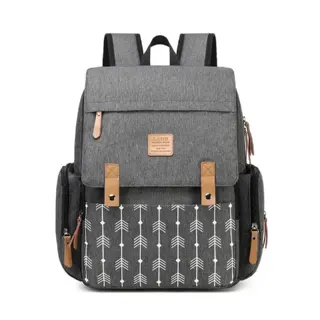 −49 %LandArrow maternity changing bag, grey – Land228 DH
instead of 450 DHView product −9 %BabymoovEat’s Isy stainless steel hot and cold food jar, 350 ml – Babymoov255 DH
instead of 280 DHView product −42 %Pasito a PasitoFleur insulated bottle, Gifts for Mums, 500 ml – Pasito a Pasito222 DH
instead of 380 DHView product −61 %BadabullePick & Go insulated meal bag with 300 ml container, cup and 2 spoons – Badabulle273 DH
instead of 700 DHView product- The whole aisle · Breast pumps2 products online, delivered anywhere in Morocco.Open the aisle
Products sold by La Maison du Bébé, publisher of this magazine. Prices as of 12 October 2026; please check the product page.
Guilt, tiredness: looking after yourself
Guilt is very common, and it says nothing about your worth as a mother. Naître et grandir reminds us that guilt and insecurity often come with going back to work, that mixed feelings are normal, and that feeling guilty does not mean you have acted wrongly. As for baby, Australia's Raising Children Network explains that stranger anxiety, which peaks around 7 to 10 months, and separation anxiety, around 14 to 18 months, are part of normal development, whether or not the child goes to nursery.
What helps:
- talk about your worries with your partner, your family and other mothers who have gone back to work;
- review how tasks and the mental load are shared, often carried by the one who was on leave, as our article on sharing the mental load explains;
- fix morning and evening routines: who drops baby off, who picks them up, who prepares dinner, who gives the bath;
- take stock together after a few weeks, and adjust what is not working.
If sadness or exhaustion set in beyond normal tiredness, talk to your doctor: our article on baby blues and postnatal depression helps tell the difference.
Frequently asked questions
Can maternity leave be extended in Morocco?
Yes, in several ways. If you are ill because of the pregnancy or the birth, a medical certificate allows the leave to be extended. After the 14 weeks, a private-sector employee can suspend her contract for up to 90 days without pay, giving her employer at least 15 days' notice before the leave ends, or take a year's unpaid leave with the employer's written agreement.
Can my employer move me to another job when I come back?
After a contract suspension to raise your child, you return to your job or an equivalent one, with the benefits acquired before you left, according to the Labour Code as summarised by Clicpaie. The law also prohibits any discrimination linked to family situation (article 9). If your return goes badly, write the facts down and seek advice from the labour inspectorate or a lawyer.
What if baby falls ill on the day I go back?
Plan a plan B in advance: a grandmother, a neighbour, an emergency nanny, or dad taking over. The Labour Code has no general leave for a sick child: it grants two days' absence when a dependent child or the spouse undergoes a surgical operation (article 274). Talk to your employer before you return to find out what flexibility they can offer.
How do I handle the guilt of leaving baby?
By knowing it is common and proves nothing. Naître et grandir reminds us that guilt and insecurity often come with going back to work, and that feeling guilty does not mean you have done something wrong. Talk to your partner and to other mothers who have gone back to work, be kind to yourself, and let the first weeks be a running-in period.
Sources
- Le congé maternité au Maroc (mis à jour mars 2026)Clicpaie · Morocco
- Les droits des femmes dans la législation relative au travailMinistry of Solidarity, Social Development, Equality and the Family · Morocco
- Maternité et travail : quels sont vraiment les droits des mères salariées ? (Rania Laabid, 9 octobre 2026)Femmes du Maroc · Morocco
- Retourner au travail après un congé parentalNaître et grandir · Canada (Quebec)
- Les enfants et la phase de familiarisation (Les Cahiers Parents 0-4 ans, janvier 2022)Service national de la jeunesse · Luxembourg
- Child care: children's feelingsRaising Children Network · Australia
- Making Child Care Choices Count for Your FamilyAmerican Academy of Pediatrics (HealthyChildren.org) · United States