







Article contents
Key points
- Official times vary: France is the most cautious, the United Kingdom and Quebec the most flexible.
- Above 25 °C, milk does not stay out: fridge, or a cool bag with ice packs.
- Small, dated portions, kept at the back of the fridge or freezer, never in the door.
- Thaw in the fridge or under lukewarm water; no microwave, no refreezing.
- A different smell or taste after thawing does not necessarily mean the milk has spoiled.
You have just filled your first bag of expressed milk, and the question lands: how long can it wait? A quick search on storing breast milk gives answers that contradict each other: 48 hours in the fridge for some, 8 days for others. This is not a mistake. Countries do not all apply the same safety margin.
The table below brings together the reference times. What follows explains why they differ, and how to apply them in a Moroccan home, when summer and the chergui wind push room temperatures up.
How long does breast milk keep?
These guidelines are for a healthy full-term baby, with milk expressed cleanly and stored at home.
| Official guidance | Room temperature | Fridge | Freezer |
|---|---|---|---|
| France (AFPA paediatricians, mpedia) | 1 hour (19 to 22 °C) | 48 hours (4 °C at most) | 4 months (-18 °C) |
| Belgium (CHRSM maternity unit) | 4 hours | 3 days at home | 4.5 to 6 months (drawer); 6 to 12 months (chest freezer) |
| United States (CDC) | 4 hours (25 °C at most) | 4 days | 6 months ideally, up to 12 months |
| United Kingdom (NHS) | Not specified | 8 days (4 °C at most); 3 days between 5 and 10 °C | 6 months (-18 °C); 2 weeks in the ice compartment |
| Quebec (Naître et grandir) | 4 hours (26 °C) | 8 days (4 °C) | 6 months (fridge freezer); 12 months (chest freezer) |
Once thawed in the fridge, milk keeps 24 hours according to mpedia, the CDC and Naître et grandir. It is never refrozen.
Why do the times differ between countries?
La Leche League France analysed these gaps. Several reasons explain them:
- ideal or acceptable time: within the "acceptable" time, the milk does not spoil, but it loses more vitamins and antioxidants;
- room temperature: a room at 20 °C and a room at 26 °C do not give the same window;
- setting and baby concerned: in hospital, and for a premature or sick baby, the rules are stricter. The Belgian CHRSM maternity unit thus limits fridge storage to 24 hours on its wards, against 3 days at home.
What we take from this for home: if baby drinks the milk within 48 hours, the fridge is enough, even by the French guidance, the most cautious. If you do not plan to use it within 3 to 4 days, freeze it from the start. And if you do not know your fridge's temperature, the NHS advises not going beyond 3 days: a small fridge thermometer settles the doubt.
In great heat: rules at home and on the move
The hotter it is, the faster milk spoils. The CDC's 4 hours at room temperature applies to a room at 25 °C at most. A study cited by La Leche League France (Hamosh, 1996) concludes that at 25 °C as at 38 °C, fresh milk does not keep properly beyond 4 hours. In summer or on chergui days, put the milk in the fridge as soon as it is expressed.
To carry it, from work to home or to the nanny's:
- use a cool bag with well-frozen ice packs: milk keeps there for 24 hours, according to the CDC and the NHS;
- put in milk that has already been chilled in the fridge, as the NHS recommends;
- never break the cold chain: mpedia aims for 15 °C at most during the journey;
- on arrival, put the milk straight into the fridge or freezer.
Never leave this bag in a car parked in the sun. To choose a bag that really keeps the cold, our guide to lunch boxes and cool bags compares models. And to protect baby from high temperatures, see our article on heatwaves.
Which containers to choose?
The CDC recommends bags designed for breast milk, or clean food containers, in glass or plastic, with a lid that closes well. It rules out ordinary plastic bags, which are not made for this use. The mpedia paediatricians favour glass or polypropylene.
A few rules apply to all containers:
- small portions, 60 to 120 ml, to avoid waste: thawed milk is thrown away if it is not drunk;
- room to expand: fill to three quarters, because milk swells as it freezes;
- a label with the date and time, and baby's first name if the milk goes to nursery;
- at the back of the fridge or freezer, where it is coldest, never in the door.
You will find bags in our milk storage pots and bags section. To collect the milk, our tips on expressing your milk cover equipment hygiene.
Freezing your milk: the right steps
- First let the milk cool in the fridge, then freeze it within 24 hours, advises mpedia.
- If you do not plan to use it within 4 days, freeze it right away, adds the CDC.
- Never add fresh milk to milk that is already frozen.
- Always use the oldest milk first.
Frozen milk remains a very good food. But La Leche League France reminds us that freezing destroys protective elements of the milk, including live cells: where possible, give fresh or refrigerated milk first, and keep the freezer for reserves.
From the shop
To keep your milk cool, at home and on the move
Bags designed for breast milk or well-sealed glass jars, a way to express straight into them, and a cool bag for the journey: this is the basic storage kit.
 −54 %BabymoovDirect-Pump breast pump adapter – Babymoov69 DH
instead of 150 DHView product −17 %BabymoovIsy Bowls glass storage jars, 6 x 250 ml and 3 x 120 ml – Babymoov719 DH
instead of 865 DHView product −48 %Walking MumPreschool insulated children’s lunch bag, Forest – Walking Mum146 DH
instead of 280 DHView product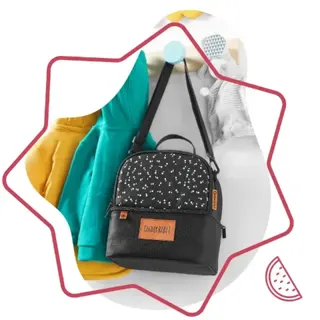 −61 %BadabullePick & Go insulated meal bag with 300 ml container, cup and 2 spoons – Badabulle273 DH
instead of 700 DHView product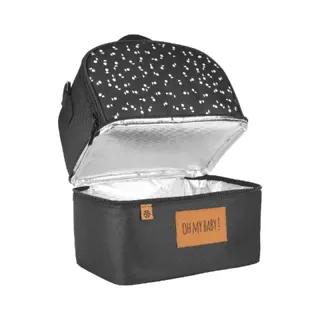 −9 %BadabullePick & Go insulated meal bag – Badabulle355 DH
instead of 390 DHView product- The whole aisle · Breast milk storage pots and bags2 products online, delivered anywhere in Morocco.Open the aisle
Products sold by La Maison du Bébé, publisher of this magazine. Prices as of 12 October 2026; please check the product page.
Thawing and warming without harming the milk
- Thaw in the fridge, the evening before: it is the gentlest method, recommended by the CDC and the NHS alike.
- In an emergency, stand the closed container in a bowl of hot water, or hold it under lukewarm running water.
- Never a microwave, or a pan on the hob: they heat unevenly, create scalding spots and damage the milk.
- Mix gently by swirling the container: the cream rising to the top is normal.
- Test a few drops on your wrist if you have warmed it: the milk should be barely warm, close to body temperature.
Thawed in the fridge, milk keeps there for 24 hours, counted from the moment it is fully thawed. Thawed under water or warmed, it should be given at once: at room temperature, allow 1 hour at most according to mpedia and Naître et grandir, 2 hours according to the CDC. It is never refrozen. Baby can also drink it cold if baby accepts it. To give it with a cup, a spoon or another way, our article on mixed breastfeeding presents the different methods.
Smell, appearance: how do you know if the milk is still good?
Stored breast milk does not look like cow's milk. At rest, the cream separates and rises to the top: mix gently, without shaking hard.
After thawing, some milk takes on a different smell or taste. Naître et grandir explains this by lipase, a natural enzyme in milk. The milk remains safe, but some babies refuse it. If that is the case for yours, heat fresh milk to just below boiling, without letting it boil, right after expressing, then cool it and freeze it.
If you are in doubt about milk kept too long, at the wrong temperature or with an unknown date, do not take a risk: throw it away. If you are preparing to go back to work, our article on breastfeeding and work helps you work out the stock you need.
Frequently asked questions
Can I mix milk expressed at different times?
Yes, as long as you respect the temperatures. The mpedia paediatricians advise never mixing warm milk with cold milk: first chill the new milk in the fridge, then you can combine milk from the same day. Never add fresh milk to milk that is already frozen. On the container, note the date and time of the oldest milk.
Do I need to warm breast milk before giving it?
No, it is not compulsory. The US CDC and the UK's NHS say baby can drink it cold or at room temperature if baby accepts it. To warm it, stand the closed container in a bowl of hot water or hold it under lukewarm running water, swirl gently and test a few drops on your wrist. Never use a microwave or a pan on the hob.
What should I do with milk baby has not finished?
It does not keep for the next feed. The NHS advises using it within the hour, the CDC within 2 hours, then throwing away the rest. Naître et grandir says to discard it. To limit waste, prepare small amounts and top up if baby is still hungry.
Can I freeze milk that has been in the fridge for several days?
It is better to decide quickly. The CDC advises freezing straight away any milk you do not expect to use within 4 days, and mpedia recommends freezing it within 24 hours after chilling it. Naître et grandir specifies that the times are not cumulative: milk kept to the end of its fridge time does not go to the freezer.
Sources
- Breast Milk Storage and PreparationCenters for Disease Control and Prevention (CDC) · United States
- Expressing and storing breast milkNHS · United Kingdom
- Techniques pour tirer et conserver son laitmpedia.fr, Association française de pédiatrie ambulatoire (AFPA) · France
- Tirer son lait : guide pratiqueNaître et grandir · Canada (Quebec)
- Pourquoi les recommandations en matière de conservation du lait maternel diffèrent-elles selon les sources ?La Leche League France · France
- L'allaitement maternel (livret pour les futurs parents, mars 2026)Centre hospitalier régional Sambre et Meuse (CHRSM), maternity unit · Belgium
- Conservation du lait humain : quelques étudesLa Leche League France · France
- High temperature (fever) in childrenNHS · United Kingdom