





Article contents
Key points
- The most comfortable window: between the 4th and 6th month, according to the NHS.
- Every airline has its own rules: check them before buying your ticket.
- Royal Air Maroc: up to the end of the 8th month, with a gynaecologist’s certificate and signed waiver.
- Always wear a seatbelt: diagonal strap between the breasts, lap strap across the pelvis, under the bump.
- Journeys over 4 hours: drink, move regularly and consider compression stockings.
A wedding in Agadir in July, a holiday with the in-laws in Paris, a work trip to Dakar: pregnancy does not put life on hold. Even travelling while pregnant can be stress-free if you pick the right moment, know your airline’s rules and take a few simple precautions.
Here is what health authorities say, what airlines actually require, and the habits that matter whether you are on the road or in the air.
When is the best time to travel during pregnancy?
The middle of pregnancy is often the most comfortable. The UK’s NHS notes that many women find the period between the 4th and 6th month ideal for a trip.
In the first trimester, nausea and tiredness often make travelling unpleasant. The risk of miscarriage is also higher in the first three months, whether you travel or not, the NHS points out. The final months are tiring and uncomfortable, and airlines become stricter.
Before making plans, talk to your gynaecologist or midwife, especially if your pregnancy has any complications. Quebec’s Mieux vivre guide suggests telling them your destination, how long you will be away and which vaccines are required, so your care can be adjusted. To work out exactly how far along you are in weeks and months, see our article on calculating your weeks of pregnancy.

Is flying safe when you are pregnant?
Yes, for a pregnancy that is going well. The NHS is clear: flying is not harmful to you or your baby.
The real thing to watch is long flights. Beyond 4 hours there is a small risk of deep vein thrombosis (DVT), a blood clot in a leg vein. To reduce it, the NHS advises you to:
- drink plenty of water during the flight;
- get up and walk around roughly every 30 minutes;
- wear compression stockings, sold in pharmacies, which also reduce leg swelling.
If your legs already feel heavy, our tips are in common pregnancy discomforts.
How late can you fly? Airline rules
There is no international rule, the Quebec guide reminds us: each airline sets its own. The NHS explains why they get stricter towards the end: the likelihood of going into labour rises after 37 weeks, and from around 32 weeks with twins.
Two examples, taken from the airlines’ websites in October 2026:
| Royal Air Maroc | Turkish Airlines | |
|---|---|---|
| Up to when | Up to and including the 8th month of pregnancy on the date of travel | Until the end of the 35th week (31st for twins) |
| Documents | Medical certificate from your gynaecologist stating the stage of pregnancy, and a signed waiver of liability (form on the website) | Medical certificate from 28 weeks, dated less than 10 days before the flight |
| After that | Refused after the 8th month | Refused from the 36th week (32nd for twins), even with a certificate |
Under the usual French way of counting, the end of the 8th month corresponds to about 36 weeks and 5 days from your last period. Ask for the exact stage to be written on the certificate. Other airlines, including low-cost carriers, have their own thresholds: check them before you buy your ticket, then again a few days before leaving, and remember the return flight, which will fall later in your pregnancy.
By car: seatbelt on, and take breaks
Wear your seatbelt throughout pregnancy. Correctly positioned, it protects both mother and baby, the Quebec guide stresses. The right position, according to the NHS:
- the diagonal strap goes between your breasts;
- the lap strap goes across your pelvis, under your bump, never over it.
The NHS points out that road accidents are a common cause of injury in pregnant women. For long drives, such as Casablanca to Marrakech or Rabat to Tangier:
- stop regularly to get out, stretch and walk a little;
- as a passenger, rotate your ankles and wiggle your toes to help circulation;
- for journeys over 4 hours, wear compression stockings;
- drink often and bring snacks, such as fruit or dried fruit;
- keep the air in the car fresh, especially in summer;
- avoid travelling alone and share the driving.
Boat, train, coach: what you need to know
Ferry companies set their own rules too. In the UK, the NHS notes that they may refuse women in late pregnancy, often beyond 32 weeks for a standard crossing and 28 weeks for a high-speed boat. If you are taking the ferry from Tangier this summer, check with the company before booking.
On trains or coaches, the same habits as on a plane apply for long journeys: drink, get up and walk whenever you can, and wear compression stockings if your legs swell.
Going abroad: vaccines, Zika, insurance
- Vaccines: according to the NHS, most live vaccines are not recommended during pregnancy, while inactivated vaccines are safe. Your doctor will decide case by case. See also vaccines recommended during pregnancy.
- Malaria: some preventive medicines are not suitable during pregnancy. Get advice before you leave.
- Zika: the NHS and the INSPQ advise pregnant women not to travel to areas where this virus circulates, as it can cause serious birth defects.
- Insurance: make sure it covers giving birth abroad, a premature birth and care for the baby, as well as changing your return date.
- Water and food: if in doubt, drink bottled water. The usual food precautions also apply when travelling: see toxoplasmosis in everyday life.
The mum-to-be’s travel kit
- your pregnancy records: latest scans, test results, blood group;
- the medical certificate and documents the airline requires;
- your insurance certificate and contact details for a maternity unit near your destination;
- any regular medicines, in their original packaging;
- compression stockings for long journeys;
- an insulated water bottle and snacks;
- loose clothing and comfortable shoes.
From the third trimester, this bag can double as your hospital bag, chosen from our maternity bags and cases: if labour starts far from home, everything is ready. What to put in it is detailed in our guide to packing your hospital bag. And for the next trip, as a family of three this time, see our tips for flying with a baby.
From the shop
Travel with peace of mind
A bag that keeps your pregnancy records, documents and essentials within reach, and a bottle so you can drink often on the way. The same bag can later become your hospital bag.
 −42 %Pasito a PasitoFleur insulated bottle, Gifts for Mums, 500 ml – Pasito a Pasito222 DH
instead of 380 DHView product −35 %DoomooMommy Vanity maternity pouch, Sand, beige corduroy – Doomoo774 DH
instead of 1 190 DHView product −48 %Pasito a PasitoElodie maternity bag, blue – Pasito a Pasito676 DH
instead of 1 300 DHView product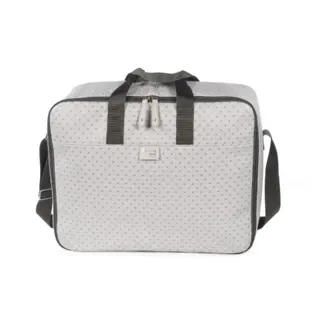 −41 %Walking MumArchie maternity bag – Walking Mum755 DH
instead of 1 290 DHView product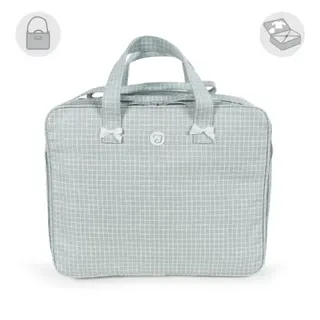 −48 %Pasito a PasitoMiel maternity bag, grey – Pasito a Pasito728 DH
instead of 1 400 DHView product- The whole aisle · Maternity bags12 products online, delivered anywhere in Morocco.Open the aisle
Products sold by La Maison du Bébé, publisher of this magazine. Prices as of 12 October 2026; please check the product page.
Frequently asked questions
Can I fly when pregnant with twins?
Yes, but for a shorter period. The NHS notes that with twins the likelihood of going into labour rises from around 32 weeks, compared with 37 weeks for a single baby, and airlines take this into account. Turkish Airlines, for example, refuses boarding from the 32nd week for a multiple pregnancy. Royal Air Maroc does not state a specific twin rule on its page: ask the airline and your gynaecologist before booking.
Do I need a medical certificate to fly while pregnant?
It depends on the airline. Royal Air Maroc asks for a certificate from your gynaecologist stating how far along you are, plus a signed waiver of liability. Turkish Airlines requires one from 28 weeks, dated less than 10 days before the flight. The NHS notes that after 28 weeks many airlines ask for a letter confirming your due date and that there are no complications. Request it well in advance.
Is it safe to fly in the first trimester?
Yes, if all is well. The NHS says some women prefer not to travel in the first 12 weeks because of nausea and tiredness. The risk of miscarriage is higher in the first three months whether or not you travel. Talk your plans over with your gynaecologist, especially if you have any bleeding.
Can I keep driving right up to the birth?
None of our sources sets a pregnancy cut-off for driving. What matters is a correctly positioned seatbelt, a comfortable position and frequent breaks. The NHS advises avoiding long journeys on your own and sharing the driving. Late in pregnancy, avoid getting behind the wheel if you are having contractions or feeling faint.
Sources
- Travelling in pregnancyNHS · United Kingdom
- Déplacements et voyages pendant la grossesseMieux vivre avec notre enfant, INSPQ · Canada (Quebec)
- Signaux d'alarme pendant la grossesseMieux vivre avec notre enfant, INSPQ · Canada (Quebec)
- Femmes enceintes (conditions de transport, accessed October 2026)Royal Air Maroc · Morocco
- Règles relatives au transport aérien pendant la grossesse (accessed October 2026)Turkish Airlines · Turkey