





Article contents
Key points
- The fifth month runs from 19 weeks and 3 days to 23 weeks and 5 days.
- First movements are usually felt between 18 and 24 weeks, like bubbles or a flutter.
- The anomaly scan checks the organs, growth and placenta.
- The whooping cough vaccine is often offered around 20 weeks.
- Learn your baby's pattern: report movements that slow down.
You are sitting still, and suddenly something moves under your hand. A bubble, a little flutter, then nothing. Was that the baby? At 5 months pregnant, the answer is often yes. This is the month of first encounters: you feel your baby, and you see it in detail on the scan.
Here is what is happening to your baby, what you may feel, and the appointments not to miss.
How many weeks is 5 months pregnant?
The fifth month runs from 19 weeks and 3 days to 23 weeks and 5 days, which is roughly 17 to 22 weeks after conception. You are in the middle of the second trimester, halfway through your pregnancy.
These weeks are counted from the first day of your last period (written "SA", weeks of amenorrhoea, on Moroccan and French paperwork). To pin down your due date and convert weeks into months, keep our pregnancy week calculator to hand.

What is happening to your baby in the fifth month?
Your baby is measured differently: from 20 weeks, it is measured from head to heel rather than from head to bottom. According to the UK's NHS:
| Week | Size (head to heel) | What is happening |
|---|---|---|
| 20 weeks | about 25.6 cm | it kicks, punches and turns over; it sucks its thumb |
| 23 weeks | about 28.9 cm | its limbs are in proportion; it practises breathing and alternates between sleep and wakefulness |
Its skin is covered with a white, greasy coating, vernix, which protects it and will help the baby slide out at birth. The NHS states that a baby is considered viable from 24 weeks: in the event of a very premature birth, every week gained counts. The week-by-week milestones are in our pregnancy week by week.
When do you feel your baby move?
Usually between 18 and 24 weeks, according to the NHS. The first sensations feel like bubbles, a butterfly, a rolling movement. You are more likely to notice them when resting, after a meal, or when you talk to your baby while stroking your bump. With a first baby, they often come later.
Little by little, the movements turn into clear kicks. The NHS advises getting to know their usual pattern, and telling your midwife or doctor if the kicks slow down. Everything you need to know is in our article feeling your baby move, week by week.
Symptoms in the fifth month of pregnancy
- Calf cramps, especially at night. Massage the muscle or pull your toes towards you; moving during the day helps prevent them, the NHS explains.
- Heartburn and bloating: your baby is taking up room.
- Breathlessness and pain under the ribs, as your ribcage widens.
- Colostrum that may leak from your breasts around 23 weeks.
- Tiredness, sensitive gums, nosebleeds, brown patches on the face, stretch marks.
If acid reflux is keeping you awake, our advice to ease the minor ailments of pregnancy will help.
The anomaly scan: this month's key appointment
This is the second-trimester scan, between 18 weeks and 21 weeks and 6 days in the UK, and during the 5th month in France. The sonographer checks your baby's organs one by one, its growth and the position of the placenta.
The sex can often be seen at this scan, if the baby's position allows and if you want to know: read boy or girl, how to find out. The details of the scan are in our article on pregnancy scans.
The WHO plans an antenatal contact at around 20 weeks and recommends at least one ultrasound scan before 24 weeks. In Morocco, since October 2026 the Ministry of Health has been extending an AI-assisted ultrasound programme to 50 health centres in the Béni Mellal-Khénifra region, where pregnant women previously travelled an average of 90 km for a scan, according to EcoActu.
Another point to raise this month: the whooping cough vaccine. The NHS usually offers it around 20 weeks (possible from 16 to 32 weeks), because the mother's antibodies pass to the baby and protect it until it gets its own vaccines. What is available in Morocco is something to discuss with your gynaecologist; see our overview of vaccines in pregnancy.
Good habits in the fifth month
Sleep on your side, with a pillow between your knees: your hips and back will thank you. A long, sausage-shaped pregnancy and nursing pillow slips under your bump and between your legs, and will be used again for feeds.
Think ahead too: look for a midwife or an antenatal class and, if you have not done so yet, choose your maternity unit.
From the shop
To ease your back and nights in the second trimester
Your bump takes up room and nights get harder: a well-chosen pregnancy pillow supports your back and bump, then helps with breastfeeding. Several shapes and prices.
 −9 %DoomooBuddy nursing and maternity pillow, Classic Light Grey – Doomoo810 DH
instead of 890 DHView product −9 %DoomooTwisty 2-in-1 maternity pillow, Sweety Cream, cream organic cotton cover – Doomoo901 DH
instead of 990 DHView product DoomooBuddy maternity and nursing pillow, Flower Pink – Doomoo890 DHView product
  −9 %DoomooComfy Big nursing and maternity pillow, Tetra Brick – Doomoo619 DH
instead of 680 DHView product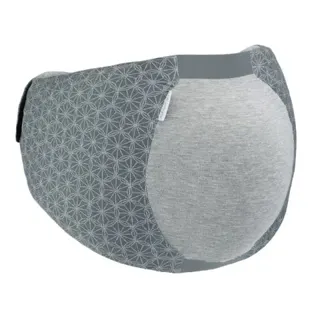 −22 %BabymoovDream Belt sleep belt, Smokey – Babymoov491 DH
instead of 630 DHView product −9 %DoomooMicrobead refill for nursing pillow, 10 L – Doomoo255 DH
instead of 280 DHView product- The whole aisle · Pregnancy and nursing pillows20 products online, delivered anywhere in Morocco.Open the aisle
Products sold by La Maison du Bébé, publisher of this magazine. Prices as of 12 October 2026; please check the product page.
Frequently asked questions
How big is the baby at 5 months pregnant?
About 25 cm from head to heel at 20 weeks, and nearly 29 cm at 23 weeks, according to the UK's NHS. From this month, the baby is measured from head to foot, whereas until now it was measured from head to bottom. It is covered in a white, greasy coating called vernix, which protects its skin.
I still can't feel the baby move at 5 months: is that normal?
Often, yes. The NHS places the first sensations between 18 and 24 weeks, and they tend to come later with a first baby. At first, they are easy to mistake for tummy rumbles. If you have felt nothing by 24 weeks, talk to your doctor or midwife, who can listen to your baby's heartbeat and reassure you.
My breasts are already leaking in the fifth month: is that normal?
Yes. Around 23 weeks, some women notice a yellowish liquid: this is colostrum, the first milk, the NHS explains. It does not mean you will have more or less milk after the birth, and it does not happen to everyone. Breast pads slipped into your bra are enough to protect your clothes.
Can you find out the baby's sex in the fifth month?
Most often, at the second-trimester scan, if the baby is well positioned and if you ask. It is not the purpose of the scan, and there is a small margin of error. If you would rather keep it a surprise, tell the sonographer before they start. The methods, how reliable they are and the popular beliefs are reviewed in our dedicated article.
Sources
- Week 20 (Your pregnancy week by week)NHS, Best Start in Life · United Kingdom
- Week 23 (Your pregnancy week by week)NHS, Best Start in Life · United Kingdom
- Week 17 (Your pregnancy week by week)NHS, Best Start in Life · United Kingdom
- Your antenatal appointmentsNHS · United Kingdom
- Guide maternité : l'arrivée de mon enfant (2023)MGEN, French national health insurance schedule · France
- New guidelines on antenatal care for a positive pregnancy experience (7 November 2016)World Health Organization (WHO) · International
- Échographie prénatale assistée par IA : le Maroc étend son programme pilote à 50 centres de santé (9 October 2026)EcoActu · Morocco