




Article contents
Key points
- Three classic moments: early morning, lunch with the sacrifice meat, festive dinner.
- Count guests per sitting, adults and children separately, before calling the caterer.
- A cooked dish stays out of the fridge no longer than two hours, especially in summer.
- The new mum has her own dishes: sellou, soups, and water within reach.
- Nobody asks the nfissa to cook: the family or the caterer takes care of it.
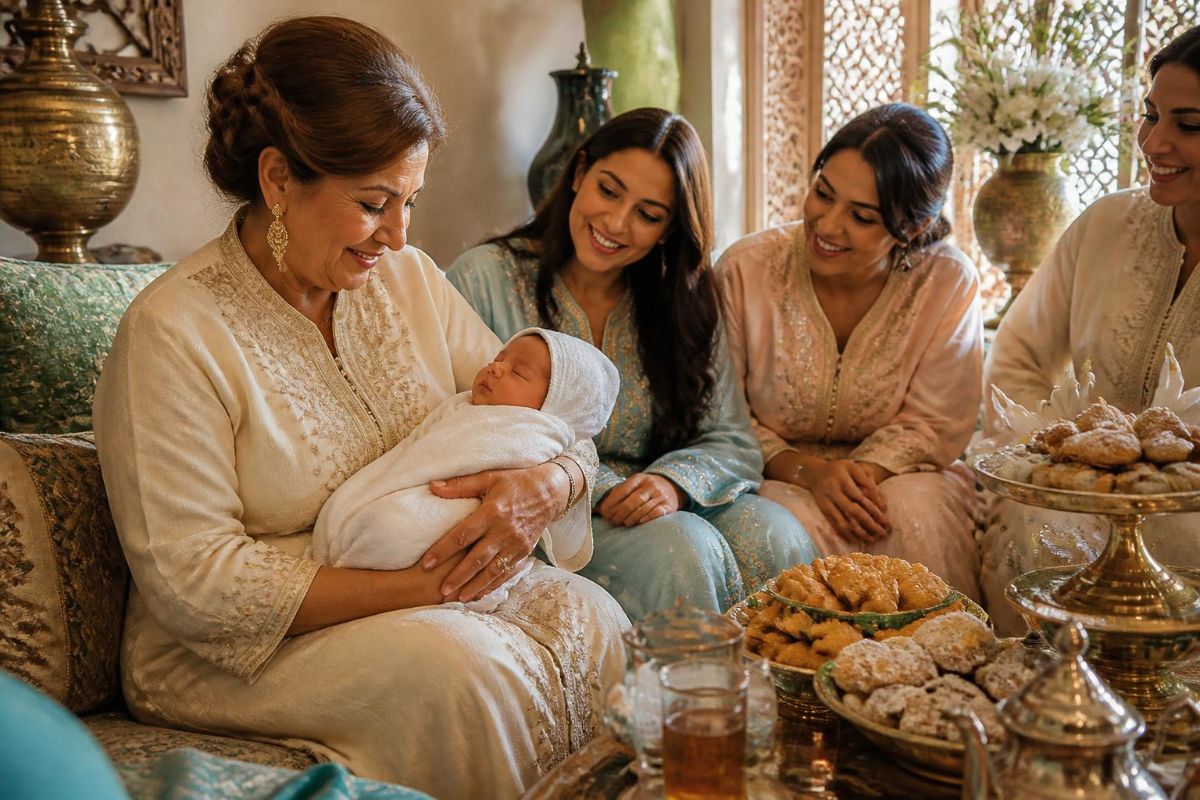
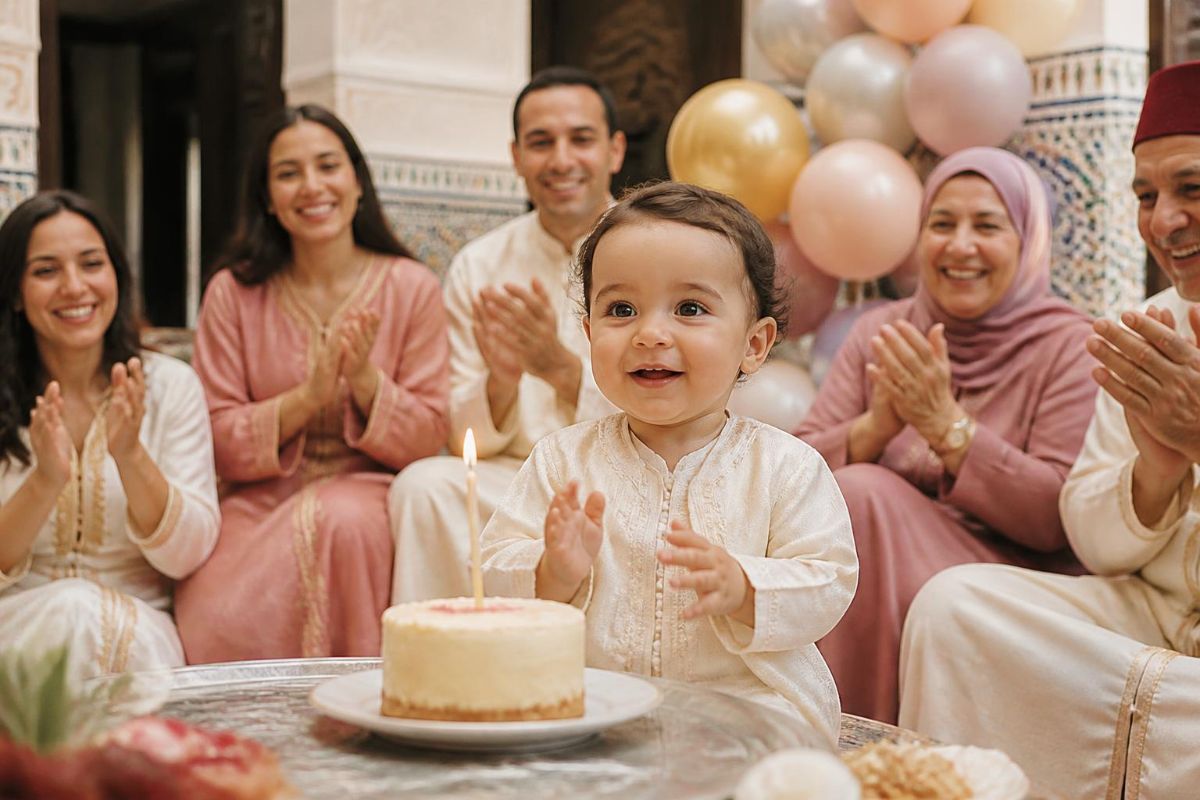
The night before, the kitchen is never empty: one aunt keeps an eye on the harira, another rolls out msemen, and the smell of toasted sellou drifts up the stairs. The sbou3 menu is not written down anywhere, but it almost always follows the same logic. The sbou3 is the Moroccan naming celebration held on the seventh day after a birth, and the food goes like this: feed the family from dawn, do justice to the aqiqa meat (the sheep sacrificed for the baby), then gather everyone around a big dinner.
Here are the traditional dishes, the regional variations, a method for working out quantities without waste, and the hygiene rules that stop a celebration ending in food poisoning. For the meaning of the day and how it unfolds, see our guide to the sbou3 and the aqiqa.
What is served at a sbou3? The menu, from dawn to dinner
The sbou3 meal comes in three stages. In Salé, Le Matin described in 2007 a breakfast at dawn on the seventh day, with harira (the classic Moroccan tomato, lentil and chickpea soup) and sfouf, followed by milk or coffee, then a big dinner in the evening for relatives and acquaintances. In between, in the North as in the Centre, the Moroccan parenting site mamanmaroc.ma describes a lunch made with the meat of the sacrificed sheep.
| Moment | Most common dishes | When to prepare |
|---|---|---|
| Early morning | Harira, sellou (sfouf), dates, msemen, baghrir, tea, milk, coffee | The day before |
| Lunch | Aqiqa meat: tagine, skewers, mrouzia | On the day, after the sacrifice |
| Afternoon tea | Mint tea, pastries, ghriba, gazelle horns | A few days ahead |
| Dinner | Pastilla, chicken with olives and preserved lemon, prune tagine, couscous, fruit | Caterer or family team |
There is no obligation to serve all four. Many families keep the early morning small and invite everyone to dinner.
Sellou, pastilla and the other classics
Sellou, also called sfouf, is made from toasted flour, almonds and sesame. It is best known as a Ramadan treat, as Hespress noted in 2024, but it holds a special place after a birth. In Salé, Le Matin described it as the new mother's main dish for the first seven days. It is made several days in advance and keeps well in a sealed tin: the ideal dish to hand over to a grandmother.
Pastilla is one of the great festive dishes of the cities. Bladi.net described it in 2004 as the typical dish of urban weddings, filled with pigeon or, these days often, chicken, with almonds, sugar and cinnamon. It is often ordered from a caterer or a neighbour known for hers, and reheated in the oven just before serving.
Festive tagines come next: chicken with preserved lemon and olives, lamb with prunes and almonds, or with hard-boiled eggs. Couscous, the dish of rural celebrations according to the same article, remains a great classic for Fridays and big gatherings. The meal traditionally ends with fruit, then tea or coffee.
Regional variations of the sbou3 meal
Each region has its specialities, and that is often what makes a sbou3 unique. In Oujda and the Oriental region, a 2003 MAP news agency dispatch described seven days of festivities around couscous, berkoukech, a coarse semolina cooked with lentils, chickpeas and dried meat, and taqnatta, made with semolina, sugar, oil and sesame. In the South, mamanmaroc.ma reports that the village women prepare several dishes for the new mother. In Fez, the family serves traditional dishes before an evening of folk and Andalusian music.
If the two families come from different regions, serve one dish from each side. It is an easy way to please everyone.
How much to plan? Working out quantities per guest
Rather than one overall figure, count by sitting. This is how caterers do it, and it avoids both running short and leftovers that go off.
- List the guests for each sitting: who comes in the early morning, at lunch, at dinner. They are not the same people.
- Separate adults and children: little ones eat less, but ask for more pastries and juice.
- Decide on the number of dishes: a starter, one or two mains, a dessert. The more dishes there are, the smaller each portion can be.
- Ask the caterer for their portions per person, in writing, and check they match your number of dishes.
- Add a small margin for unexpected visitors, who are the rule in Morocco, but no more: whatever is left must fit in the fridge.
- Plan water and tea separately: over a whole day, and especially in summer, that is what runs out first.
The aqiqa meat changes the maths: depending on the size of the sheep, it often covers lunch and part of dinner. The rest is stored following the same rules as for Eid meat, which we cover in our article on Eid al-Adha with a baby.
Caterer or home cooking: how to organise it
Both work, as long as the roles are shared out. The one non-negotiable principle: the new mum does not cook. Seven days after giving birth, she is still bleeding and sleeping little. Our guide to the first weeks after giving birth is clear: she needs rest and help.
Home cooking is the warmest option. It needs a conductor, a shared shopping list and dishes divided up: the mother-in-law makes the sellou, an aunt the harira, a cousin the pastries.
A caterer takes the weight off everyone, especially for a big dinner. Ask for a detailed quote, the portions per person, the delivery time, the equipment supplied (warmers, serving dishes, waiting staff) and who takes the leftovers.
A mix of both is often best: the family prepares the early morning and the sweets, the caterer handles dinner. For the table itself, take your cue from our article on sbou3 decorations.
Hygiene and heat: a risk-free buffet
A family celebration is a textbook setting for food poisoning: lots of dishes, prepared in advance, served over several hours. The WHO estimates that contaminated food made 866 million people ill worldwide in 2021, and that children under 5 bear 29% of that burden.
The right habits, based on the WHO's advice for safer food:
- wash your hands before cooking and after touching raw meat;
- keep raw and cooked apart: separate boards, knives and dishes;
- cook thoroughly meat, poultry and eggs;
- keep chilled whatever needs to be: the specialists quoted by Hespress in May 2026 point out that a fridge should stay at 4°C or below, and that a cooked dish should not stay out of the cold for more than two hours in hot weather;
- do not overload the fridge, so the cold air can circulate.
In practice, bring out cold dishes, salads and cream pastries at the last minute, keep hot dishes on warmers, and throw away anything that has sat on the table for hours. Homemade mayonnaise and creams made with raw eggs are best avoided when it is hot.
What the new mum eats on the day of the sbou3
The nfissa (the new mother during her postnatal rest) has her own dishes, and tradition has always known it. In Salé, Le Matin described the sellou of the first seven days and a soup of onion, nfoula and smen (aged butter) meant to lift her spirits. In the South, it is the village women who cook for her.
Health-wise, if she is breastfeeding, the UK's NHS points out that no special diet is needed: a varied diet with fruit, vegetables, wholegrain starchy foods and protein, and a drink within reach during feeds. It advises limiting caffeine to 200 mg a day, and even less while the baby is under six months, which matters on days when the tea and coffee flow freely. The common myths are covered in our article on diet while breastfeeding.
The most helpful thing on the day is often very simple: a plate served and brought to a quiet room, a jug of water, and permission to eat without having to make conversation.
Frequently asked questions
What should you serve for the sbou3 breakfast?
The most widely described tradition is harira served with sellou (or sfouf) at dawn on the seventh day, followed by milk or coffee. Le Matin described this breakfast in Salé in 2007. You can add msemen, baghrir, dates and mint tea, depending on family habits. The main thing is to have dishes ready the day before.
What should you eat on the day of the sbou3 if you are breastfeeding?
Whatever you enjoy and whatever does you good. The UK's NHS points out that no special diet is needed to breastfeed: a varied diet is enough, with a drink within reach during feeds. For coffee and tea, it advises staying under 200 mg of caffeine a day, roughly two mugs of coffee, and cutting down further in the first months.
How do you keep food cool during a summer sbou3?
Make room in the fridge the day before, cook as close to serving time as possible, and only bring out cold dishes when it is time to serve them. Specialists interviewed by Hespress during Eid 2026 stressed that a cooked dish should not stay out of the fridge for more than two hours in hot weather. Leftovers in sauce are reheated until boiling or thrown away.
Should you hire a caterer for the sbou3?
It is not compulsory, but it is often a relief. Once the guest list grows, home cooking ties up several people for days, and it is often the new mum who ends up worrying about everything. A caterer also lets you keep the ritual within the family and separate it from the reception. If the family cooks, the only rule is that the new mum does not lift a finger.
Sources
- « Laâkika » célébrée dans le respect des traditions séculaires (6 March 2007)Le Matin · Morocco
- La naissance chez les Oujdis (13 May 2003, MAP news agency dispatch)Bladi.net, from MAP · Morocco
- La cuisine marocaine, un élément de joie et un régal des sens (25 May 2004)Bladi.net · Morocco
- Aïd Al-Adha : des experts mettent en garde contre la mauvaise conservation des viandes (25 May 2026)Hespress FR · Morocco
- Food safety (fact sheet, 4 June 2026)World Health Organization (WHO) · International
- Breastfeeding and dietNHS · United Kingdom
- Les Marocains avortent une tentative algérienne de s'approprier « Sellou » (28 February 2024)Hespress FR · Morocco
- Les préparatifs du baptême (11 November 2020)Site de la maman marocaine (mamanmaroc.ma) · Morocco